

An IPTV Reseller Profit Margin Calculator is really just a formula: take your retail price, subtract your credit cost and any operating costs, then divide the result by your retail price and multiply by 100. That gives you your margin as a percentage rather than a raw number, which matters because a £5 profit on a £10 subscription is a very different business to a £5 profit on a £30 one.
Most resellers never sit down and do this properly. They know roughly what a credit costs them and roughly what they charge, and they assume the gap between those two numbers is their profit. It usually isn’t, because credit cost is only one part of what it actually costs to keep a customer subscribed for a year.
Working Through the IPTV Reseller Profit Margin Calculator Step by Step
Start with the raw numbers you already have. Your credit cost is whatever you paid your panel provider per credit, and one credit typically covers one month of a single subscription, so a twelve month plan usually costs twelve credits. Your retail price is whatever you charge that customer for the same period.
Subtract the credit cost from the retail price and you get your gross profit per subscription. Divide that gross profit by the retail price, multiply by 100, and you have your margin percentage. A customer paying £60 for a year on a plan that costs you £36 in credits gives you £24 gross profit, which works out to a 40 percent margin before anything else is deducted.
That “before anything else” part is where most UK IPTV reseller margin calculations fall apart. Gross profit isn’t the same as what actually lands in your account at the end of the month.
What Actually Eats Into Your Margin
Credit cost is the obvious variable, but it’s rarely the only one worth tracking.
Free trials and reactivations quietly cost money even when no cash changes hands. If you’re issuing a 24 or 48 hour trial to every enquiry and only converting a fraction of them, the credits or server load spent on non-converting trials should be factored against your paying customer base, not written off as free marketing.
Refunds and reissues do the same thing from a different angle. A customer whose connection drops because of a server issue on the provider’s end and who gets a free month added to their account as compensation has just reduced that subscription’s margin for the year, even though nothing appears as a cost on paper.
Support time has a real cost too, even if you’re not paying yourself an hourly wage for it. A customer who messages you weekly about buffering or device setup is taking time you could spend acquiring new customers. It’s worth being honest with yourself about which customers are actually profitable once support time is weighed against what they pay.
Discounting for renewals or referrals is common and often sensible, but it needs to be tracked separately rather than blended into your average price. If half your customers renew at a 15 percent discount, your real average margin is lower than the number on your price list suggests.
Pro tip: Track credit cost, support time, and refund frequency separately rather than as one combined “costs” figure. It makes it obvious which one is actually shrinking your margin.
A Worked Example
Say you’re running 40 active customers on annual plans priced at £55 each, and your credit cost works out to £2.80 per month per subscription, so £33.60 for the year. That’s a gross profit of £21.40 per customer, or roughly a 39 percent margin.
Across 40 customers that’s £856 in gross profit for the year. Now factor in that four of those customers needed a free month added after a server issue, at a cost of roughly £11.20 each in credits, and that you spent an estimated six hours across the year on support messages for a handful of high-maintenance accounts. The real annual profit sits noticeably below £856, even though nothing about your pricing changed.
This is the gap a proper IPTV Reseller Profit Margin Calculator approach is meant to close. It isn’t about finding a hidden number. It’s about not lying to yourself with a figure that only counts the easy part.
| Cost factor | Effect on margin |
|---|---|
| Credit cost per subscription | Direct and predictable, the easiest to calculate but not the whole picture |
| Free trials and reissued credits | Reduces margin quietly, rarely tracked against paying customers |
| Refunds for service issues | Shrinks margin on specific accounts without appearing as a listed cost |
| Support and admin time | No direct cash cost but reduces effective hourly return |
| Renewal or referral discounts | Lowers real average price below your published pricing |
Common Mistakes Resellers Make When Calculating Margin
Working from the cheapest available credit package rather than the one you actually buy is a frequent error. If you top up in smaller batches because of cash flow, your real per credit cost is higher than the headline rate on a bulk package, and your margin calculation needs to reflect that.
Ignoring churn is another common gap. A customer who cancels after four months on a twelve month plan hasn’t delivered the margin your spreadsheet assumed, particularly if you paid for the full year of credits upfront rather than issuing them monthly.
Treating every customer as equally profitable is probably the biggest one. A reseller with 100 customers isn’t automatically better off than one with 60, if a third of that larger base is on heavily discounted legacy pricing or needs constant support.
Pro tip: Recalculate your margin every quarter rather than once a year. Credit pricing, customer mix, and support load all shift, and a stale margin figure leads to pricing decisions based on old assumptions.
Sub-Reseller Margin Considerations
If you’re buying credits from a parent reseller rather than directly from a panel provider, your margin calculation needs an extra layer. You’re working with whatever markup your parent reseller applies on top of the base credit cost, which usually means a thinner margin per subscription than a direct reseller would see.
It’s worth asking your parent reseller directly what happens to your customer base and remaining credits if that relationship ends. A sub-reseller margin looks fine on paper right up until the account it depends on disappears, and that risk should factor into how comfortable you are operating on a thin margin in the first place. Comparing what a reseller panel actually offers before committing to a sub-reseller arrangement is usually worth the time.
How Pricing Strategy Changes Your Margin
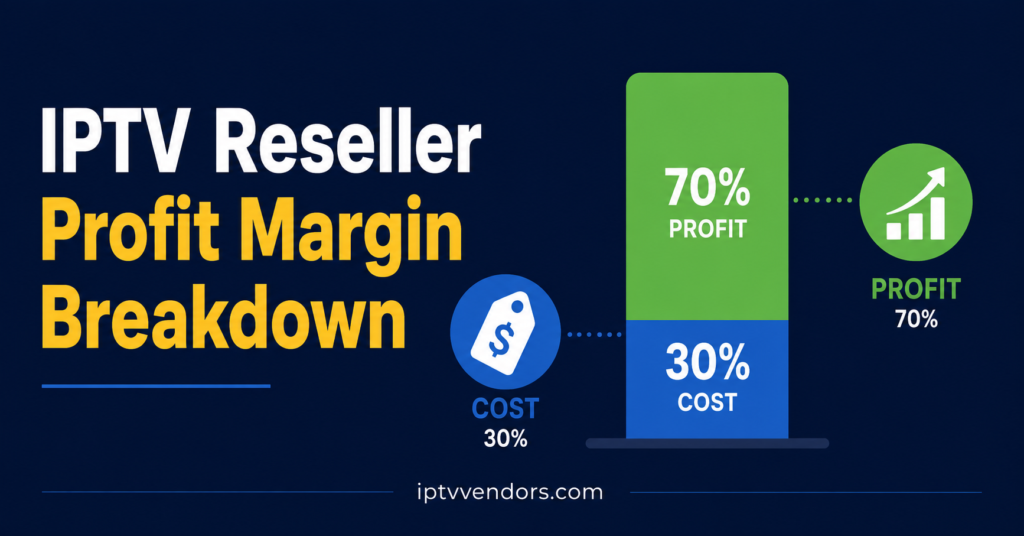
Margin and price aren’t the same lever, and treating them as interchangeable causes problems. Raising your price by 10 percent doesn’t automatically raise your margin by 10 percent, because your credit cost stays fixed while your retail price moves, which actually improves your margin percentage faster than a straight price comparison suggests.
The reverse is also true. Undercutting competitors on price without checking what that does to your margin is how resellers end up working long hours for very little once support time and churn are factored in. Reviewing a proper IPTV reseller pricing strategy before setting your rates gives you a clearer starting point than guessing based on what other resellers charge.
FAQ
How do I calculate profit margin on IPTV credits specifically?
Take your retail price for the subscription period, subtract the total credit cost for that same period, divide by the retail price, and multiply by 100. This gives your gross margin before support time and refunds are factored in.
What counts as a good margin for a UK IPTV reseller?
There’s no single verified industry benchmark for this, and any figure quoted without a source should be treated with caution. What matters more is knowing your own number and tracking whether it’s improving or slipping over time.
Should support time be included in a margin calculation?
It’s not a cash cost, but it is a real cost to your time. Many resellers find it useful to track support hours separately so they can see which customers or plans consistently need the most attention relative to what they pay.
Does a free trial affect my overall margin?
Yes, indirectly. Trials that don’t convert still use server resources and sometimes credits, so it’s worth weighing your trial to conversion ratio against your overall customer base rather than treating trials as costless.
Do I need software to work this out, or is a spreadsheet enough?
A basic spreadsheet is enough for most reseller operations. What matters is consistency, recalculating on the same schedule with the same categories each time, rather than the tool itself.

Reseller Checklist for Calculating Real Margin
- List your actual credit cost per subscription length, not just the headline package price
- Add up trial and reissue costs from the last quarter
- Note any refunds or free months given for service issues
- Estimate rough support hours per customer segment
- Recalculate your margin percentage using the full figures, not just credit cost versus retail price
- Compare the result against last quarter to spot drift early
Conclusion
Getting an accurate IPTV Reseller Panel Profit Margin Calculator figure isn’t about finding a clever formula nobody else knows. It’s the plain retail price minus credit cost minus operating costs calculation, done properly and repeated regularly, with trials, refunds and support time actually accounted for instead of assumed away. Resellers who check this every quarter tend to catch pricing problems early. Those who calculate it once and never revisit it usually only notice their margin has slipped when the bank balance tells them so. Set a recurring reminder, pull the real numbers, and run the calculation properly next time credits are due for a top up.