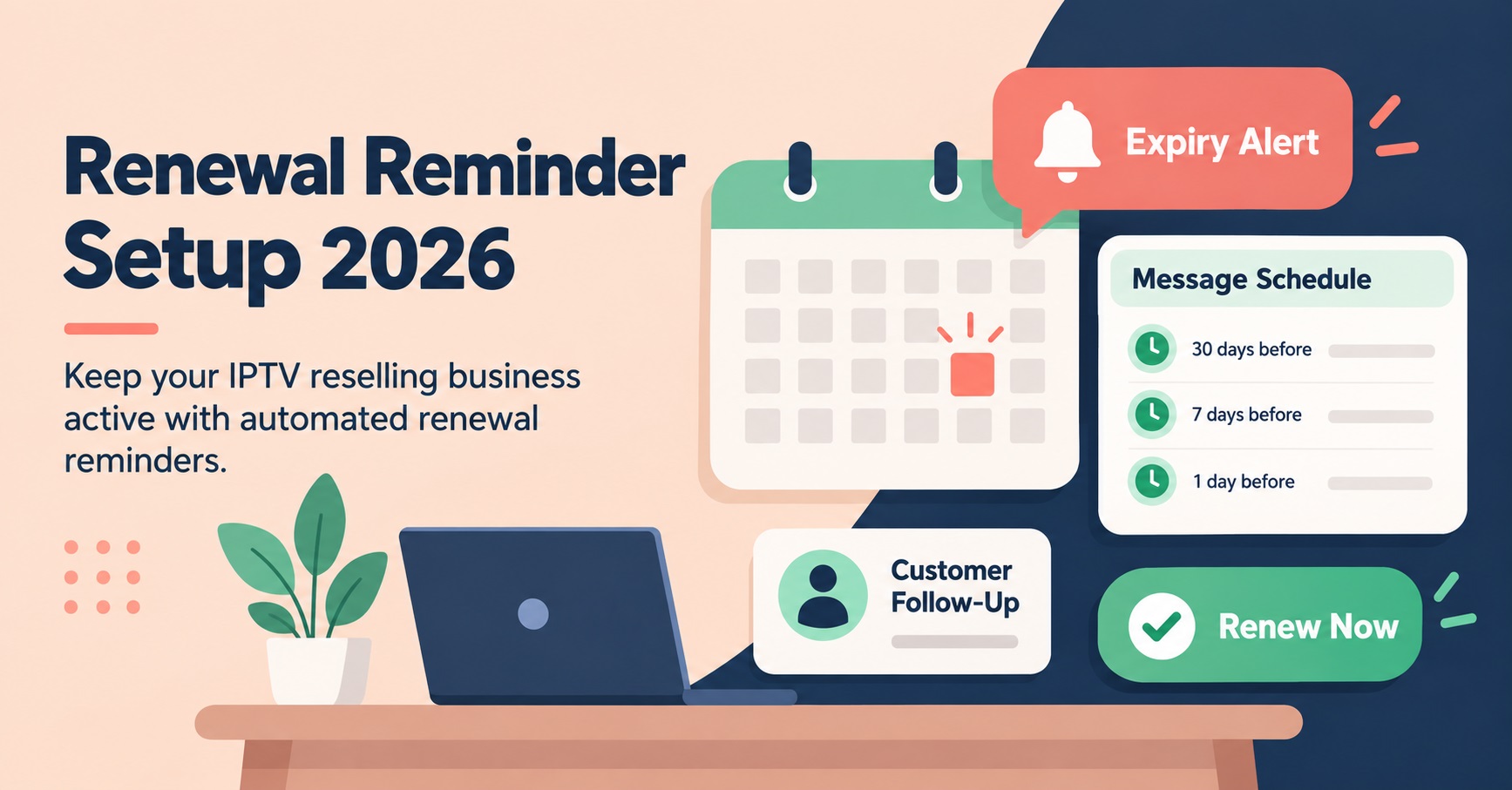

An IPTV Subscription Renewal Reminder is a short, scheduled message sent to a customer shortly before their line expires, telling them the exact expiry date, the renewal price, and how to pay. Most resellers get more value from the timing than from the wording. A plain message sent seven days out will recover more accounts than a beautifully written one sent on the morning the connection drops.
The part that catches people out is the gap between the reminder and the actual cut-off. If your reminder goes out at expiry, you are not reminding anyone, you are announcing an outage. Decide first how much warning you want to give, then check that your panel’s expiry dates are accurate enough to build a schedule on. Those two decisions shape everything else, including whether you automate the process or send messages by hand.
The Reminder Schedule That Recovers Renewals
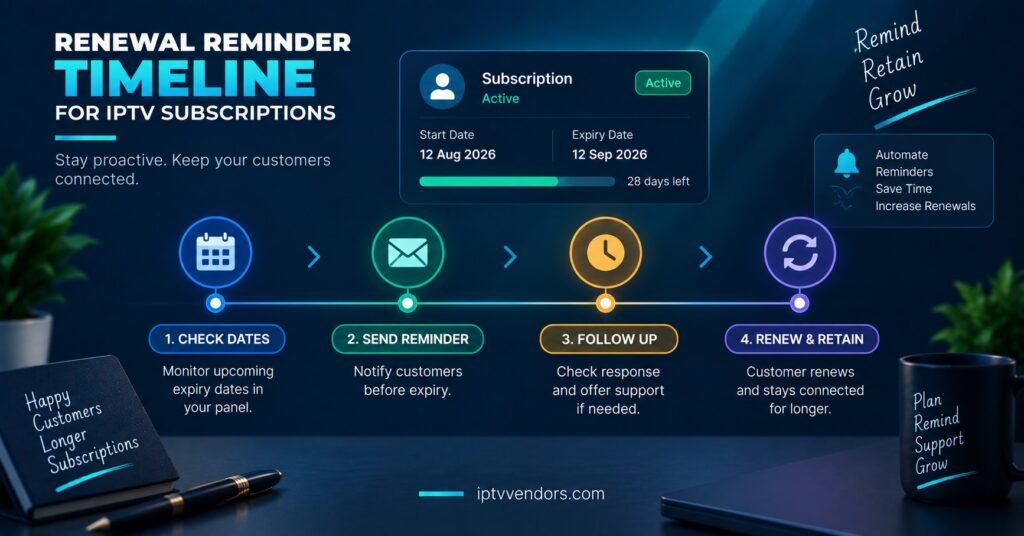
Renewal messages work in sequence, not in isolation. A single message asks a customer to act at whatever moment you happened to choose. A short sequence gives them several chances, each with a different job to do.
Three or four touchpoints is usually enough for a monthly or annual subscription. Beyond that you start training people to ignore you.
| Send point | What that message should do | What to avoid |
|---|---|---|
| 7 days before expiry | State the exact expiry date, the renewal price, and the payment method | Urgency language this early, which reads as pressure |
| 48 hours before | One short nudge, one clear action, nothing new added | Repeating the first message word for word |
| Expiry day | Confirm when access stops and how long the account stays recoverable | Silence followed by a surprise cut-off |
| 2 to 5 days after expiry | A single recovery message confirming the same credentials can be restored | Chasing someone who has already said no |
Annual subscribers need a longer runway than monthly ones. A customer who paid twelve months ago has forgotten what they paid, who they paid, and possibly that the subscription renews at all. Fourteen days of notice is more realistic there, with the price restated in full rather than referred to as “the same as last year”.
Pro tip: Put the expiry date in the message as a written date rather than “in 7 days”. Messages get read late, forwarded, or opened on a different day, and a relative countdown ages badly.
What Goes Inside an IPTV Subscription Renewal Reminder
Keep it to the information the customer needs to make a payment decision. Everything else dilutes it.
A workable reminder contains the account identifier or username in a form the customer recognises, the expiry date, the renewal price in their currency, the payment method, and how long you hold the account after expiry before the line is removed. If the account can be renewed without reconfiguring the device, say so explicitly. A surprising number of non-renewals come from customers who assume they will have to set everything up again on a new device and quietly decide it is not worth the afternoon.
What to leave out matters just as much. Do not bundle the reminder with an upgrade offer, a referral scheme, or a seasonal discount. It buries the action you actually want, and in the UK it also changes the legal character of the message, which is covered further down.
One more detail worth getting right: send the reminder from the same number, address, or account the customer has dealt with before. A renewal request arriving from an unfamiliar sender is the single fastest way to have a paying customer ignore you out of caution.
Choosing a Channel the Customer Will Actually See
Channel choice is where most reminder systems quietly fail. The reseller sends a well-written email, the email lands in a promotions tab, and the customer disappears without ever seeing it.
Messaging apps generally outperform email for this specific job, because the conversation history is already there and the customer can reply in one tap. That reply matters more than people expect. A renewal reminder that invites a response turns into a support conversation, and support conversations are where you find out that the customer was about to leave because of a device issue nobody told you about.
Email still has a place for annual renewals and for business customers who need something they can file or forward for expenses. SMS works as a fallback when a messaging account has gone quiet, though it is the most expensive option per message and the easiest one to make look like a scam.
If you sell across several English speaking markets, do not assume one channel covers all of them. Messaging app preferences vary considerably between the UK, North America, and Australia, and the practical answer is usually to record a preferred contact method at sign-up rather than guess later. This is one of the small things worth adding to your customer onboarding process rather than retrofitting when renewals start slipping.
Your Panel Data Has to Be Right Before Any of This Works
A reminder schedule is only as accurate as the expiry dates it reads from. Before automating anything, spend an hour checking a few things inside your IPTV reseller dashboard.
Confirm what time zone the panel records expiry in and whether that matches the time zone your customers live in. A line that expires at midnight server time can cut out mid evening for a customer several hours behind, and they will report it as a fault rather than an expiry.
Check how your panel handles part-renewals and early renewals. Some dashboards extend from the existing expiry date, others reset from the day you apply the credit, and the difference decides whether an early-paying customer loses days they already bought. Know which one you are running before a customer asks.
Also check your credit balance against the coming month’s expiries. There is little point sending reminders on Monday if you cannot apply the renewals on Tuesday because your credits have run out. Resellers running larger books tend to top up against a forward view of expiries rather than waiting for the balance to look low, which is straightforward enough when you are buying from a reseller panel with instant credit activation and can restock at short notice.
Pro tip: Export your expiry list weekly rather than checking it daily. A weekly export gives you a working queue for the whole week and makes it obvious when two dozen annual subscriptions are landing in the same fortnight.
The Failure Modes Worth Designing Around
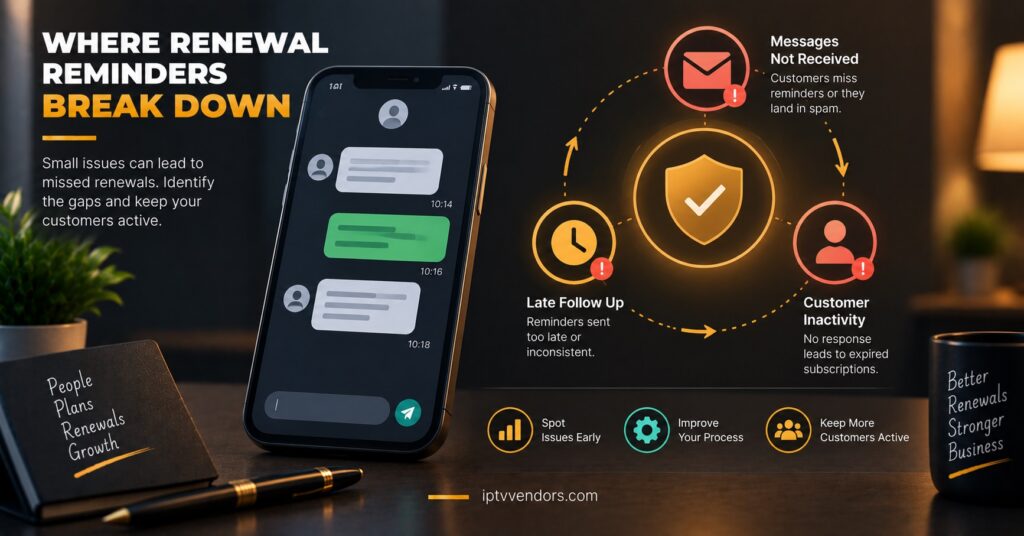
Reminder systems rarely break loudly. They degrade, and the symptom is a slow drop in renewal rate that gets blamed on pricing or server quality.
The most common failure is reminding people who have already paid. It happens when payment confirmation and panel renewal are two separate manual steps and the reminder script reads only the panel. The customer receives a chase for money they have sent, which damages trust far more than a missed reminder would have.
The second is volume without variation. Four identical messages in nine days reads as automated noise, and customers mute the thread. Each message in the sequence should say something the previous one did not.
The third is treating the reminder as a substitute for support. If a customer stopped watching six weeks ago because of a playback problem, no renewal message will fix that. Reminder recovery works best when it sits on top of a functioning support and escalation routine, so silent churn gets caught before the expiry date arrives rather than at it.
The fourth is sub-reseller ambiguity. If your sub-resellers own the customer relationship, decide clearly whether they send reminders or you do. Both sending is worse than neither, because the customer receives two prices from two sources and starts asking which one is real.
Service Message or Marketing? The Line Is Thinner Than It Looks
This matters if you sell to customers in the UK, and something broadly similar applies in most other English speaking markets, though the detail differs and you should check your own.
UK guidance from the Information Commissioner’s Office treats routine customer service correspondence about an existing contract as something other than direct marketing. Routine customer service messages, meaning correspondence giving customers information they need about a current contract or past purchase, do not count as direct marketing, and general branding or logos in those messages do not change that. A neutral notice that a subscription is ending on a given date generally sits on the service side of the line.
Add a promotion to it and the position shifts. Where a message includes significant promotional material aimed at getting customers to buy extra products or to renew a contract that is coming to an end, the marketing rules apply to that message. Factual notices that set out the options available at the end of a contract without pushing one option, and neutrally worded automatic renewal notices, are the examples given of communications that stay on the service side, though the guidance is clear that a neutral tone alone is not decisive because context also counts.
The practical takeaway is simple enough. Keep the renewal reminder factual and keep the discount codes in a separate message that people have agreed to receive. It also keeps your opt-out handling clean, which is worth having in order before your customer list gets large.
If You Received a Renewal Reminder and You Are Not Sure It Is Real
This section is for subscribers rather than IPTV Panel resellers, and it is worth knowing because expiry dates are predictable and predictable things get impersonated.
Check whether the message came from the contact you originally bought from. Genuine reminders come through an existing thread, not a new number introducing itself as your provider’s billing department. Check whether the account details in the message match what you actually have, including the username or line reference. A real reminder knows your account, a fraudulent one usually talks in generalities.
Be wary of any renewal message that asks you to pay through a method you have never used with that seller before, that demands payment within an hour, or that asks you to confirm card details in a chat. If in doubt, ignore the message entirely and contact your seller through the route you already have saved. A real expiry date does not move because you took twenty minutes to verify something.
Common Questions About Renewal Reminders
How many reminders should one customer receive?
Three is a sensible default for monthly subscriptions, plus one recovery message after expiry. Annual subscribers can take an extra early notice because the gap since their last contact is so long.
Should the reminder include the price?
Yes. Leaving the price out creates a second exchange before the customer can decide anything, and every extra exchange loses people. If your price has changed since their last renewal, say so plainly in the first message rather than at the payment stage.
What if a customer renews after the line has already expired?
Most panels allow the same credentials to be restored if the account has not been purged. Tell the customer the retention window in your expiry-day message so they know they have not lost their setup. Confirm your own panel’s retention behaviour before quoting a window.
Is it better to automate reminders or send them manually?
Below roughly a few dozen customers, manual sending from a weekly expiry export is workable and gives you better conversations. Past that, automation stops being optional, but keep a manual step for anyone who has raised a support issue in the last fortnight.
Should sub-resellers send their own reminders?
Whoever owns the customer relationship should own the reminder. Splitting it produces conflicting prices and duplicated messages. Set the expectation when the sub-reseller account is created, not after the first complaint.
Getting the Sequence Right and Then Leaving It Alone
A working IPTV Panel Subscription Renewal Reminder is mostly a matter of accurate expiry data, sensible spacing, and messages that contain the price and the date without padding. Seven days out, forty-eight hours out, expiry day, and one recovery message covers most subscription lengths, and a longer runway suits annual customers.
It will not fix everything. Reminders recover customers who forgot, not customers who left because the service disappointed them, and no message sequence compensates for a support gap or a quality problem. Treat the reminder as the last step of retention rather than the whole of it, and pair it with the wider renewal and retention approach you already run.
Start with one change this week. Pull your expiry list, find everyone lapsing in the next fourteen days, and send the seven-day message manually before you build anything automated. The response rate you get will tell you far more about your schedule than any template will.


[…] and service operator rather than a content distributor, which is the correct position for a IPTV reseller to […]