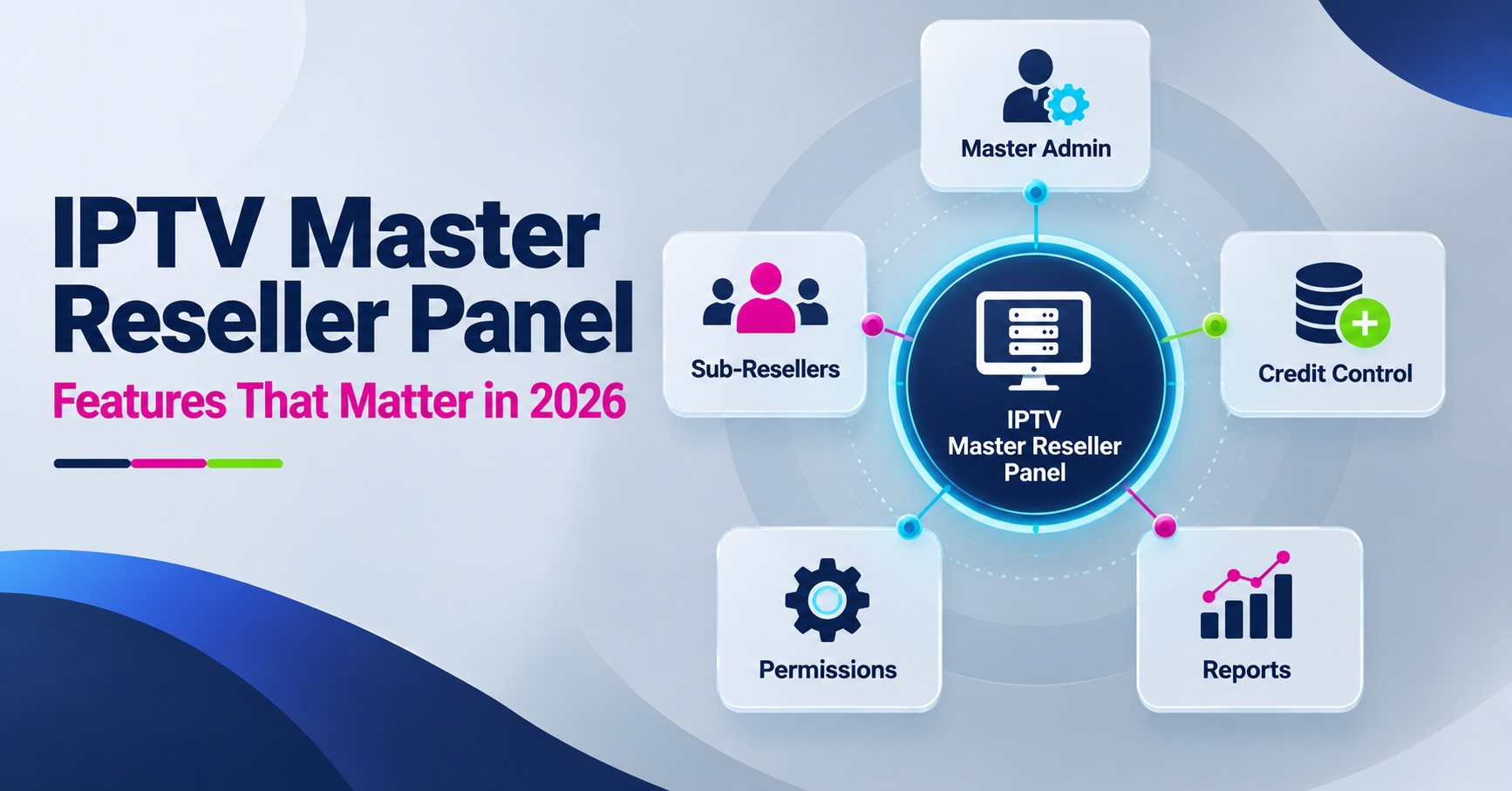

An IPTV Master Reseller Panel gives you a top-tier dashboard that can create sub-reseller accounts beneath you, allocate credits in bulk, and manage pricing and permissions across everyone you supply. That’s the structural difference from a standard reseller account, which only lets you sell to end customers directly. Whether that structure is actually worth paying for depends on how the panel handles the details underneath it, and that’s where most buying decisions go wrong.
Master reseller access changes what you’re responsible for
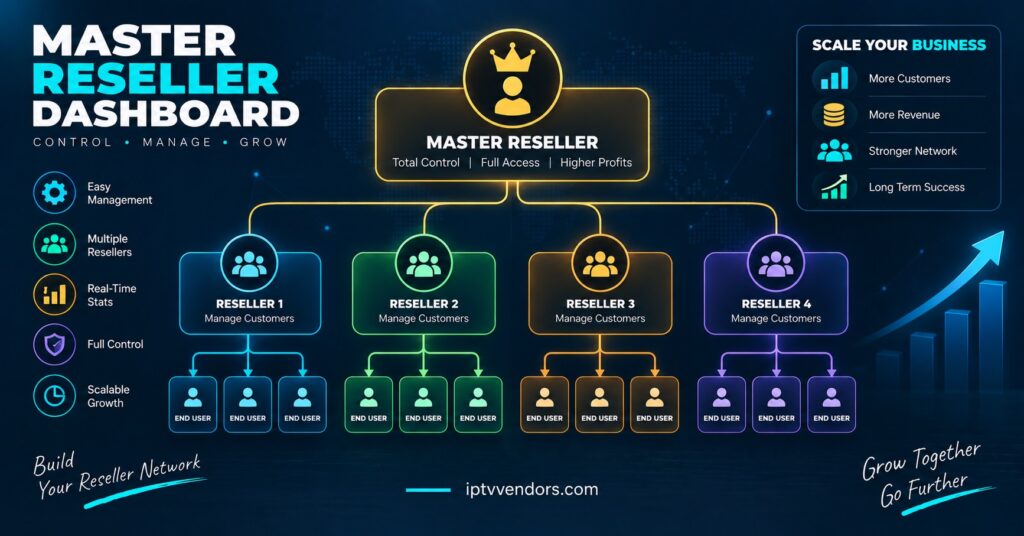
A standard reseller buys credits, creates customer accounts, and manages renewals. A master reseller does all of that plus one more layer: they can create other resellers underneath them, hand those resellers a portion of their credit balance, and set the boundaries of what those sub-resellers can and can’t do. That extra layer is genuinely useful if you’re planning to build a network rather than sell one-to-one, but it also means any weakness in the panel’s permission system becomes your problem, not just a subscriber-facing inconvenience.
This matters because a badly designed master panel doesn’t just annoy you. It creates situations where a sub-reseller can see more of your operation than you intended, or where a credit allocation error affects several of your resellers’ customers at once rather than one person’s account. Before comparing feature lists, it helps to understand that a master reseller panel isn’t simply “reseller panel plus more credits.” It’s a different operational structure, and the panel needs to be built to support it properly.
Permission granularity is the feature that gets overlooked
Most comparisons of reseller software focus on server locations, uptime claims, and pricing tiers. Permission granularity rarely gets mentioned, yet it’s the setting that determines whether your sub-resellers can quietly overreach.
A properly built master panel lets you control, per sub-reseller, whether they can see your cost price, whether they can create their own sub-resellers, whether they can issue trial accounts without using a credit, and whether they can view or only manage the customer accounts under their allocation. Weaker panels bundle these permissions together, so giving a sub-reseller the ability to issue trials also gives them visibility into figures you’d rather keep at your level.
Pro tip: Before committing credits to a master IPTV panel reseller setup, ask the provider to walk you through the permission settings on a live account rather than a feature list. Screenshots in a sales pitch rarely show the actual granularity.
How the IPTV Master Reseller Panel structure typically works
Most master reseller systems follow the same basic mechanics, even when the interface differs between providers. You purchase a large block of credits at a wholesale rate. From your dashboard, you allocate portions of that balance to sub-reseller accounts you create. Each sub-reseller then works inside their own smaller panel, drawing against the allocation you’ve given them, without being able to touch your main balance or see other sub-resellers’ activity.
The way IPTV credits work inside reseller panels is the same underlying system at both levels; the master account simply has the added ability to distribute credits downward instead of only spending them on its own customers. Where master and standard panels genuinely diverge is in reporting. A standard reseller dashboard needs to show one person’s activity clearly. A master dashboard needs to show that same clarity multiplied across every sub-reseller, without burying you in noise when you’re trying to spot which one is running low on balance or generating an unusual number of support tickets.
What actually separates a strong panel from a mediocre one
| Feature | Why it matters at master level |
|---|---|
| Per-sub-reseller permission controls | Prevents sub-resellers from seeing cost data or exceeding their intended access |
| Consolidated credit and balance view | Lets you spot a depleting sub-reseller before their customers lose service |
| Transaction-level audit logs | Gives you a record when a dispute arises between you and a sub-reseller |
| API access at the master tier | Supports automated credit distribution as your network grows |
Not every provider offers all four at the master tier, and some reserve the stronger reporting tools for higher-priced packages. It’s worth asking directly rather than assuming a “master” label guarantees the deeper feature set.
Credit distribution needs a policy, not just a button
The technical ability to allocate credits to a sub-reseller is straightforward in almost every panel. What’s harder, and what separates operators who scale smoothly from those who end up firefighting, is having a clear policy for how much to allocate and when to top up.
A common mistake is allocating a large block to a new sub-reseller before they’ve demonstrated consistent sales, tying up capital that could have gone to a proven performer. The opposite mistake, allocating too little too often, creates a stream of small requests that eats into your own time. A reasonable middle ground is to start new sub-resellers with a conservative allocation, review their consumption rate after a set period, and adjust based on actual usage rather than promised volume.
Pro tip: Set a low-balance alert threshold for each sub-reseller rather than relying on them to tell you when they’re close to running out. A single missed renewal because a sub-reseller forgot to top up reflects on your business, not theirs.
Where master reseller panels tend to fall short
No panel handles everything perfectly, and it’s worth going into a master IPTV panel reseller arrangement with realistic expectations rather than assuming the dashboard will manage relationships for you.
Dispute resolution between you and a sub-reseller usually happens outside the panel entirely, through messaging or email, because most systems don’t include a formal escalation workflow. Branding customisation for sub-resellers is often limited or absent, meaning their customers may see panel elements that reveal the underlying infrastructure rather than the sub-reseller’s own identity. And billing automation, when it exists, is usually built for the master account’s convenience rather than giving sub-resellers their own independent payment collection tools. None of these are dealbreakers on their own, but they’re worth factoring into how much manual oversight you’ll still need to provide once the technical setup is finished.
Evaluating a provider before you commit credits
A few direct questions tend to separate providers who’ve built a genuine master tier from those who’ve simply relabelled a standard account:
- Can sub-reseller permissions be set individually, or only in preset bundles?
- Does the audit log record who made a change, or only that a change occurred?
- Is there a minimum credit purchase required to unlock master-level access?
- What happens to sub-reseller accounts if you pause or reduce your own credit purchases?
- Does the panel support API access at the master tier, or only for individual resellers?
Getting clear answers to these before buying in bulk avoids the more expensive lesson of discovering the limitations after your sub-resellers are already active.
Choosing between master reseller and standard reseller
Not every operator needs the master tier. If you’re selling directly to end customers and have no plans to bring other sellers under your account, the extra permission layers and reporting complexity of a master panel add cost and configuration overhead without a corresponding benefit. The master structure earns its keep once you’re managing, or planning to manage, more than one selling relationship at a time, whether that’s a small team, regional partners, or an existing customer who wants to resell under your supply.
Reviewing how the IPTV business model you’re building actually operates, retail, wholesale, or a niche focus, is a reasonable step before deciding whether the master tier’s added complexity is worth the switch.
Frequently Asked Questions
Do I need a large upfront credit purchase to access master reseller features?
This varies by provider. Some unlock master-level permissions once you reach a set credit volume, while others offer it as a distinct package regardless of purchase size. Confirm this before assuming the tier is included automatically.
Can a sub-reseller see how many credits I have left overall?
Properly configured panels restrict this. A sub-reseller should only see their own allocated balance, not your total remaining credits or other sub-resellers’ figures.
What happens if a sub-reseller’s customer has a technical issue?
This depends on the support structure you set up with each sub-reseller. Some master resellers handle first-line support themselves and pass complex cases to the sub-reseller; others expect the sub-reseller to handle their own customers entirely.
Is it possible to demote a sub-reseller back to a standard account?
Most panels allow this, though the process and whether existing customer accounts transfer smoothly varies between providers. Ask about this specifically if you expect sub-reseller relationships to change over time.
Does a master reseller panel cost more than a standard one?
Typically yes, reflecting the additional infrastructure needed to support permission tiers and consolidated reporting. The cost difference is worth weighing against how much of that structure you’ll actually use.
Conclusion
An Master IPTV Reseller Panel is worth the added cost and complexity when you’re genuinely building a network of sub-resellers rather than selling directly to end customers alone. The features that matter most in practice aren’t the ones that show up first in a sales pitch, they’re the permission controls, audit logs, and consolidated balance visibility that keep a growing network manageable instead of chaotic. Before allocating a large credit purchase to any provider’s master tier, get direct answers on how granular the permissions actually are and what reporting you’ll have once sub-resellers are active under your account.
Master Reseller Evaluation Checklist
- Confirm whether permissions can be set individually per sub-reseller
- Check whether audit logs record who made each change, not just that one occurred
- Ask about minimum credit thresholds required for master-tier access
- Test the consolidated balance view before committing to a large purchase
- Clarify what happens to sub-reseller accounts if your own credit purchases pause
- Confirm API availability at the master tier if automation is part of your plan
- Ask directly about dispute handling between you and sub-resellers