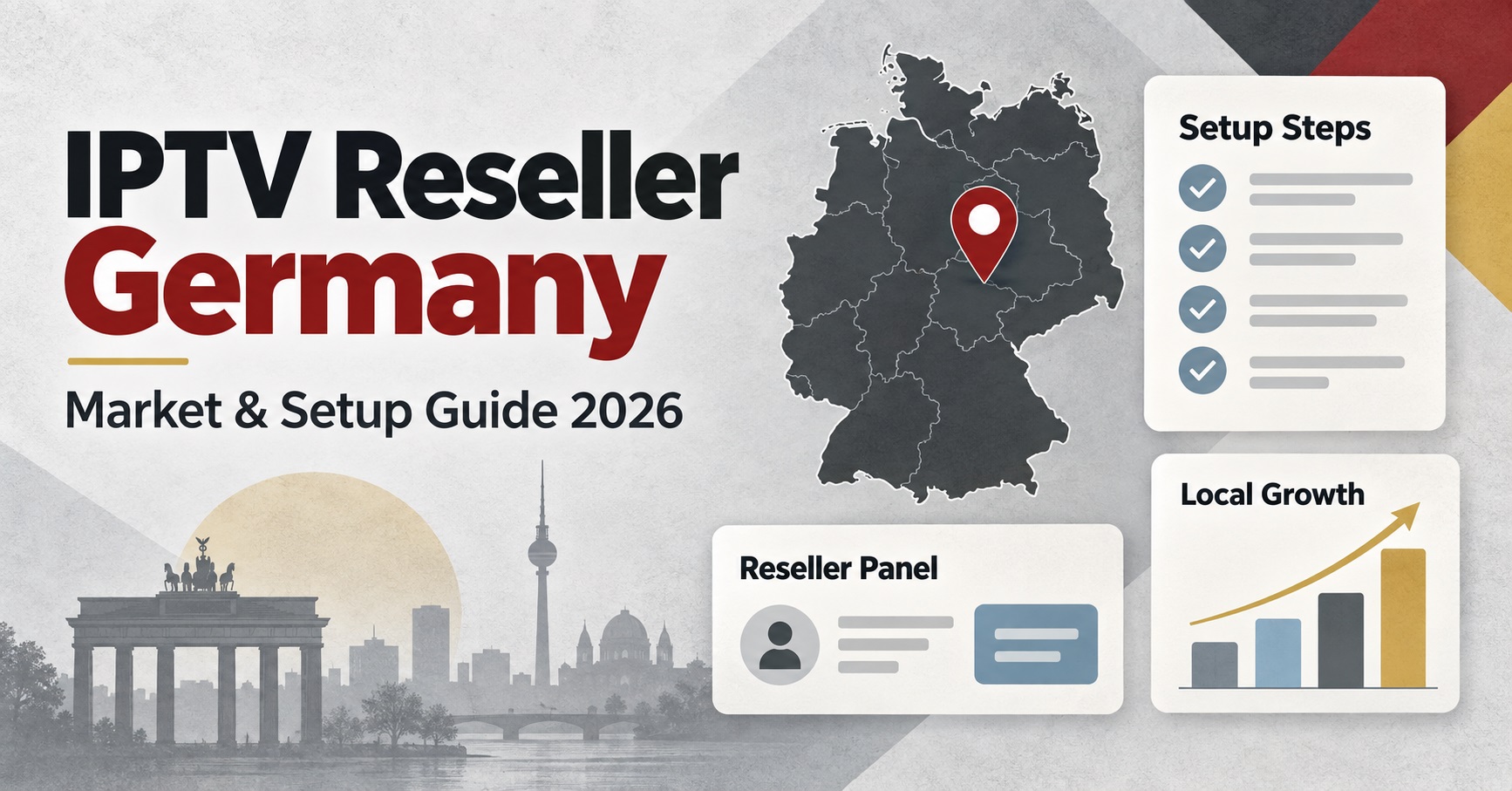

An IPTV Reseller Germany operation runs on the same basic mechanics as any other reseller setup: you buy credits from a panel provider, activate subscriptions for customers, and set your own retail price. What changes when Germany becomes your target market isn’t the software. It’s everything around it, from how content rights are treated under German law to whether your invoices meet local expectations.
Most IPTV panel resellers who struggle with the German market didn’t misjudge demand. They assumed it would behave like whichever market they’d already worked in, usually the UK, and skipped the parts that don’t transfer: currency and invoicing habits, GDPR obligations that apply the moment you hold a German customer’s data, and a customer base that generally expects support in German rather than English.
Why Germany Gets Treated as a Separate Market at All
Germany’s broadband infrastructure is dense and consistent across most regions, which is part of why streaming delivery methods have grown steadily as an alternative to cable and satellite packages. That growth has come from multiple directions at once: households replacing traditional pay-TV bundles, expat and diaspora communities wanting channels in their first language alongside German programming, and small businesses such as cafes or shared accommodation wanting a simpler single subscription than a full broadcast contract.
None of that automatically makes Germany an easier market than any other. It’s a market with its own legal framework, its own payment habits, and its own language expectation, and a reseller who treats it as an English-language market with a different currency symbol will lose customers to whoever gets the basics right.
The Legal Line You Need to Understand Before You Sell Anything
IPTV is a delivery method, not a license. That distinction matters more in Germany than in some markets because content rights there are governed specifically by the Urheberrechtsgesetz, Germany’s copyright act, and broadcasting activity aimed at German audiences can fall under the Medienstaatsvertrag, the interstate media treaty that covers licensing and content rules for services operating like a broadcaster. The Bundesnetzagentur oversees telecoms infrastructure compliance, while the state media authorities handle broadcasting-specific oversight.
None of this means IPTV itself is restricted. It means the legality of what you’re reselling depends entirely on whether the underlying content is properly licensed for distribution to German viewers. As a reseller, you’re not the one negotiating those rights, but you are the one whose business model collapses if the panel provider behind you isn’t operating on a legitimate footing. Ask a provider directly how their content sourcing works before you commit to them, and be wary of anyone who avoids a straight answer.
IPTV Reseller Germany: What the Business Model Actually Involves
Strip away the market-specific detail and an IPTV Reseller Germany setup is a credit-based wholesale arrangement. You purchase a batch of credits, each one converts into an active subscription of a set length inside your dashboard, and the margin between your wholesale cost and your retail price is your income. Learn how IPTV credits work if you haven’t run a credit-based account before, since the mechanics affect how you price for a new market.
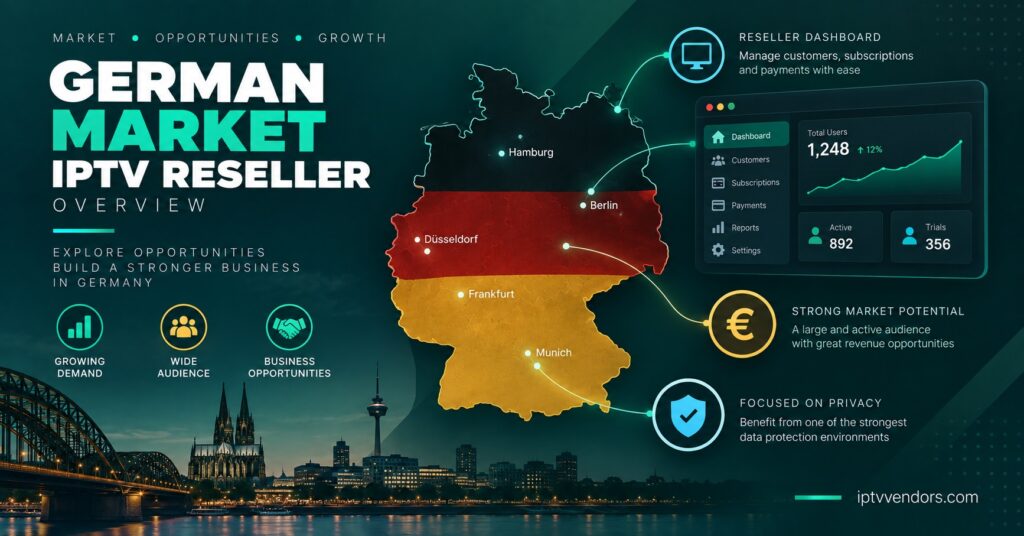
The part that catches new resellers out isn’t the credit system. It’s assuming that a customer base in Germany will convert and renew at the same rate as customers elsewhere, without adjusting for the fact that German buyers are, on the whole, more cautious about upfront payment and more likely to ask direct questions about data handling before they commit. Build that expectation into your sales process rather than treating it as friction.
Pricing and Payment: Where Assumptions Go Wrong
Pricing in euros is the easy part. The harder part is payment method fit. SEPA bank transfers and debit cards are far more embedded in everyday German spending habits than they are in some other markets, and a checkout that only offers card payment or cryptocurrency will quietly lose customers who never bother to explain why they didn’t buy. If you’re running billing through a platform connected to your panel API integration, check whether it supports SEPA before you launch, not after your first complaint about a failed payment.
Invoicing matters more here too. German customers, including small business buyers, are used to receiving a proper invoice with clear line items, and a reseller who only sends a payment confirmation screenshot looks noticeably less established than one who sends a formatted invoice automatically.
Pro tip: Set your billing platform’s default invoice language to German even if your storefront is in English, since it costs nothing to configure and removes one of the more common reasons a first-time customer hesitates.
Language Support Isn’t Optional, It’s the Difference Between a Sale and a Support Ticket
An English-only reseller can still sell into Germany, particularly to expat households who want channels in a language other than German. But once a customer has an issue, whether that’s a device not authenticating or an EPG showing the wrong schedule, the expectation shifts. A support conversation that can’t move into German at that point often ends in a refund request rather than a resolved ticket, simply because the customer couldn’t get a clear answer fast enough.
You don’t need a fully German-speaking operation from day one. You do need a plan for it: a translated FAQ, a support contact who can at least handle basic German, or a clear statement upfront that support is English-only so customers can decide before they buy rather than after something breaks.
| Decision factor | What to check |
|---|---|
| Server routing | Whether the panel routes German connections through EU-based infrastructure rather than distant nodes |
| Payment support | Whether SEPA transfer and standard card payment are both available at checkout |
| Data handling | Whether the provider’s data storage and processing terms are written to meet GDPR requirements |
| Language coverage | Whether the EPG, app interface, or support channel can function in German |
| Invoicing | Whether your billing setup can issue a properly itemised invoice, not just a payment receipt |
Data Protection Isn’t a Footnote Here
GDPR applies to any business processing personal data of people in the EU, and that includes a UK or non-EU IPTV panel reseller selling to German customers. In practice, this means you need a privacy policy that actually reflects what you collect and store, a lawful basis for keeping customer records, and a process for deleting a customer’s data if they ask you to. This isn’t unique to Germany, but German customers are, in general, more likely to ask about it directly than customers in markets where data protection gets less day-to-day attention.
Pro tip: Keep a short, plain-language data policy on your storefront rather than a dense legal document nobody reads. A customer who can find a clear answer in thirty seconds is far less likely to abandon checkout over it.
Common Mistakes Resellers Make When Targeting This Market
The mistakes that show up repeatedly aren’t technical. They’re assumptions carried over from another market without being checked:
- Pricing purely by converting an existing price into euros, without checking what comparable services actually cost locally
- Assuming a customer base built for one language will convert the same way for another, without adjusting the sales message
- Skipping SEPA support because it wasn’t needed in a previous market
- Treating a GDPR question from a customer as unusual rather than expected
- Launching without any German-language fallback for support, then losing customers over issues that had simple answers
None of these require rebuilding your operation. They require checking the assumptions before launch rather than after the first wave of customer complaints.
When It Makes Sense to Build a Sub-Reseller Layer Instead
Once demand in the German market grows past what you can manage directly, some operators bring on local sub-resellers rather than continuing to run every customer relationship themselves. This works especially well where language is the bottleneck, since a German-speaking sub-reseller can handle first-line support and sales conversations you’d otherwise struggle with. If you’re considering this route, it’s worth reading through how the IPTV reseller business model scales through sub-resellers before setting margins, since pricing a sub-reseller layer badly is one of the more common ways operators erode their own profit.
This isn’t a step every reseller needs to take. A smaller, direct-to-customer operation can run indefinitely without ever adding a sub-reseller layer, and forcing the structure in early just adds management overhead without matching demand.
Frequently Asked Questions
Is it legal to run an IPTV reseller business targeting German customers?
IPTV as a delivery method is legal. What determines legality is whether the content being distributed is properly licensed under German copyright law. As a reseller, your responsibility is to work with a provider whose content sourcing you can trust, since you’re relying on their licensing position, not negotiating it yourself.
Do I need to be registered as a business in Germany to sell there?
Not necessarily to sell to German customers from abroad, but tax and invoicing obligations can apply depending on your turnover and where your business is legally based. This varies by situation, so check with an accountant familiar with cross-border digital sales rather than assuming one rule fits every case.
Does GDPR apply even if my business isn’t based in the EU?
Yes. GDPR applies based on whose data you’re processing, not where your business is registered. If you hold personal data belonging to customers in Germany, GDPR requirements apply to how you store, use, and delete that data.
Do German customers really expect support in German?
Many do, particularly once something goes wrong with their account. Expat customers buying content in another language are often more comfortable with English-only support, but a reseller relying entirely on German customers should plan for at least basic German-language support.
What payment methods should I prioritise for this market?
SEPA bank transfer and standard debit or credit cards cover the majority of everyday payment habits. Treat card-only or crypto-only checkout as a limitation to fix rather than a acceptable default.
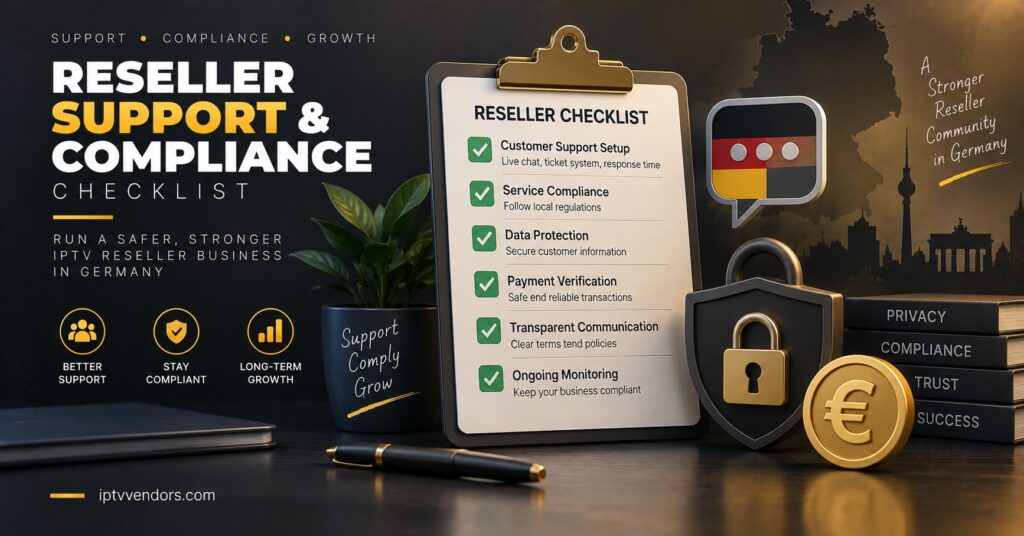
Germany Market Reseller Checklist
- Confirm your provider’s server routing includes EU-based infrastructure for German connections
- Check that SEPA transfer and card payment are both supported at checkout
- Write a plain-language data protection policy that reflects what you actually collect
- Decide your language support plan before launch, even if it’s just a translated FAQ
- Set up invoice-capable billing rather than payment-confirmation-only receipts
- Review your provider’s content licensing position before committing to a wholesale volume
Running an IPTV Reseller Panel Germany operation isn’t harder than reselling into any other market, but it does punish shortcuts that other markets tolerate. Get the legal framing, payment methods, and language support right from the start, and the credit system underneath behaves exactly the same way it does anywhere else. Skip those checks, and you’ll spend your first few months fixing problems that a short setup review would have caught before launch.