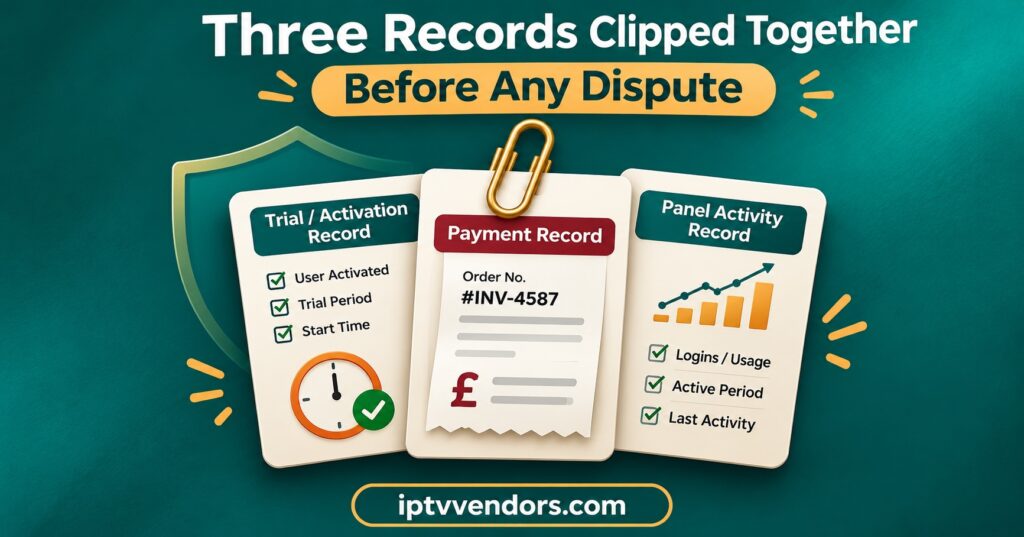
IPTV Reseller Chargeback Prevention works best when you create the evidence at the moment of sale, not after a dispute arrives. Three records do most of the work: proof the customer agreed to your terms and asked for immediate access, a receipt that matches the name on their bank statement, and activity from your reseller dashboard showing the account was activated and used. Add a quick, no-drama refund route for genuine problems and you remove the most common reasons a customer goes to their bank instead of to you.
Timing is what catches resellers out. A cardholder can usually raise a dispute up to around four months after paying, and sometimes later. The window you get to respond is set by your payment processor, and it’s often a matter of days. By then the customer’s chat history may be gone, the panel’s connection logs may have rolled over, and nobody remembers which version of your terms was live in the spring. Most disputes in a subscription business aren’t outright fraud either. They tend to be an unrecognised charge, a renewal the customer forgot about, or a setup that never worked and was never reported. Each of those leaves a different trail, and each can be closed off before it reaches the bank.
[ez-toc]
Reading a Dispute the Way the Card Issuer Does
When a customer raises a dispute, their own bank reviews it. Your payment processor doesn’t decide it, and neither do you. The person handling it won’t phone you, visit your website or log in to your panel. They read what you upload, usually once, and compare it against the reason the customer gave. A long explanation of how unfair the claim is carries no weight. A short, dated record that directly answers the stated reason carries a great deal.
That’s why the dispute reason matters more than the amount. Evidence that wins a “service not received” claim can be useless against “I didn’t authorise this”, and the other way round. In an IPTV reseller panel business, almost every dispute falls into one of four groups:
| What the customer tells their bank | What actually answers it | Record you must already have |
|---|---|---|
| I don’t recognise this payment | The charge matches a named order the customer placed | Receipt showing your trading name, order ID, date and amount |
| I didn’t authorise it | The buyer is the account holder and used the service | Checkout consent, customer email, first-connection time from the dashboard |
| I paid but never got it, or it didn’t work | Access was delivered and used, and support was offered | Credentials delivery message, activity log, support ticket history |
| I cancelled or asked for a refund | Your stated policy and what the customer actually requested | Terms version accepted, cancellation messages, refund decisions with dates |
Treat the right-hand column as a to-do list for the day of sale. If one of those records doesn’t exist for a customer, no honest effort later will create it.
One limit belongs here. Payment processors judge the business as well as the transaction. If the service you resell doesn’t have proper distribution rights, a processor can close your account however good your paperwork is, and no evidence pack changes that. IPTV is a delivery technology. Whether a particular service is lawful depends on the licences behind the content. Chargeback controls protect a legitimate operation from avoidable losses. They aren’t a way to keep an unlicensed one running.
Consent You Can Actually Show Later
Consent only helps if you can prove three things about it: what the customer agreed to, when they agreed, and that it was them. A sentence in your footer saying “by using this site you accept our terms” proves none of those.
At checkout, use an unticked box the customer has to tick. Store the result against the order with a timestamp, the email address and the version or date of the terms they saw. Keep old versions of your terms rather than overwriting them, because a dispute in July may concern a purchase made under March’s wording.
Under UK distance-selling rules, customers who buy online generally have a 14-day cancellation period. If a customer wants their subscription switched on straight away, the usual approach is to get their express request for immediate access and their acknowledgement of how that affects cancellation, then confirm both in writing. Take advice on the exact wording for your situation, because the rules treat services and digital content differently. The operational point is simple, though: the request has to be recorded, not assumed.
Renewals need their own consent. If a plan renews automatically, the customer should agree to that specifically at sign-up. The renewal terms should state the amount, the frequency and how to stop it. A forgotten renewal is one of the most predictable disputes there is, and a reminder a few days before the charge costs far less than defending one.
Many IPTV panel resellers take orders through messaging apps rather than a checkout page. That’s workable, but the consent still has to exist. Send a written order summary with the plan, connections, price, renewal terms and a link to your terms. Ask the customer to reply with a clear confirmation before you activate. Export or screenshot that exchange into the order record the same day, because chat histories get deleted and phones get replaced.
Pro tip: Put a date in the title of each version of your terms, such as “Terms of Service, updated 1 October 2026”, and record that title in every order. It ends any argument about which rules applied.
Receipts That Match the Bank Statement
From the customer’s side, “I don’t recognise this payment” is often true. They bought from a brand name they remember, then weeks later saw a different company name, an abbreviation or a payment platform’s name on their statement. The fix is mostly admin.
Check the billing descriptor your processor puts on statements and get it as close to your customer-facing brand as the processor allows. If it can’t match exactly, say so on your checkout page and on the receipt: “This payment will appear on your statement as …”. Then email a receipt straight after payment that includes:
- your trading name and a contact route that actually gets answered
- the order ID, date and amount, in the currency charged
- a plain description of what was bought, such as “12-month subscription, 2 connections”, rather than vague wording
- the renewal date, or a clear statement that the plan doesn’t renew
- how to get help with setup and how to cancel
Keep the receipt description generic and accurate. Naming specific channels or programming on a receipt adds nothing to a dispute and can cause problems of its own.
Keep your order ID short and consistent too, so the customer, your records and the payment reference all line up. If you already match payments against panel activations, the same ID should run through every step. That’s easier to keep straight once you understand how a subscription moves from order to activation.
Activity Evidence From the Reseller Dashboard
For a digital service, “proof of delivery” means showing the customer got access and used it. Your reseller dashboard is the obvious source, but what it can show varies a lot between panels, and sub-resellers often see less than the parent account.
Find out exactly what your panel records before you need it. Typical fields include account creation time, expiry date, connection limit and last active time. Some panels also show the first connection, the device or player type, and the IP address used. Check how long those logs are kept. If activity history only goes back a few weeks, you can’t count on it when a dispute arrives three months later.
The practical answer is to save a snapshot at two moments: when you deliver the credentials, and once the customer has connected for the first time. A dated screenshot or export showing the account active and in use is often enough to answer a “never received it” claim. If your panel shows the customer’s IP address at first connection and it matches the one recorded at checkout, that link between buyer and user is especially useful against “I didn’t authorise this”.
Support history belongs in the same file. Picture a ticket where the customer reported buffering on one device, you suggested a fix and they confirmed it worked. That’s strong evidence the service was delivered and the problem was dealt with. A good IPTV support process, with tickets saved against order IDs rather than scattered across personal chats, does two jobs here.
Collect only what you need for these purposes, keep it secure, and set a retention period. UK data protection rules expect you to justify what you hold and for how long. A period that covers the realistic dispute window plus a margin is a reasonable basis.
IPTV Reseller Chargeback Prevention in Practice: A Worked Example
This example is an illustrative composite, not a real case. The amounts are placeholders, chosen only to make the timeline easy to follow.
A customer buys a 12-month plan with two connections for £60 through the reseller’s checkout. Here’s what the record looks like when the reseller follows the steps above:
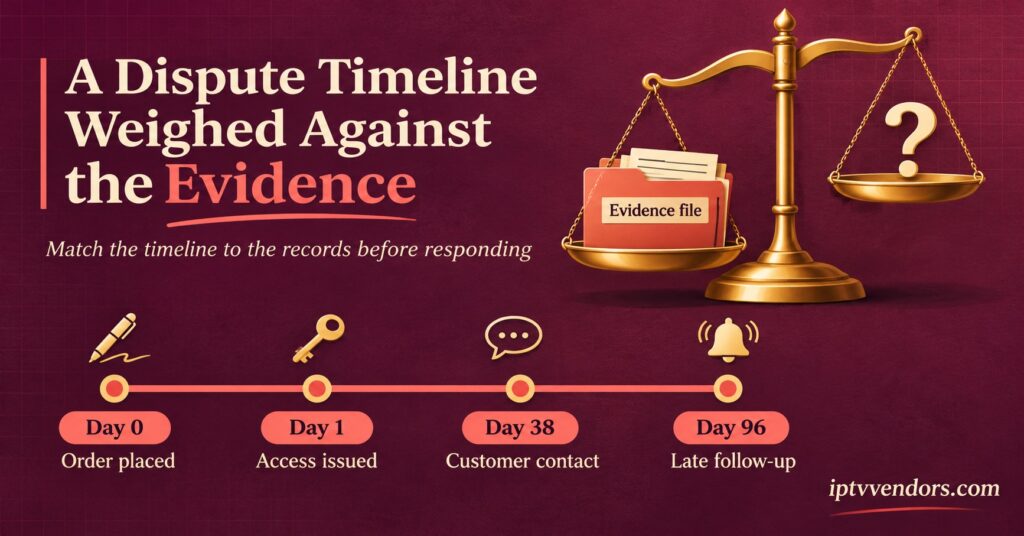
- Day 0, 19:42. The order is created with ID R-4471. The customer ticks the terms box (terms dated 1 October 2026) and a separate box requesting immediate access. The checkout logs their email address and IP address.
- Day 0, 19:44. A receipt is emailed showing the trading name, the statement descriptor, R-4471, £60, “12-month subscription, 2 connections”, “does not auto-renew” and the help address.
- Day 0, 19:51. Credentials are sent by email. The reseller saves a panel screenshot showing the account created and active.
- Day 1, 08:15. The panel shows the first connection. Its IP address matches the one logged at checkout. A second screenshot goes into the order file.
- Day 38. The customer opens a ticket about freezing on one television. Support suggests a change to a player setting, and the customer replies that it’s fixed. The ticket is saved against R-4471.
- Day 96. A dispute arrives with the reason “transaction not recognised”. The processor gives a short window to respond.
The response pack takes under half an hour to put together, because nothing has to be hunted down. It holds the receipt, the checkout consent record, the two panel screenshots, the saved ticket and a one-page summary in plain sentences:
“The cardholder purchased order R-4471 on [date] using the email address [address], accepting our terms dated 1 October 2026 and requesting immediate access. A receipt showing the statement descriptor was sent at 19:44. The account was first used the next morning from the same IP address recorded at checkout. On day 38 the cardholder contacted support, the issue was resolved and the cardholder confirmed the service was working. Copies of each record are attached in date order.”
Now run the same story without the records. The order came in by direct message and the chat has since been deleted. There’s no receipt, the panel only keeps 30 days of activity, and the support conversation happened on a personal phone. The reseller knows the customer used the service, but the issuer has no way of knowing it. Losing that dispute says nothing about whether the customer was honest. It reflects what was submitted.
Even the well-documented version isn’t certain to win. The issuer decides, and nothing guarantees the outcome. What the records do is turn a dispute from guesswork into a straightforward comparison, and they let you decide quickly whether a case is worth contesting at all.
When a Refund Beats a Fight
Prevention includes knowing when not to argue. Say a customer tells you the service never worked on their device and you can’t fix it. Refunding promptly is usually cheaper than a dispute once you count the fees, the lost time and the effect on your dispute ratio. A customer who gets a fair answer from you has no reason to call their bank.
The order matters. Refund before a dispute is opened, through the same payment method, and keep the confirmation. Once a dispute has been raised, don’t send a separate refund outside the process, because you can end up paying the money back twice. Respond through your processor instead. If you agree the customer should get their money back, accept the dispute there.
Some cases aren’t worth contesting even with decent records. Low-value orders where the response time costs more than the sale are one example. Customers with a genuine unresolved fault are another, and so are cases where your own records are incomplete. Contest the ones where your evidence directly answers the stated reason. Processors watch the share of payments that turn into disputes, and a rising ratio can bring extra fees, reserves on your funds or account closure. So every avoidable dispute you prevent is worth more than the single order.
Your refund policy should be easy to find, written in plain English and consistent with what support actually does. It fits naturally alongside the pricing on your IPTV reseller plans and credit options, so customers see the rules before they buy. One quiet cost to remember: when you refund the end customer, the upstream IPTV provider rarely gives back the IPTV credits spent on that activation. Factor that in when you decide how generous a refund window you can afford.
Habits That Stop Disputes Before They Start
This list is for resellers and sub-resellers who handle their own customers’ payments. Work through it once to set things up, then check it again whenever your checkout, panel or terms change.
- Confirm what your payment processor shows on statements, and put that exact wording on the checkout page and the receipt.
- Add an unticked terms checkbox and a separate immediate-access request, both stored with a timestamp, email and terms version.
- Date every version of your terms and keep the old ones.
- For orders taken by message, send a written summary and get a clear “confirmed” reply before activating. Save the exchange the same day.
- Email a receipt with order ID, amount, plan description, renewal status and help contact within minutes of payment.
- Find out how long your reseller dashboard keeps activity logs, and save a snapshot at credential delivery and at first connection.
- Log support tickets against order IDs in one shared system, not in personal chats.
- Send renewal reminders several days before any automatic charge, with a one-step way to cancel.
- Write a refund rule your team can apply in minutes, and refund genuine failures before they turn into disputes.
- Keep a simple folder for each order so you can build a response pack in one sitting.
- Review your dispute count monthly and trace each one back to the missing record or broken step.
Questions Resellers Raise About Disputes
How long should I keep chargeback evidence?
Long enough to cover the realistic dispute window plus a margin. Most card disputes are raised within about four months of payment, but some categories allow longer, so many businesses keep order evidence for at least a year after the last payment on an account. Weigh that against your data protection duties and delete what you no longer need.
Are screenshots from my panel acceptable evidence?
They can be, as long as they’re readable, dated and clearly tied to the order in question. For example, show the username or account ID next to the order ID in your notes. Where your panel offers a timestamped export, that’s stronger.
What if my parent reseller controls the logs I need?
Ask now, not during a dispute. Find out what activity data your parent account can provide, how quickly, and how long it’s kept. If the answer is “not much”, lean more heavily on your own checkout and support records.
Should I fight a dispute from a customer I know used the service?
Only if your evidence shows it in a way the issuer can check. Knowing something isn’t the same as proving it. If the records are thin, you’ll often do better to accept the dispute and fix the gap in your process.
Do renewal reminders really reduce disputes?
They tackle one of the most common causes head on. A customer who’s reminded before a charge either cancels through you or expects the payment. Both outcomes beat a surprised customer calling their bank.
Records First, Arguments Second
IPTV Reseller Chargeback Prevention is less about winning disputes than about having a fair answer on file before anyone asks for it. Most of what an issuer looks for comes from three records: consent captured at checkout, a receipt that matches the statement, and dashboard activity saved at activation. A sensible refund rule handles the cases you shouldn’t fight. None of this overrides the issuer’s decision, or a processor’s view of an unlicensed service. It does let a legitimate IPTV reseller business respond calmly inside a short deadline. A good place to start is your three most recent orders: check whether you could build a complete evidence pack for each one today. If you’re still shaping the wider operation, the overview of the IPTV business model for panel resellers shows where payments and disputes fit.