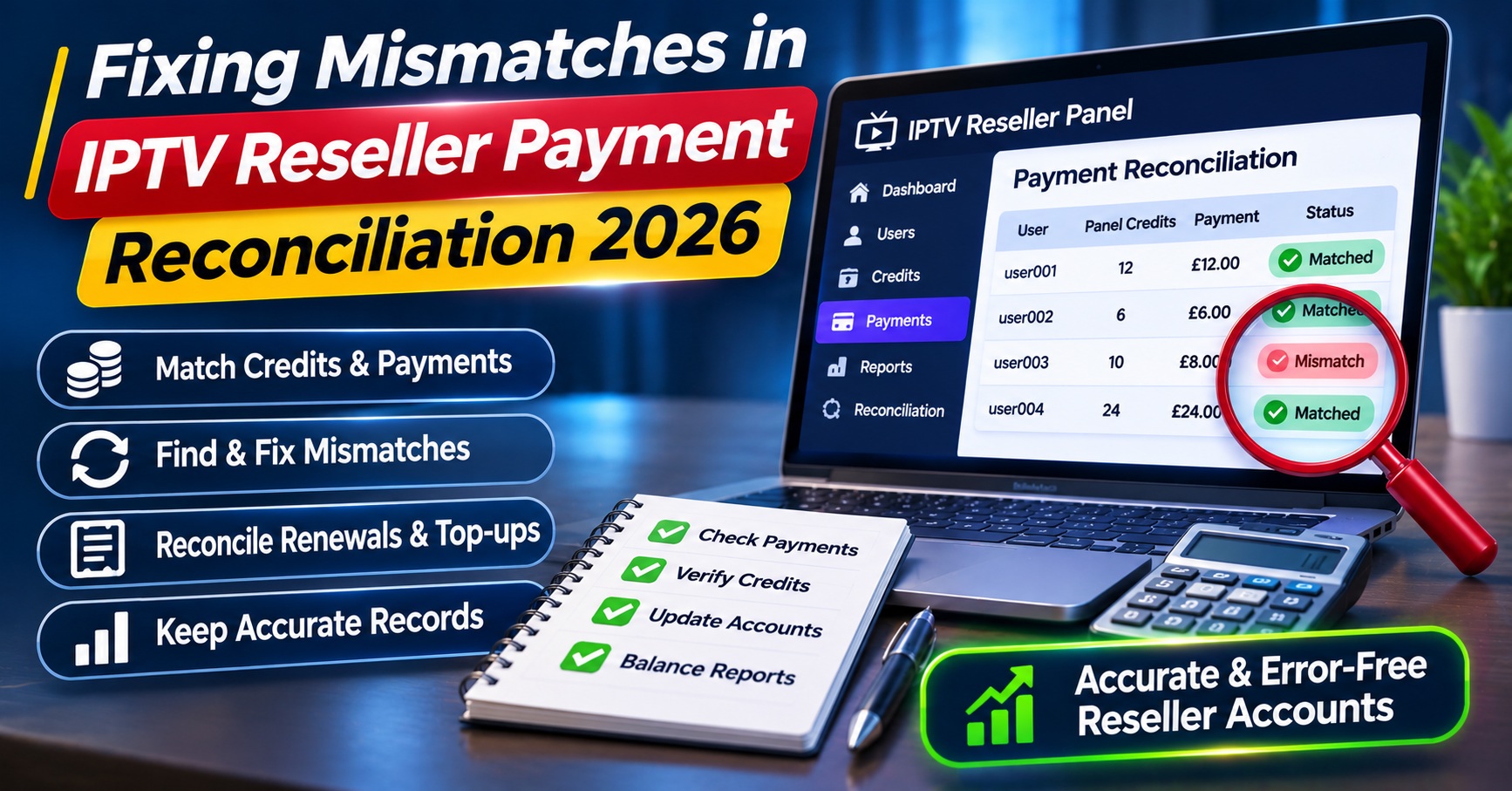

IPTV Reseller Payment Reconciliation means proving two things every week: that each order ID in your records has money behind it, and that each payment in your bank or processor account belongs to a specific order. You do it by lining up three records side by side (your order log, your money records, and the panel’s activation history) and marking every line as matched, or as an exception with a reason and an owner.
Most of the lines will match in seconds. The real work sits in the leftovers: the customer who sent £25 for a £30 plan, the transfer with “TV PAYMENT” as its only reference, the card payout that arrives as one net figure covering several orders and a refund. Those exceptions are where unpaid activations hide, so the method below is built around catching them early rather than admiring the clean matches.
[ez-toc]
The Three Records That Have to Agree
Reconciliation only works if you know which record is the source of truth for which question.
Your order log answers “what did we sell?”. Every sale gets one row with an order ID, the plan, the price, the date and the payment method. A spreadsheet is fine at small volume, provided nobody edits a row once it is closed.
Your money records answer “what actually arrived?”. For bank transfers that is the bank statement export. For card or wallet payments it is the processor’s payout report, not the bank line, because the bank only shows the lump sum.
Your panel activation history answers “what did we give away?”. Each activation or renewal consumes credits, so the panel log is effectively a list of goods handed over. If you want a refresher on how credits move through a IPTV reseller panel, that page covers the mechanics.
A healthy week is one where every order has money and an activation, every activation has an order, and every payment has an order. Anything that breaks that triangle is an exception.
Designing an Order ID That Survives a Bank Transfer
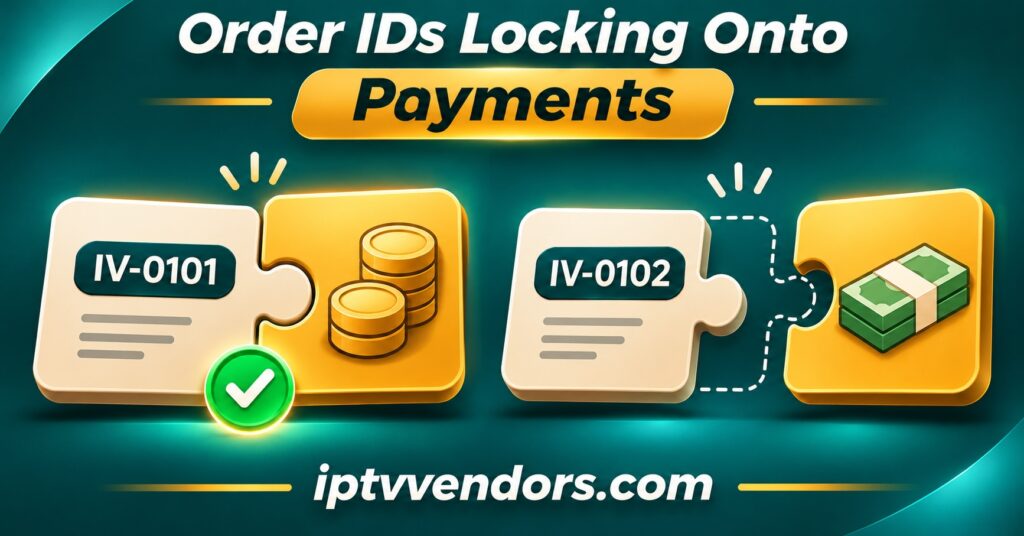
Most reconciliation pain starts at checkout, not at month end. If customers pay by UK bank transfer, the order ID has to fit through a narrow gap: Faster Payments carries a free-text reference of no more than 18 characters, and some services restrict references to letters, numbers, spaces and dashes, rejecting characters such as slashes, @ signs and ampersands.
So keep IDs short, plain and sequential. A format like IV-2611-0101 (prefix, year and month, running number) is 12 characters, survives any banking app, and sorts neatly. Avoid putting the customer’s name or email in the reference; it wastes characters and spreads personal data around bank statements.
Then make the instruction impossible to miss. Show the exact reference on the payment page, repeat it in the confirmation message, and tell customers the order cannot be activated until a payment with that reference arrives. That last line matters, because it lets you hold firm when a transfer turns up without one.
Pro tip: Put the order ID inside the panel account’s notes field when you activate it. When a payment and an activation need tying together months later, the shared ID is the bridge.
For card and wallet payments, pass the same order ID into the processor’s metadata or description field. Processor reports can then be filtered by it, which removes guesswork when one payout covers dozens of sales.
IPTV Reseller Payment Reconciliation for One Week, Line by Line
The figures below are illustrative and kept deliberately round. They are not market prices or real processor fees.
A small IPTV panel reseller sells three plans: monthly at £12, three months at £30 and annual at £90. Between 2 and 8 November 2026 the order log shows ten orders worth £330. Bank transfers and card payments both come in, and the card processor pays out once for the week.
The bank statement for the week shows six credits totalling £200.90: five customer transfers and one processor payout. The processor report breaks that payout down as three card charges of £12, £30 and £90 (£132 gross), one £90 refund and £4.10 in fees, leaving £37.90.
Matching each order against those records gives this:
| Order ID | What the money shows | Status |
|---|---|---|
| IV-2611-0101 (annual, £90) | Bank transfer £90, full reference | Matched |
| IV-2611-0102 (monthly, £12) | Bank transfer £12, reference “0102” only | Matched, partial reference noted |
| IV-2611-0103 (3 months, £30) | Bank transfer £25, correct reference | Exception: underpaid £5 |
| IV-2611-0104 (monthly, £12) | Card charge £12 inside processor payout | Matched |
| IV-2611-0105 (3 months, £30) | Card charge £30 inside processor payout | Matched |
| IV-2611-0106 (annual, £90) | Card charge £90, then refunded £90 | Exception: refunded, account still active |
| IV-2611-0107 (monthly, £12) | Bank transfer £12, reference “TV SUB” | Matched after payer name check |
| IV-2611-0108 and 0109 (monthly, £12 each) | One bank transfer £24, reference “0108 0109” | Matched as a split payment |
| IV-2611-0110 (3 months, £30) | No payment found anywhere | Exception: activated unpaid |
Now the bridge. If the records are honest, the order value minus every explained difference should land exactly on the cash received:
| Line | Amount |
|---|---|
| Order value for the week | £330.00 |
| Less refund on IV-2611-0106 | −£90.00 |
| Less processor fees | −£4.10 |
| Less shortfall on IV-2611-0103 | −£5.00 |
| Less unpaid IV-2611-0110 | −£30.00 |
| Equals money received | £200.90 |
The bridge closes to the penny, which tells you there is no unexplained money in either direction. It also tells you the week’s real problems in one glance: £35 owed by two customers and one refunded account that still has a working line. Notice that the processor fees are a cost to record, not a mismatch to chase. Recording sales at their gross value and fees as a separate expense keeps the books honest; netting fees silently against sales distorts true revenue, and many accountants recommend posting gross sales in and fees out.
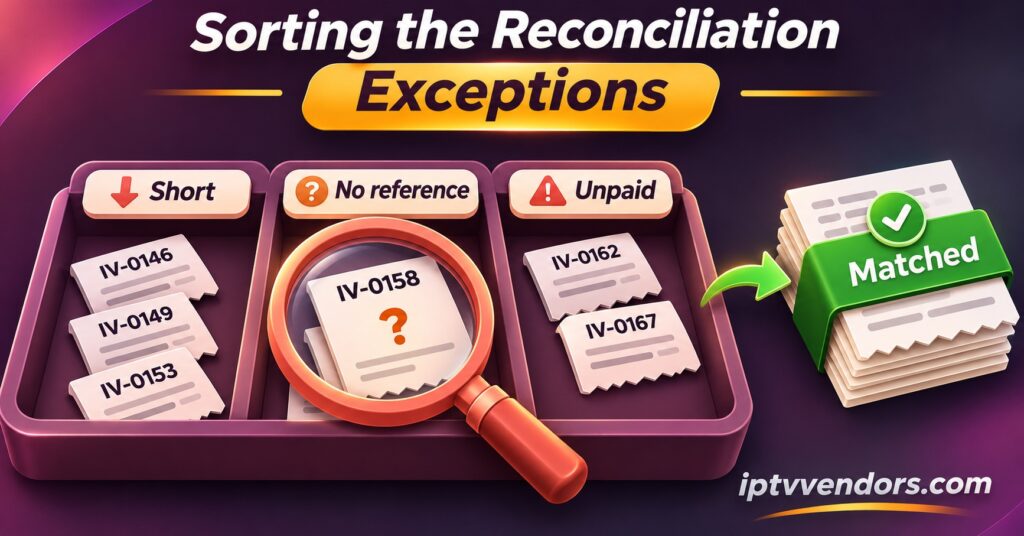
Reading the Exception Queue
Every exception needs three things written next to it: what you think happened, who is dealing with it, and the date it will be looked at again. A queue without owners just grows.
Short payments
An underpayment like IV-2611-0103 usually means the customer used an old price or misread the plan. Ask for the balance before activating, or activate a shorter term the money does cover if your terms allow it. Don’t quietly absorb small gaps; they repeat.
Money with a poor reference
Payments like IV-2611-0107 are matched on amount, date and payer name together, never on amount alone. Two £12 transfers from different people on the same day are easy to swap. If you cannot match with confidence, park the money as unallocated and contact the likeliest customers rather than guessing.
One payment, several orders (or the reverse)
A combined transfer is fine once you split it explicitly across both IDs. The opposite case, one order paid in two instalments, should stay open until the second part arrives.
Processor payouts
Card platforms rarely send one deposit per sale. A processor typically bundles many transactions, deducts its fees and sends a single net amount, so the bank line alone can never be matched to orders. The processor’s own breakdown is the record to reconcile; Stripe, for example, offers a payout reconciliation report that ties each payout to the batch of transactions it settles.
Refunds and disputes after activation
IV-2611-0106 is the most expensive kind of exception, because the customer has their money back and may still have service. The fix is operational: disable or shorten the account the same day the refund is processed, then record whether your provider returns any credits. That varies between providers, so check rather than assume.
Activations with no money
IV-2611-0110 often traces back to a trial converted in good faith, an activation done by a sub-reseller, or a team member trusting a “paid” screenshot. Screenshots are not payments. A firm rule that nothing is activated until money appears in the real statement removes most of these.
Tying Credits Back to the Money
The money side can balance perfectly while credits still leak. So the final cross-check runs through the panel.
Count the activations and renewals in the panel log for the week, and convert them into credits using your provider’s credit rules. That figure should equal the credits needed for the orders in your log. In the example, ten orders mean ten activations; if the panel shows eleven, someone created an account with no order behind it, and that is a bigger question than a missing £12.
Then compare the panel’s closing credit balance with your expectation: last week’s balance, plus credits purchased, minus credits used. A gap points to trials nobody recorded, test accounts left running, or sub-reseller allocations that never reached the books. Keeping a clean subscription workflow from order to activation makes this check much shorter, because every activation is born with an order ID already attached.
Bear in mind what this exercise can’t tell you. Reconciliation proves that money and service records agree; it says nothing about whether the upstream provider holds proper distribution rights for the content it delivers. That still needs its own due diligence before you choose a provider or one of its IPTV reseller plans.
The Weekly Reconciliation Run, Step by Step
Pick a fixed day and do the steps in this order, because each one depends on the last.
- Close the order log for the period so no rows change while you work.
- Export the bank statement and the processor payout report for exactly the same dates.
- Match bank transfers to order IDs, starting with full references, then partial references, then amount, date and payer name together.
- Open each processor payout and match its individual charges, refunds and fees to orders.
- Record processor fees as an expense, not as a short payment.
- Build the bridge from order value to money received and make sure it closes exactly.
- Log every exception with a cause, an owner and a review date.
- Disable or shorten any account linked to a refund or chargeback.
- Compare panel activations and credit balance against the order log.
- Carry unresolved exceptions forward as the first lines of next week’s run.
Keeping the Evidence Without Hoarding Data
Reconciliation records are accounting records, so keep them properly. For UK limited companies, company and accounting records must be kept for at least six years from the end of the last financial year they relate to, and sole traders have their own rules, so confirm the period that applies to you with an accountant.
Keep what proves the match: order ID, plan, amount, date, payment method, the payment’s transaction reference and the activation date. Do not copy card numbers or full bank details into spreadsheets or chat threads. The processor and bank already hold that, and your records only need the reference that points to it.
Questions Resellers Ask About Payment Reconciliation
How often should a small reseller reconcile payments?
Weekly suits most small operations. Daily is worth it if you activate many bank-transfer orders, because an unpaid activation caught the next morning is far easier to recover than one found a month later.
Can I match payments on amount alone?
Only when nothing else on that day shares the amount, and even then add the payer name as a second check. Plans with identical prices make amount-only matching unreliable very quickly.
What should I do with money I can’t match to any order?
Hold it as unallocated, don’t activate anything against it, and contact the customers most likely to have sent it. If it remains unclaimed, take advice before treating it as income or returning it.
Should sub-reseller activations go through the same process?
Yes. Their activations consume your credits, so each one needs an order or an internal transfer record behind it. Otherwise the credit check will never balance.
Does a refund always return the panel credits used?
No. Some providers return credits within a set window and others don’t return them at all. Read your provider’s terms and record the outcome for each refund.
Closing the Week With Nothing Unexplained
IPTV Reseller Payment Reconciliation isn’t finished when most lines match; it’s finished when every remaining difference has a name. Short, plain order IDs make the matching fast, the bridge from order value to cash proves nothing has slipped through, and the panel check catches the quieter problem of service handed over without payment. Start by changing your payment reference format to something under 18 characters, then run this week’s bridge and see what is left in the exception queue.