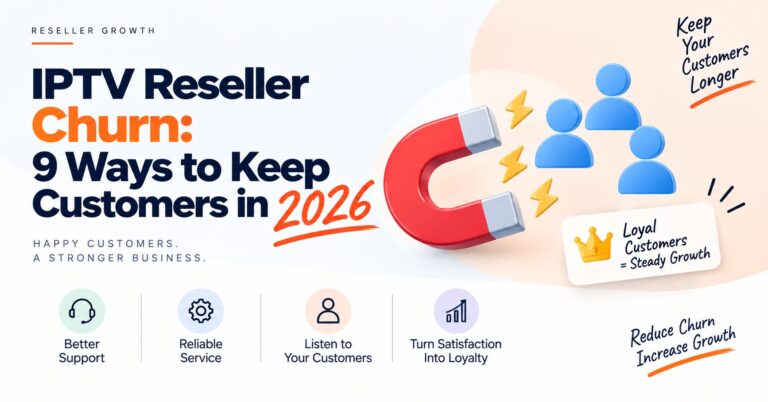

IPTV Reseller KPIs fall into three groups: what each credit earns you, whether customers stay, and how much support each line costs you. Twelve numbers cover all three, and none of them needs more than a spreadsheet and your panel’s account list.
Before you track anything, fix the definitions. Decide what counts as an active line, keep trials separate from paying customers, and always measure from the same source on the same day each month. A KPI that changes meaning halfway through the year is worse than having no KPI, because it makes a bad month look like a good one.
Why “credits sold” is a poor scoreboard
Most UK IPTV panel resellers start by watching how many credits they buy or how many accounts they have created. Both numbers only ever go up, which is exactly why they mislead. An account created two years ago and never renewed still sits in the total.
The better question is what happened to the lines you already have. Did they renew, did they cost you support time, and did each one leave you with money after credit cost and payment fees? The twelve KPIs below answer those questions, grouped by the decision each one informs.
Money KPIs: what each credit really earns
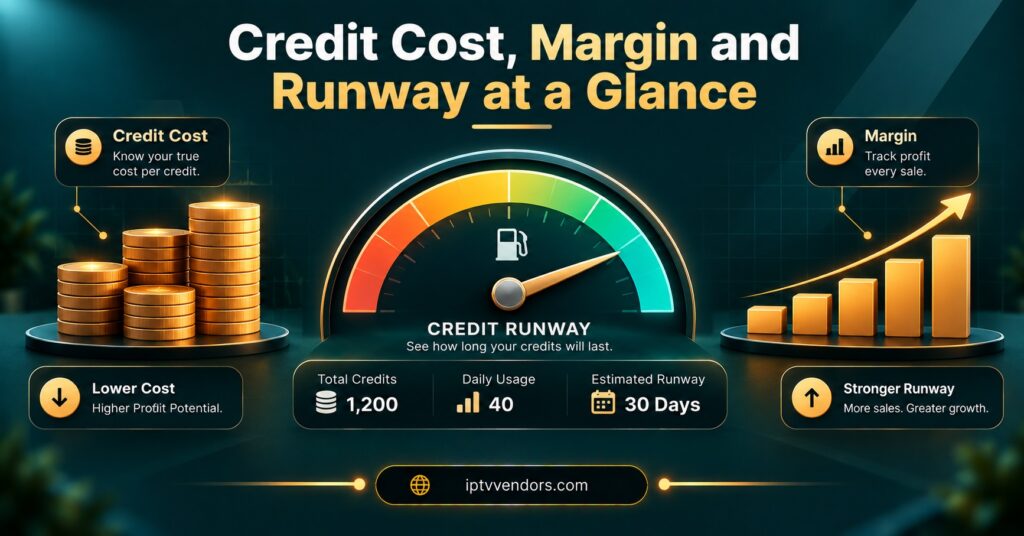
1. Effective credit cost per month
Divide your total spend on credits by the total months of service those credits deliver. If a bundle includes bonus credits or a volume discount, the effective cost is lower than the headline rate, and that lower figure is the one that belongs in your margin sums. Recalculate whenever you top up, because your cost changes as your order size changes.
2. Gross margin per line
Take the monthly price the customer actually pays, then subtract effective credit cost and any payment processing fee. Express it as both an amount and a percentage. IPTV Resellers who only look at the percentage can miss that a cheap, low-margin line still consumes the same support time as a better one.
3. Monthly recurring revenue
Add up the monthly-equivalent value of every paid line that is currently active. A customer on a twelve-month term should be counted as one-twelfth of that payment each month, otherwise one big annual payment makes a single month look unusually strong. Track this figure as a trend rather than a single reading.
4. Credit runway
Compare your current credit balance with the number of credits you normally use in a month. The result is roughly how many months you can operate before you must buy more. Running out unexpectedly is one of the more avoidable operational failures, and watching runway also shows when a bulk purchase would genuinely pay off versus when it would just tie up cash.
Credits that never expire do not remove the need for this number. They only mean an over-purchase is a cash-flow decision rather than a wastage problem.
Customer KPIs: who stays and who drifts away
5. Active paid lines
Count only lines that are currently paid up. Report trial lines separately and never merge them into this total. If you sell multi-connection plans, also record how many lines are single-screen and how many are multi-screen, since they behave differently in the figures that follow.
6. Trial to paid conversion
Divide the number of trials that became paying customers by the number of trials issued in the same period. Where you can, measure from the date the trial was issued rather than the date you happened to review it. A weak conversion rate usually points to setup friction or a poor first-day experience rather than a pricing problem, so check the onboarding path before you cut your price.
7. Renewal rate
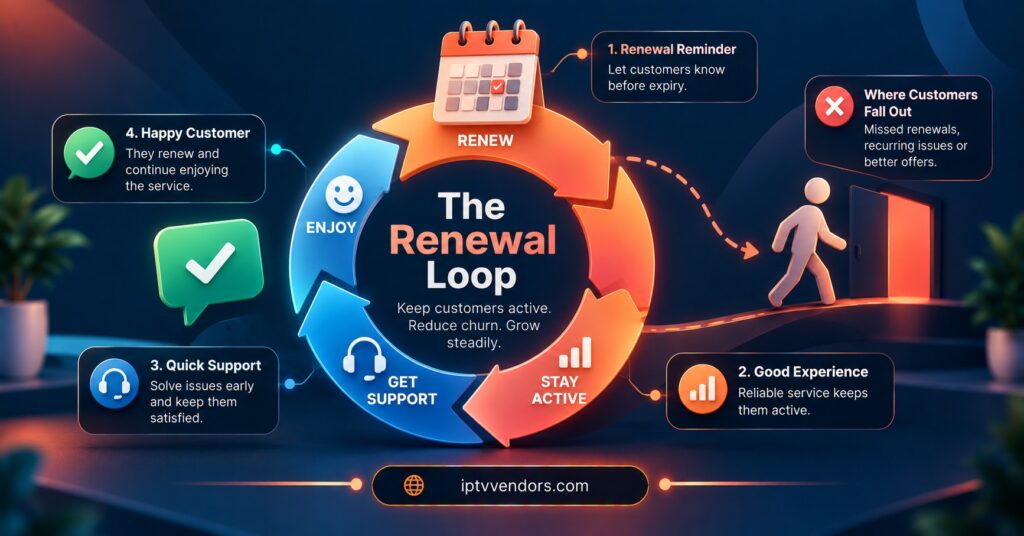
Of the lines that came up for renewal this month, how many renewed? Use only lines that were actually due, not your whole customer base. This is the single most useful retention number for a IPTV subscription reseller because it shows the result of every earlier decision about service quality, support and price.
8. Churn, split by cause
Churn is lines lost divided by lines at the start of the period, but the total is not very useful on its own. Split it into customers who chose to leave and customers whose payment simply failed or lapsed. The first group tells you about service and value. The second tells you about reminders and payment friction, which is usually easier to fix.
9. Revenue per customer
Divide monthly recurring revenue by the number of paying customers, not lines. If one household holds two lines, that is one customer. A rising figure suggests customers are adding connections or moving to longer terms. A falling figure with stable customer numbers suggests discounting is creeping in.
Service KPIs: what each line costs you in effort
10. Support contacts per 100 active lines
Counting raw tickets rewards you for having a small base and punishes you for growing. Normalising per 100 active lines lets you compare this month with last month fairly. When the number climbs, look at what changed: a new app recommendation, a batch of new customers, or a change at the provider side.
11. First response time and resolution time
Record two separate times. First response is how long a customer waits to hear anything. Resolution is how long until the problem is actually fixed. Customers tolerate a slow fix much better than silence, so a good first response time can protect renewals even when the underlying issue takes longer.
12. Repeat contact rate
Out of the customers who contacted you this month, how many contacted you about the same problem again within a short window? A high repeat rate means your fixes are not holding or your instructions are unclear. It is one of the earlier warnings of future churn, which is why it sits alongside the retention numbers rather than in a separate support report.
Recording these without a data team
A single spreadsheet with one row per month is enough. Add columns for each KPI, plus a notes column where you write down anything unusual, such as a price change, a provider outage or a promotion. Those notes are what make the numbers readable six months later.
Check what your panel actually exports before you build anything. Dashboards differ in whether they show expiry dates, creation dates, credit history or activity logs, and you should not assume a particular report exists. If you need a refresher on how panels and credit systems are usually laid out, the IPTV panel and reseller options at iptvvendors.com page is a reasonable place to compare what different setups offer.
Keep your own notes on content and rights too. IPTV is a delivery technology, and whether any service is lawful depends on the rights, permissions and local rules attached to the content being delivered. KPIs measure how a business runs. They do not show that it is permitted to operate.
Which IPTV Reseller KPIs to watch at each stage
You do not need all twelve from day one. A new reseller with a handful of customers will learn more from a few numbers than from a full dashboard.
| Stage of business | Numbers to prioritise | Why |
|---|---|---|
| First customers | Effective credit cost, gross margin per line, trial to paid conversion | You are still testing whether the model pays and whether onboarding works |
| Steady base | Renewal rate, churn split by cause, support contacts per 100 lines | Retention now matters more than acquisition |
| Growing or using sub-resellers | Credit runway, revenue per customer, repeat contact rate, resolution time | Stock and support load start to limit how fast you can grow |
Pro tip: Review the numbers on the same date every month, ideally just after your busiest renewal week, so each reading is comparable with the last.
Pro tip: When a figure moves sharply, change one thing at a time before drawing conclusions. If you alter price, app recommendation and reminder timing together, you will not know which one caused the shift.
Where these numbers can mislead you
A strong gross margin can sit alongside weak retention, and the reverse is also true. Cheap credits do not help if a third of your customers leave after two months. Likewise, a good renewal rate on a very small base can swing widely from a single customer. Treat each KPI as a prompt to look closer, not as a verdict.
Also avoid comparing your figures with numbers quoted in sales pages or forum posts. Those rarely share your definitions, your customer mix or your pricing.
Conclusion
IPTV Reseller KPIs are only useful if they change what you do next month. Start with credit cost, margin per line and renewal rate, write down your definitions, and add the support and retention measures once the first three feel routine. Then revisit your spreadsheet after one full renewal cycle and decide which two numbers deserve the most attention in the following quarter.
Note: the fetch for iptvvendors.com redirected to itpanels.co.uk, so I could not verify any inner pages on iptvvendors.com. I used the verified homepage once with a descriptive anchor. If you share live iptvvendors.com article URLs, I will swap in two or three relevant internal links.