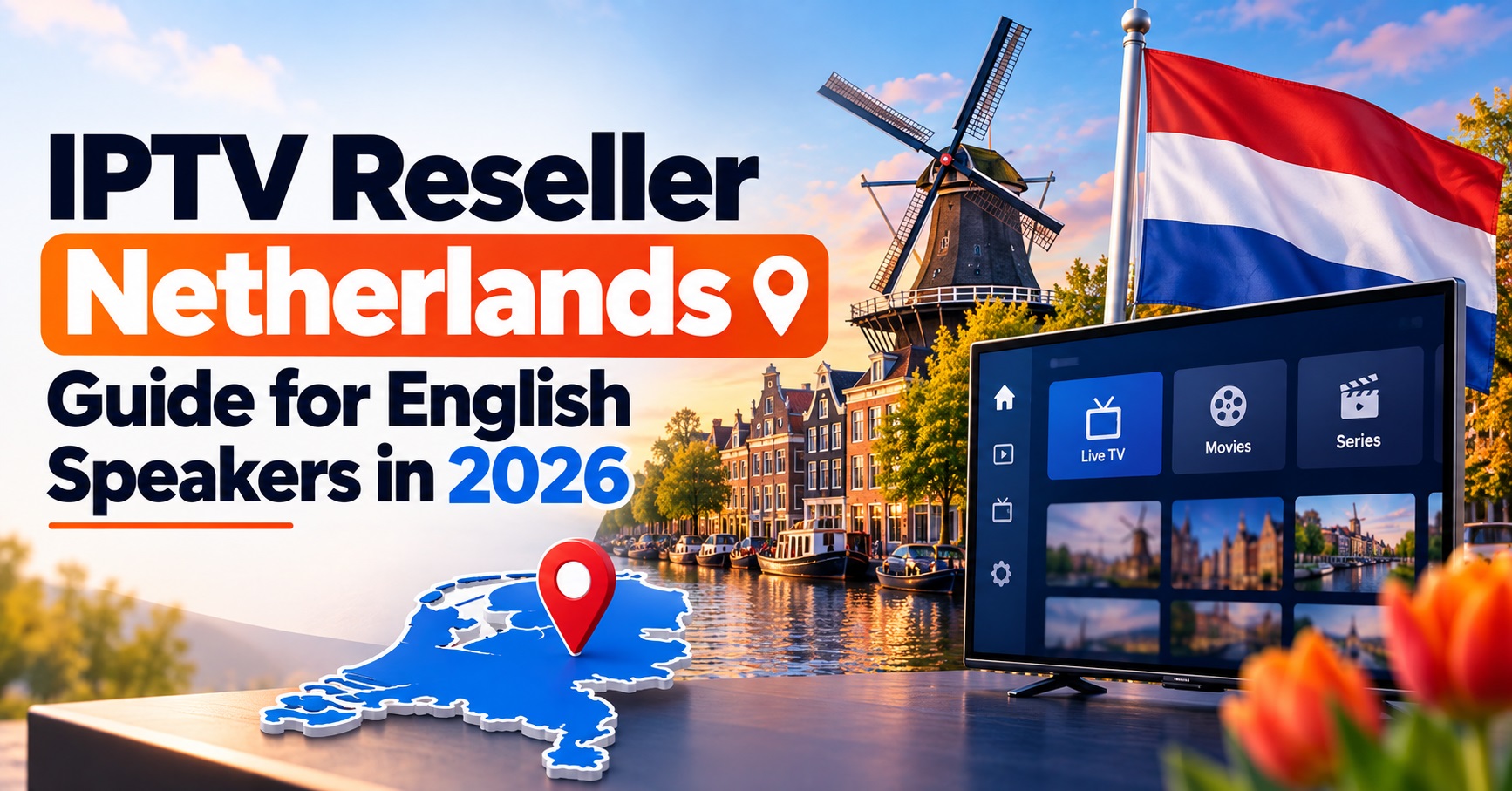

Running an IPTV Reseller Netherlands operation is entirely possible in 2026, and the dashboard side is no harder than in the UK or anywhere else in Europe. What catches people out is that the Netherlands is one of the most actively policed IPTV markets on the continent, so the supplier you choose and the paperwork behind their service matter far more than the price per credit.
Before you spend anything, ask one question and insist on a straight answer: what is this provider authorised to distribute, and can they show it? If that conversation goes vague, nothing else about the offer is worth comparing. The rest of this page covers what Dutch customers expect at checkout, how VAT works when you sell from outside the country, and how to size your first credit order without tying up money you cannot recover.
Why the Netherlands Is Not Just Another Region on the Panel
Plenty of reseller dashboards list the Netherlands as a region you can tick, the same way you would tick Germany or Portugal. Operationally that is fair. Legally and commercially, it is a different environment.
The Dutch anti-piracy foundation BREIN has spent years pursuing IPTV sellers, and it has become more systematic rather than less. At the end of February 2026 it had 15 IPTV websites taken offline in a single action after noticing that the same hosting company kept turning up behind them, and it also obtained details from that host identifying the people running the sites, which lets it go after them directly. That last point is the one IPTV panel resellers should read twice. Enforcement no longer stops at a takedown notice.
Courts have backed this up. In one case heard in Breda, the seller was ordered to cover all costs and faced penalty payments of up to €75,000. There is also a 2017 ruling from the Court of Justice of the European Union, which BREIN regularly cites, establishing that streaming from an unlawful source is not protected simply because the viewer never downloads a file.
None of this makes IPTV itself a problem. IPTV is a delivery method, and licensed operators in the Netherlands use it every day to deliver television over fibre and broadband. The legal question always comes back to rights: whether the content passing through the panel is authorised for distribution to Dutch customers. As a reseller, you are the name on the website and the person taking the payment, so you inherit whatever the supplier gets wrong.
Running an IPTV Reseller Netherlands Operation Starts With the Supplier’s Paperwork
Most reseller guides tell you to compare server stability, trial periods and credit prices. Those things matter, but in this market they come second. If your supplier cannot account for its content sources, stable servers only mean a stable route to a legal problem.
Here is how the early conversation with a potential supplier tends to separate the serious operators from the rest.
| What to ask the supplier | An answer that should worry you |
|---|---|
| Which content in the package is licensed for distribution in the Netherlands? | “Everything is fine, all our resellers sell it” |
| Is there a registered company behind the panel, and where? | No company name, or only a messaging handle |
| Will you give me written terms covering refunds and credit expiry? | Terms exist “only on request” or not at all |
| How do you notify resellers about maintenance or source changes? | “You’ll see it when customers tell you” |
| Can I invoice my customers under my own business name? | Advice to avoid invoices or keep things informal |
Two things are worth saying plainly. First, a polished website is not evidence of anything. Neither is a familiar payment method. Both are easy to set up and say nothing about what the supplier is allowed to distribute. Second, a supplier who is honest about limitations (fewer live sources, a narrower catalogue, clear regional restrictions) is usually a safer bet than one promising everything for very little.
Pro tip: Save every written answer a supplier gives you, including chat messages, in one folder before you buy credits. If you ever need to show that you checked, a dated record of the questions you asked is far more useful than a memory of a phone call.
The Dutch Customer Expects Different Things at Checkout
If you have sold subscriptions in the UK, some of your habits will not carry across.
Payment is the obvious one. iDEAL, the bank-linked payment method, is the default way most Dutch shoppers pay online. Checkouts that only offer card payments or ask customers to send money through unusual routes tend to lose people at the last step, and an insistence on untraceable payment methods reads as a warning sign to informed Dutch buyers rather than a convenience.
Prices need to be shown including VAT. Dutch consumers expect the figure they see to be the figure they pay, and consumer protection rules support that expectation. A price that grows at checkout is a quick way to collect complaints.
Then there is the 14-day right of withdrawal that applies across the EU to distance sales. For digital services that start immediately, the rules allow that right to be lost, but only if the customer has expressly agreed to immediate performance and acknowledged that they lose the right. That usually means a clear tick box at checkout and a confirmation email. Skipping this step leaves you exposed to refund claims you may not have planned for.
Language is the softer point but still worth thinking through. Many Dutch customers are comfortable in English, yet support questions about billing or account access often arrive in Dutch, particularly from older subscribers. If your supplier offers Dutch-language escalation support, that removes a real bottleneck. IPTV Vendors, for example, lists Dutch among its support languages on its page about wholesale IPTV reseller panels and multilingual support.
Registering, Invoicing and Handling Customer Data
Where you are based changes the admin, so it helps to separate the two common situations.
If you live in the Netherlands, trading as a business generally means registering with the Chamber of Commerce (KVK), which also sets you up for VAT. The standard Dutch VAT rate is 21 percent, and subscription services sold to consumers normally fall under it.
If you are based outside the EU, including in the UK, and you sell digital services to consumers in the Netherlands, VAT is still due at the Dutch rate because these services are taxed where the customer lives. The EU’s One Stop Shop scheme exists so that non-EU sellers can register once and report VAT across member states rather than registering country by country. The thresholds and filing details change, so confirm your position with an accountant who handles EU digital services before you launch rather than after your first quarter.
Customer data is the other obligation that follows you into the Dutch market. Names, email addresses, device details and payment records all fall under the GDPR, which is enforced in the Netherlands by the Dutch Data Protection Authority. Practically, that means keeping only what you need, storing it securely, having a short privacy notice on your site, and knowing what you would do if a customer asked for their data to be deleted. Recent Dutch enforcement cases have shown how customer records held by a questionable operator can end up in other hands, which is a reminder that the data you collect is a responsibility, not an asset you can treat casually.
Where the Panel Itself Makes a Difference
Once the legal and commercial footing is sorted, the technical questions become the familiar ones, with a few Dutch specifics.
Fibre and fast broadband are widespread in the Netherlands, so many customers will have enough bandwidth that buffering complaints point to the service rather than their connection. That cuts both ways. You get fewer “my internet is slow” cases, but when problems do happen, customers are quicker to blame you. Ask where the supplier routes Dutch traffic. Servers in or near Western European data centres generally give shorter routes than a node chosen simply because it had spare capacity.
Evening load is the real test. A panel that performs well at lunchtime on a trial account tells you little about peak hours on a weeknight. If a trial is available, use it between roughly 8pm and 11pm local time across a few different days before judging.
The device mix will look similar to other Western European markets: smart TVs with native app stores, Android boxes, streaming sticks and phones. Each needs its own setup steps, and inconsistent instructions generate most first-week support tickets. A written step-by-step IPTV installation guide covering each device type is worth preparing before your first sale, ideally with a Dutch version for the platforms your customers use most.
Finally, set expectations about delay on live streams. Streaming protocols deliver video in segments, so live content will always run a little behind a traditional broadcast signal. Saying so in your welcome message heads off a common complaint, and the approach is covered in more detail in this guide to managing IPTV subscriptions and customer expectations.

Credits, Margins and the Size of Your First Order
Wholesale credit systems are straightforward: you buy credits from the supplier, convert them into customer subscriptions inside the panel, and set your own retail price. The mistake new resellers make in any market, and especially in a new one, is buying a large batch to get a better unit price before they know how quickly they can sell.
Check three things before committing. Whether credits expire, and after how long. Whether unused credits are refundable if the supplier changes its terms or you decide to stop. And how credits move to sub-resellers if you plan to build a small network later. This overview of how IPTV reseller panel credits work across main and sub-accounts explains the mechanics well.
On margins, resist the urge to compete purely on price. The Dutch market has no shortage of very cheap offers, and informed buyers increasingly read a suspiciously low price as a sign of an unlicensed service. A fair price backed by proper invoices, clear terms and reliable support is easier to defend and attracts customers who stay longer.
Pro tip: Start with the smallest credit pack that still covers your first month of expected sales plus a few spares for replacements. Reorder when you have real sales data rather than guessing at demand in a market you have not sold into yet.
Signs an Offer Will Cause You Trouble in the Netherlands
Some warning signs are general to IPTV reselling, but a few carry more weight in a market where enforcement is active and customers are well informed.
Be cautious if the supplier markets its service mainly by listing branded content rather than describing its infrastructure and terms. Be cautious if you are advised to advertise only through private channels, avoid using a business name, or steer customers away from traceable payments. Be cautious if there is no written refund policy, no company details, and no way to reach anyone other than a single messaging account. And be cautious if a supplier seems unconcerned about the legal side when you raise it. Suppliers who have thought about compliance usually welcome the question.
Positive signs look almost boring by comparison: a registered company, written terms, advance notice of maintenance, honest statements about what the service does and does not include, and willingness to answer questions in writing.
Questions English-Speaking Resellers Often Ask
Do I need to live in the Netherlands to sell to Dutch customers?
No. You can sell from the UK or elsewhere, but Dutch consumer rules and VAT still apply to your sales, and enforcement bodies can pursue sellers outside the country when their customers are Dutch.
Is English-only support enough?
It can work for a small customer base, particularly expats. As you grow, billing and account questions in Dutch become more common, so Dutch-language escalation from your supplier or a Dutch-speaking team member saves time.
Can I use the same website I use for UK customers?
You can, but add Dutch-specific details: prices including Dutch VAT, a clear withdrawal-right consent at checkout, a privacy notice, and ideally iDEAL as a payment option.
Does a free trial prove a service is reliable?
Only partly. A trial shows the setup process and basic performance. Test it during peak evening hours on several days, and remember that a trial says nothing about whether the content is properly licensed.
How much should I charge Dutch subscribers?
There is no fixed answer. Price according to your supplier cost, VAT, payment fees and the support time you expect to spend, rather than trying to match the cheapest offers you see advertised.
Where This Leaves You
An IPTV Reseller Netherlands business is realistic in 2026, and the panel, credits and device setup will feel familiar to anyone who has resold elsewhere. The difference is that the Dutch market rewards resellers who get the unglamorous parts right: a supplier who can account for its content, prices shown with VAT, proper withdrawal consent, careful handling of customer data, and a support process that can cope with Dutch-speaking customers. The limitation worth accepting early is that no dashboard feature compensates for a supplier with unclear rights. Your sensible next step is to shortlist two or three suppliers, put the questions from the table above to each of them in writing, and only then compare credit prices.
Reseller Checklist Before Your First Dutch Sale
- Written answers from your supplier about content authorisation and company details
- Credit expiry, refund and sub-reseller terms confirmed in writing
- VAT position checked with an accountant, including the One Stop Shop if you are based outside the EU
- Prices on your site shown including Dutch VAT
- Checkout includes clear consent for immediate service start and withdrawal-right acknowledgement
- Privacy notice published and a plan for handling data deletion requests
- Device setup guides written, with Dutch versions for the most common platforms
- Trial tested during peak evening hours on several different days
- First credit order sized to one month of realistic sales