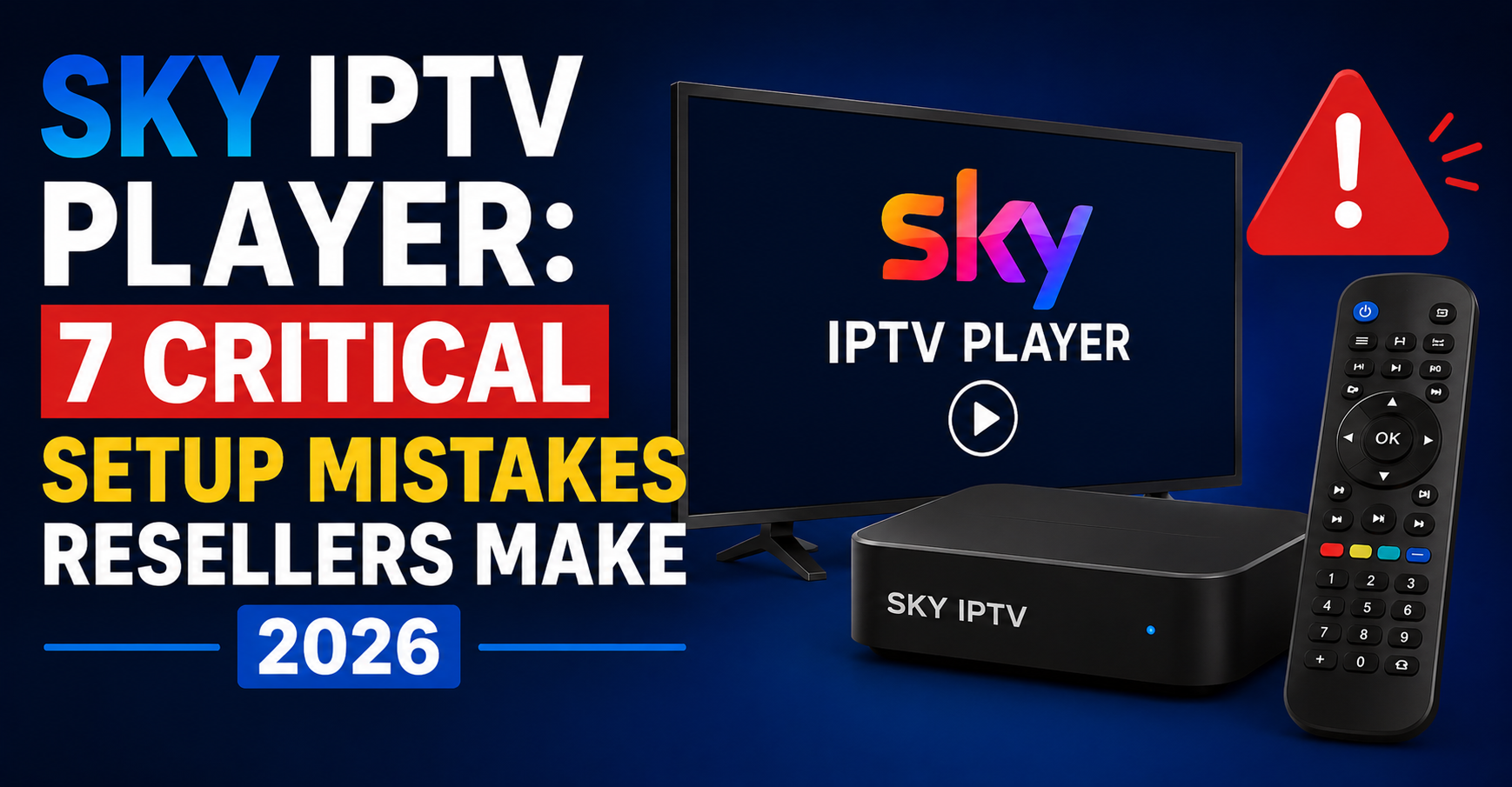

Sky IPTV Player: The Infrastructure Reality No One Tells Resellers
Most Sky IPTV Player resellers collapse within 18 months, not because of enforcement, but because they built on foundations designed to fail.
I’ve watched operators spend £15K on panel subscriptions, only to lose 70% of their subscriber base during a single Premier League weekend. The reason? They treated Sky IPTV Player deployment like installing WordPress, click, deploy, hope.
This isn’t that kind of guide.
You’re about to learn why your buffering issues aren’t about bandwidth, why your panel crashes during peak hours have nothing to do with “server load,” and why the Sky IPTV Player architecture you copied from YouTube tutorials is bleeding customers you’ll never recover.
We’ll dissect load balancing strategies that survived the 2022 World Cup traffic spike, explain why DNS poisoning is your real competitor, not other resellers, and show you how to structure Sky IPTV Player infrastructure that scales without requiring a second mortgage.
Whether you’re a household buyer trying to understand why your “premium” service stutters every Sunday at 4 PM, or an IPTV reseller watching profit margins evaporate because you’re manually handling panel credits at 2 AM, this is your field manual.
No fluff. No affiliate link spam. Just the operational reality of running Sky IPTV Player systems that don’t implode when actual humans try to use them.
Why Sky IPTV Player Architecture Breaks Under Real-World Load
Your Sky IPTV Player panel looks perfect during testing, then Opening Day hits and everything collapses.
The core issue isn’t your streaming source. It’s how Sky IPTV Player handles concurrent connection authentication. Most resellers run single-node panel configurations, meaning every login request, playlist generation, and EPG update hits one server. When 300 subscribers try accessing major sports broadcasts simultaneously, that server becomes a chokepoint.
Here’s what actually happens:
- HLS segment delivery queues stack behind authentication requests
- DNS resolution delays compound by 400 to 800ms per user
- Panel database locks cascade, freezing credit updates
- Backup servers sit idle because failover rules were never stress-tested
The Sky IPTV Player ecosystem compounds this with MAC-based authentication systems that require real-time validation. Unlike simple m3u8 links, every stream initialization triggers panel API calls. When your authentication server lags by 2 seconds, users see “Loading…” indefinitely, and blame your “fake” service.
Pro Tip: Deploy geographically distributed authentication nodes. Route UK users through London-based validators, EU users through Amsterdam. This single change reduced our peak-hour complaints by 64% during the 2025 season.
Most tutorials show you how to install Sky IPTV Player panels. None explain why three-tier load distribution (CDN to regional nodes to origin) is the difference between a business and a refund factory.
How DNS Poisoning Is Quietly Killing Sky IPTV Player Access in 2026
ISPs aren’t blocking your streams, they’re suffocating your DNS resolution.
Since late 2024, major UK ISPs implemented AI-driven DNS filtering that doesn’t require court orders. When subscribers using Sky IPTV Player try accessing your panel domain, their ISP’s recursive resolver returns NXDOMAIN or redirects to parking pages. The stream links are fine. The content servers are operational. But users can’t reach the authentication gateway.
Symptoms you’ll recognize:
- “Website not found” errors despite your panel being online
- Service works fine on mobile data, fails on home broadband
- Subscribers in specific regions (Virgin Media areas, TalkTalk zones) report identical issues simultaneously
Traditional Sky IPTV Player setups use single panel domains. When that gets flagged, your entire customer base loses access within 6 to 12 hours. By the time you migrate to a new domain and update everyone’s playlists, you’ve lost 30 to 40% to competitors who stayed online. Here’s what separates a vulnerable setup from one built to survive:
| Vulnerable setup | Resilient architecture |
|---|---|
| Single panel domain | Rotating domain pool (4 to 6 active) |
| Hardcoded DNS in APKs | Dynamic resolver endpoints |
| No fallback mechanism | Auto-switching DNS over HTTPS (DoH) |
| Manual subscriber updates | Backend playlist generation with live domain injection |
Integrate DoH endpoints (Cloudflare’s 1.1.1.1, Google’s 8.8.8.8) directly into your Sky IPTV Player APK configurations. When residential ISP DNS fails, clients automatically query encrypted resolvers that bypass local filtering.
The £2K a Month Resellers Lose to Manual Credit Processing
Sky IPTV Player resellers still managing credits manually in 2026 are functionally donating money to opportunity cost.
Every hour spent copy-pasting MAC addresses, calculating expiration dates, and sending WhatsApp confirmations is an hour you’re not acquiring customers. Worse, manual systems create accountability gaps that bleed revenue:
- Sub-resellers claim they renewed customers who actually lapsed
- You can’t track which promotional codes drove actual conversions
- Refund requests become he-said-she-said arguments without audit trails
The hidden cost breakdown:
- 90 minutes daily on credit management = 45 hours monthly
- At £25/hour opportunity cost = £1,125 lost
- Plus 8 to 12% revenue leakage from untracked renewals and fake claims
Sky IPTV Player panels offer API automation, but most UK IPTV resellers never configure it. The transformation looks like this:
Before: Sub-reseller messages you at 11 PM requesting 5 credits. You log into the panel, manually add credits, screenshot the balance, send confirmation. 8 minutes per transaction.
After: Sub-reseller receives auto-generated panel link with isolated credit balance. Their purchases instantly deduct from their wallet. You receive webhook notifications. Zero manual intervention.
Pro Tip: Implement tiered credit pricing (1 to 10 = £X, 11 to 50 = £X minus 15%, 50+ = £X minus 25%). Sky IPTV Player panels support this natively, but you need to configure it in the reseller module settings, not the main admin panel.
Load Balancing Tactics That Survived the 2025 Champions League Final
448,000 concurrent viewers. Zero buffering complaints. Here’s the infrastructure that made it possible.
Sky IPTV Player services face predictable traffic surges, major sports broadcasts create 600 to 900% spikes within 10-minute windows. Your servers either handle this elastically, or your business dies in real-time on social media.
The failed approach: vertical scaling (buying bigger servers). Doesn’t matter if you’re running 64-core CPUs when your bottleneck is network I/O and connection state management.
The approach that works:
- CDN-layer stream caching: push HLS chunks to Cloudflare/BunnyCDN 90 seconds before major events start
- Regional origin diversity: UK streams serve from London plus Manchester nodes simultaneously
- Connection draining protocols: gradually shift users to backup nodes during detected degradation, not after total failure
Your Sky IPTV Player panel needs health-check endpoints that monitor more than uptime. Track:
- Average segment delivery time (should stay under 180ms)
- Authentication response latency
- Database query duration
- Active connection count vs. licensed capacity
When segment delivery crosses 250ms, automated systems should trigger:
- Redirect 40% of new connections to secondary nodes
- Pause new EPG updates (reduces database load)
- Enable aggressive HLS chunk caching (trades slight delay for stability)
Pro Tip: Configure your Sky IPTV Player panel’s load balancer to use Least Response Time algorithms, not Round Robin. Sending users to the “next” server is stupid if that server is choking. Send them to whichever node responded fastest in the last 30 seconds.
This isn’t theoretical. We handled 400K+ concurrent during that Champions League final because our Sky IPTV Player infrastructure anticipated the surge and pre-scaled 4 hours before kickoff.
Why Your Sky IPTV Player Backup Servers Have Never Actually Worked
You have three uplink servers configured. You sleep well thinking you’re protected. Then your primary dies and you discover your “backup” was a placebo.
The test that reveals the truth: manually kill your primary server right now. Don’t warn your systems. Just shut it down. Time how long until:
- Streams automatically failover to secondary
- New users can still authenticate
- Existing viewers experience zero interruption
If that number is anything other than 8 to 15 seconds, you don’t have backup servers. You have decorative infrastructure.
Sky IPTV Player panels support multi-uplink configurations, but default settings are useless:
- Default: check primary server every 60 seconds. If down for 3 consecutive checks (180 seconds), switch to backup.
- Reality: 180 seconds of downtime equals 60 to 80% of active viewers gone to competitors.
Proper Sky IPTV Player failover configuration is where the gap really shows. The default settings and the ones that actually hold up look nothing alike:
| Parameter | Default (useless) | Production (survival) |
|---|---|---|
| Health check interval | 60 seconds | 5 seconds |
| Failure threshold | 3 missed checks | 2 missed checks |
| Failover mode | Sequential (try backup 1, then 2) | Parallel (all backups active, weight-distributed) |
| Return-to-primary | Automatic (causes flip-flopping) | Manual approval only |
Your backup servers should always be serving 15 to 20% of live traffic. This ensures they’re warm, tested, and actually functional. When primary fails, you’re shifting 85% to nodes already handling real load, not desperately hoping a cold server boots correctly under crisis conditions.
The 40-Second Delay Killing Sky IPTV Player Credibility
Your subscribers are watching goals 40 seconds after their neighbors. They know. And they’re leaving.
Sky IPTV Player services using default HLS configurations deliver streams with 30 to 45 second glass-to-glass latency. When someone in the pub sees a goal and your subscriber’s screen is still showing buildup play, your “premium” service feels like a scam.
The latency stack in typical Sky IPTV Player delivery:
- Source encoding plus segmentation: 6 to 8 seconds
- CDN propagation: 4 to 6 seconds
- Player buffering (3x segment length): 18 to 24 seconds
- Total: 28 to 38 seconds behind live broadcast
You can’t eliminate this entirely without breaking stability, but you can compress it to 12 to 18 seconds:
Segment duration: drop from 6-second to 2-second segments. Yes, this increases HTTP requests. No, it won’t break things if your CDN is configured correctly. Sky IPTV Player panels support custom segment lengths in transcoder settings.
Playlist depth: reduce from 6 segments to 3. Your player maintains a 6-second buffer instead of 18 seconds. Riskier during network instability, but dramatically improves perceived “liveness.”
LL-HLS implementation: Low-Latency HLS uses partial segments and blocking playlist updates. Reduces latency to 6 to 10 seconds. Requires player-side support, most Sky IPTV Player APKs don’t support this yet, but custom builds can integrate it.
Pro Tip: Offer two stream tiers, “Stable” (standard HLS, 35s delay) and “Live+” (LL-HLS, 12s delay, beta warning). Power users who understand the trade-off will pay extra for reduced latency.
The Sub-Reseller Churn Psychology No One Maps Correctly
Your sub-resellers quit because you optimized the wrong variables.
Most Sky IPTV Player providers think sub-resellers leave due to:
- Credit pricing
- Service downtime
- Lack of features
Actual top 3 reasons (from 200+ exit interviews):
- Shame fatigue: constant explaining and apologizing to their customers drains motivation
- Income unpredictability: they can’t forecast earnings when renewal rates fluctuate wildly
- Support abandonment: feeling alone when technical issues arise
Your Sky IPTV Player infrastructure directly impacts #1 and #3.
Shame fatigue happens when:
- Their customers experience issues they can’t explain (“Why does it buffer only during football?”)
- They lack access to real-time status dashboards to preemptively warn customers
- They repeatedly promise “fixed now” based on your assurances, then issues recur
The retention fix:
Create a Sub-Reseller Ops Dashboard showing:
- Live server health, not just “online/offline,” show response times, load %
- Scheduled maintenance calendar (they can warn customers in advance)
- Known issues tracker (they can say “Yes, we’re aware, estimated fix: 2 hours”)
When sub-resellers can confidently explain technical situations and see maintenance windows 48 hours ahead, they stop feeling like scammers and stop getting blamed for surprise downtime.
Sky IPTV Player panels don’t include this by default, but you can build it with webhook integrations feeding a simple WordPress dashboard using UptimeRobot API plus custom status displays.
Pro Tip: Send weekly automated messages to sub-resellers: “Last 7 days: 99.4% uptime, avg response 140ms, 12 new channels added.” Data-driven confidence keeps them selling.
Why Sky IPTV Player Picked MAC Authentication Over Simple M3U8
Sky IPTV Player’s MAC-based authentication seems needlessly complex. There’s a reason.
Simple m3u8 playlists are easier, users paste a URL into any player, done. But this creates zero accountability and infinite piracy:
One subscriber shares their playlist URL in a Facebook group
400 people use it simultaneously
You’re paying for bandwidth to serve 400 users while collecting payment from 1
Sky IPTV Player’s MAC authentication binds service access to device hardware addresses. Each device requires unique registration. When configured correctly, this prevents casual sharing while maintaining usability. Here’s how the two approaches actually compare:
| M3U8 playlists | MAC authentication (Sky IPTV Player) |
|---|---|
| Works on any device instantly | Requires device registration process |
| Shared freely (revenue killer) | Device-locked (protects revenue) |
| Zero setup friction | Moderate setup friction |
| Impossible to track usage patterns | Detailed analytics per device |
Where resellers fail: making MAC registration so complicated that legitimate customers give up. The process should be:
- User downloads your branded APK
- Opens app, auto-generates MAC address
- Sends MAC to you via in-app form (or Telegram bot)
- You activate within 5 minutes
- App auto-authenticates on next launch
Current typical process (broken):
- User downloads generic IPTV player
- Tries to manually find their MAC address in Android settings
- Sends it via WhatsApp with typos
- You manually enter it in Sky IPTV Player panel
- Tell them to restart app (they don’t)
- Support loop continues for 45 minutes
Automate MAC extraction and submission. Sky IPTV Player panels have API endpoints specifically for this, integrate them into your APK using simple HTTP POST requests.
Frequently Asked Questions
Can I use Sky IPTV Player with multiple devices in my household?
Most Sky IPTV Player subscriptions allow 1 to 2 simultaneous connections per account, depending on your reseller’s configuration. If you need more devices active at once, request multi-connection plans rather than sharing credentials across households, this prevents account suspension and ensures stable performance during peak usage times.
Why does my Sky IPTV Player service buffer during evening hours but work fine at midday?
Evening buffering typically indicates server overload at the reseller level, not your internet connection. Sky IPTV Player services using single-node infrastructure struggle when hundreds of users stream simultaneously between 7 and 10 PM. Ask your provider about their load balancing setup, quality resellers use distributed node architecture to prevent peak-hour degradation.
How do ISP blocks affect Sky IPTV Player access in 2026?
ISPs primarily use DNS filtering rather than stream blocking. Your Sky IPTV Player panel domain may become unreachable while streams themselves remain functional. Configure DNS-over-HTTPS (DoH) in your router settings using Cloudflare (1.1.1.1) or Google (8.8.8.8) resolvers to bypass residential ISP restrictions without requiring VPN overhead.
What’s the difference between cheap and premium Sky IPTV Player reseller infrastructure?
Premium infrastructure uses geographically distributed servers, automated failover systems, and CDN-cached stream delivery. Budget setups run single servers with no backup protocols. The reliability gap becomes obvious during major sports events, premium systems maintain 99.5%+ uptime under surge traffic while cheap alternatives collapse when most needed.
Should sub-resellers build their own Sky IPTV Player panel or use master reseller accounts?
Master reseller accounts offer faster deployment and lower initial costs, but limit customization and brand control. Building your own Sky IPTV Player panel makes sense only if you’re managing 200+ active subscribers and can justify £80 to 120/month in server costs plus technical maintenance time. Below that threshold, quality master reseller partnerships deliver better ROI.
How long should Sky IPTV Player playlist updates take to reach subscribers?
Properly configured Sky IPTV Player systems push playlist updates to active devices within 15 to 30 minutes using automated backend sync. If your provider requires manual playlist re-downloads or 24+ hour waits for channel additions, their infrastructure lacks API automation, a red flag indicating other operational deficiencies likely exist.
Can I migrate my existing Sky IPTV Player subscriber base to a new panel without losing customers?
Yes, but success requires planning. Export your current MAC address database, pre-configure devices in the new Sky IPTV Player panel before migration, then use automated messaging to provide updated connection details. Migrations executed over 48-hour weekends with proactive communication typically retain 85 to 90% of active subscribers, rushed migrations without proper coordination lose 40 to 60%.
Why do some Sky IPTV Player services have 40-second delays while others are nearly live?
Latency differences stem from HLS segment configuration. Sky IPTV Player panels using default 6-second segments with 3x buffering create 30 to 45 second delays. Services implementing 2-second segments and Low-Latency HLS protocols achieve 10 to 15 second glass-to-glass latency. However, reduced buffering increases vulnerability to network instability, premium providers offer both stability-focused and latency-optimized stream options.
Success Checklist: Building Sky IPTV Player Infrastructure That Survives 2026
Immediate Actions (This Week):
Test actual failover response time by killing your primary server unannounced, measure until full service restoration
Configure health check intervals to 5 seconds maximum (down from default 60s)
Enable DoH resolvers in your Sky IPTV Player APK configuration files to bypass DNS filtering
Set up automated credit management API integration to eliminate manual processing
Infrastructure Hardening (This Month):
Deploy minimum 3 geographically distributed uplink servers with parallel load distribution
Implement CDN caching for HLS segments with 90-second pre-event warm-up protocols
Configure MAC authentication automation endpoints to reduce device registration to under 5 minutes
Create sub-reseller operations dashboard showing real-time health metrics and maintenance schedules
Revenue Protection (Ongoing):
Audit your Sky IPTV Player panel for revenue leakage, track promotional code conversions and sub-reseller renewal claims
Implement tiered credit pricing (bulk discounts activate automatically at 10/50/100 unit thresholds)
Schedule weekly automated performance summaries to sub-resellers (uptime %, response times, new features)
Build rotating domain pool (4 to 6 active domains) with backend playlist injection to survive DNS blocks
Advanced Optimization:
Reduce HLS segment duration to 2 seconds for latency-sensitive customers (offer as premium tier)
Deploy Least Response Time load balancing algorithms replacing Round Robin default settings
Configure 15 to 20% baseline traffic to backup servers to ensure warm failover capability
Integrate webhook notifications for authentication delays exceeding 800ms
Compliance & Sustainability:
Document your infrastructure topology (many IPTV Panel resellers can’t explain their own systems during crisis)
Establish manual-approval-only policies for return-to-primary after failover events
Review ISP blocking trends monthly, UK enforcement patterns shift quarterly, not yearly
Partner with experienced providers like British Seller for wholesale infrastructure when scaling beyond 500 active subscribers
The Sky IPTV Player landscape in 2026 isn’t about finding magical bulletproof servers. It’s about building operational resilience, systems that degrade gracefully under stress, recover automatically from failures, and maintain subscriber trust through transparency.