
IPTV Sub Reseller Management is the set of controls a parent reseller uses to keep credits, permissions and customer ownership straight once other people start selling under their panel. Get it wrong and a sub-reseller can quietly drain your margin, mishandle your customers, or walk away with accounts you built. Get it right and sub-resellers become one of the fastest ways to grow volume without hiring staff or managing every customer yourself.
Where Sub-Resellers Sit in the Credit Chain
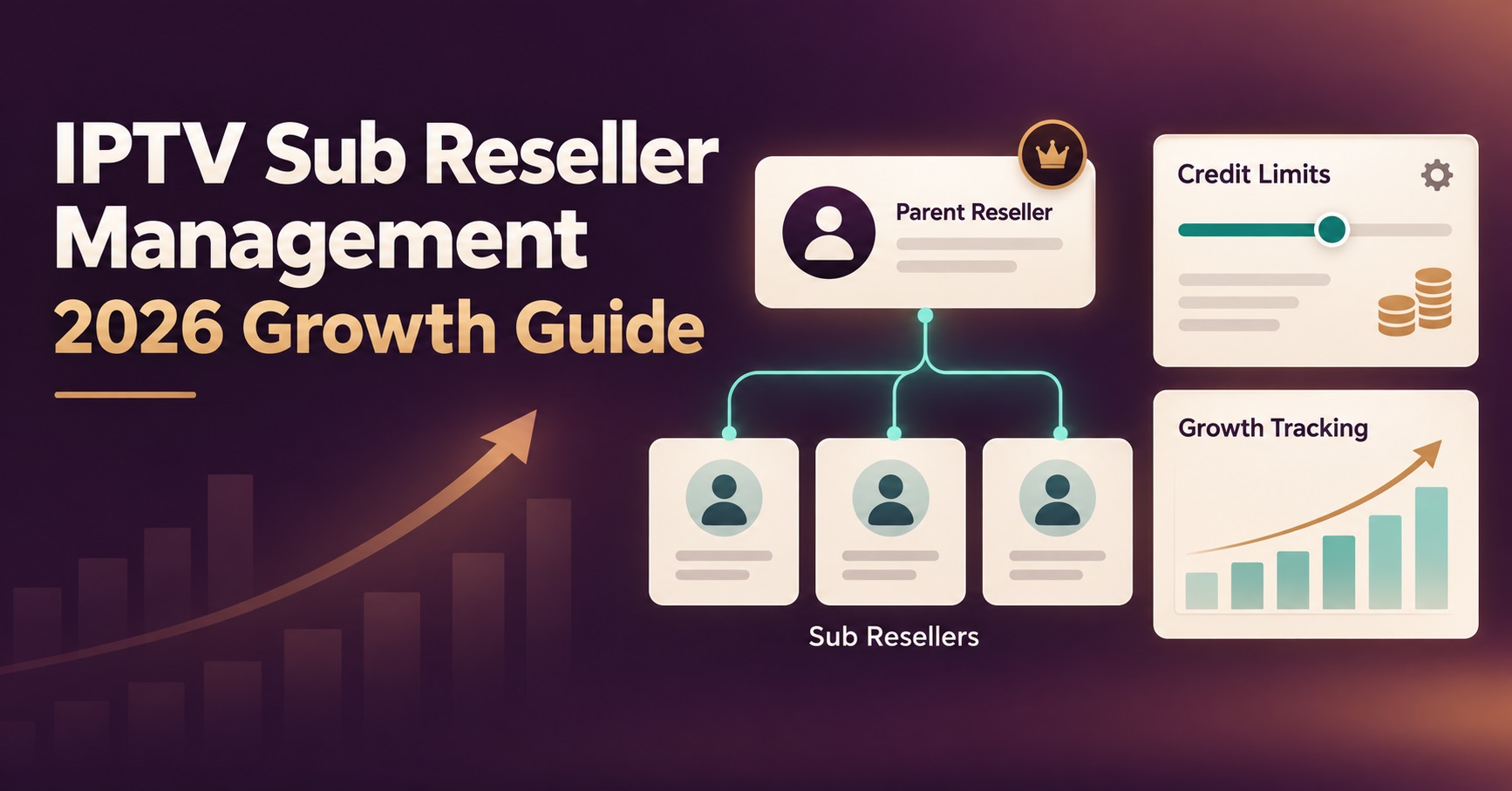
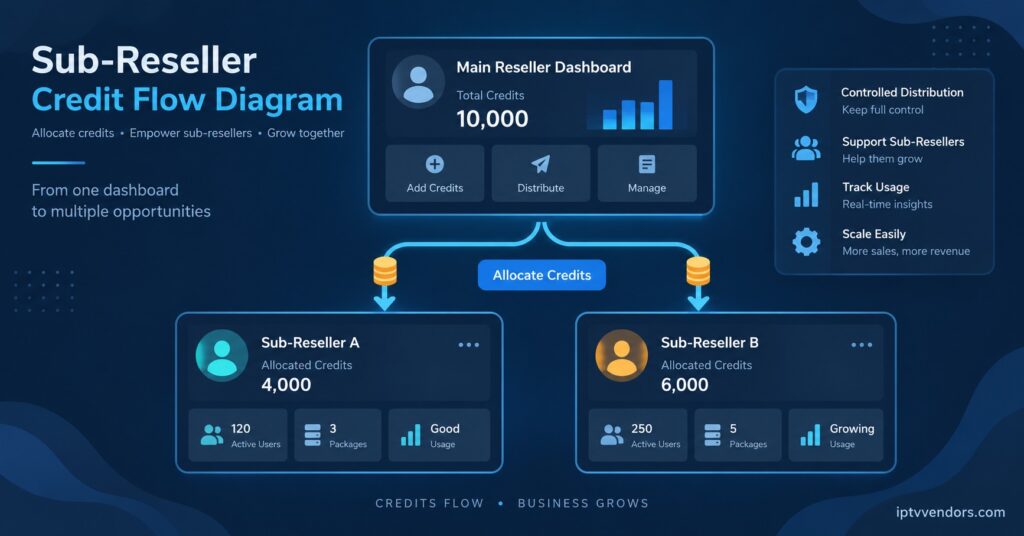
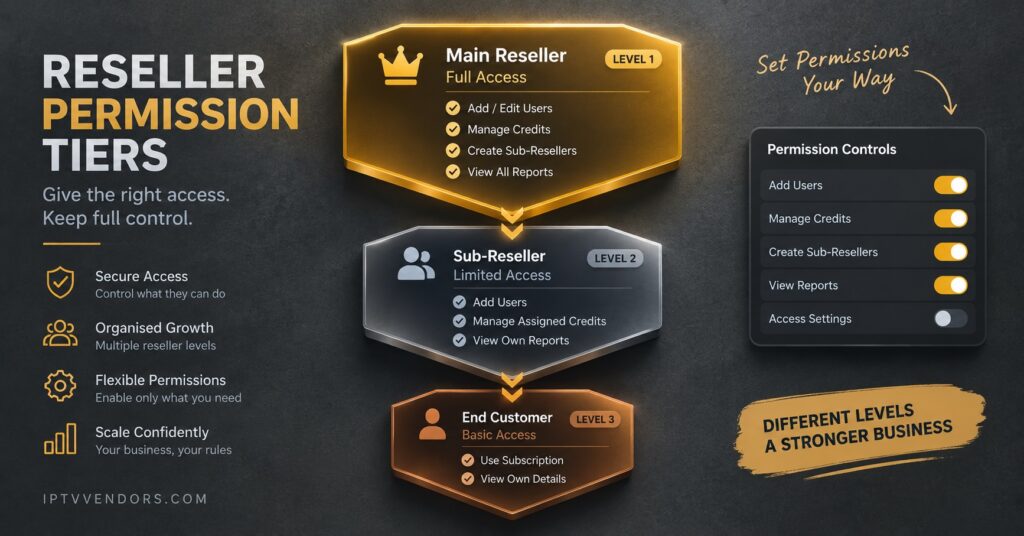
A sub-reseller sits below you in the same structure you sit below your provider. You buy credits wholesale, convert them into subscriptions, and set your own price. A sub-reseller does the same thing under you, using credits you allocate from your own balance, at a price you set for them.
That middle position is where most of the confusion starts. Your sub-reseller answers to you the way you answer to your provider, but their customers usually think of the sub-reseller as the actual business. If a sub-reseller disappears, you’re often the one left explaining to confused end customers why their subscription stopped working, even though you never spoke to them directly.
Before bringing anyone into a sub-reseller arrangement, it helps to be clear on what you’re actually delegating. You’re not handing over your provider relationship. You’re extending a slice of your own dashboard, under conditions you define. Reviewing what to look for in a IPTV reseller panel before you commit to a multi-tier structure will tell you whether the platform even supports proper sub-account separation, because not all of them do.
Setting Permissions Before You Set Prices
The first practical decision isn’t pricing. It’s what a sub-reseller can actually see and do inside your dashboard. Some panels let you create a genuinely separate sub-account with its own credit balance and its own customer list. Others just give the sub-reseller a login into your existing panel with no real boundary between their customers and yours.
That difference matters more than most new resellers expect. A properly separated sub-account means a sub-reseller can create, extend and manage their own customers without ever seeing your other accounts. A shared login means one careless click, one shared password, or one disgruntled sub-reseller can expose or disrupt your entire customer base.
If your current panel doesn’t support that separation cleanly, it’s worth treating that as a genuine limitation rather than something to work around with trust alone. A white label IPTV setup is often the more sensible route once you’re running several sub-resellers, since it lets each one operate under branding that looks independent while the underlying control stays with you.
Credit Allocation and Margin Protection
Credits are the actual currency of the relationship, and how you allocate them decides whether the arrangement is profitable or just busy work. Give a sub-reseller too large a credit pool upfront and you’ve extended trust you can’t easily withdraw. Give them too little and they’ll be back asking for top-ups constantly, which slows both of you down.
| Decision factor | What to look for |
|---|---|
| Credit release pace | Smaller, more frequent batches until payment history is established |
| Pricing gap | Enough margin between your cost and their buy-in price to absorb occasional disputes |
| Top-up reliability | A pattern of on-time top-ups before extending larger batches |
| Customer volume growth | Gradual increases that match their actual sales, not promised sales |
Pro tip: Set a maximum outstanding credit limit per sub-reseller and review it monthly rather than leaving it open-ended. An open credit line is the easiest way for a small arrangement to turn into a large, unrecoverable exposure.
Margin protection isn’t only about the price you charge. It’s also about not letting a sub-reseller’s customer service failures land back on your support queue for free. If you’re constantly fixing problems a sub-reseller created, the margin you thought you were keeping is being spent on time instead of money. Understanding realistic reseller profit margin expectations before adding a sub-reseller tier helps you price the arrangement so it still makes sense once support time is factored in.
Where Sub-Reseller Management Breaks Down
Most problems in this structure follow a small number of patterns, and they tend to repeat across different panels and different countries.
Credit hoarding happens when a sub-reseller buys a large batch and then sits on it instead of activating customers, often because they’re testing the market or waiting on their own buyers. It ties up your capital without producing renewal revenue.
Price undercutting happens when a sub-reseller starts quoting your other resellers’ customers a lower rate than you’d approved, usually to win volume quickly. It damages trust across your whole network, not just with the one sub-reseller involved.
Customer poaching is the more serious version. A sub-reseller who has direct contact with end customers can, in principle, move those customers to a different provider entirely, taking your investment in acquiring and supporting them with them. This is precisely why permission separation matters as much as it does. The less a sub-reseller can see about your underlying infrastructure and provider relationship, the less there is for them to redirect elsewhere.
Support Escalation Without Confusion
Deciding who answers which question, before a customer asks it, saves a surprising amount of friction. A sensible default is that the sub-reseller handles first-line questions, billing confusion, and basic setup guidance for their own customers, while genuinely technical issues, server-level problems or account-level errors escalate to you.
Writing this down, even briefly, avoids the common failure mode where a sub-reseller forwards every message straight to you and effectively becomes a reselling layer in name only. A clear support workflow between you and your sub-resellers keeps response times predictable for end customers and stops your own inbox from becoming the single point of failure for a business you’re meant to have delegated.
Pro tip: Give each sub-reseller a short written escalation guide covering what they should try first, what counts as urgent, and how to reach you outside normal hours. Most disputes about who should have fixed something faster come down to nobody having agreed this in advance.
Warning Signs Worth Watching
- A sub-reseller who repeatedly asks for credit on trust before paying for the previous batch
- Customer complaints about pricing that doesn’t match what you approved
- Long gaps between customer activations followed by sudden bulk activity
- Reluctance to use the onboarding or activation process you’ve set, preferring workarounds
- Direct customer contact details being requested when the panel already handles that
- Sudden interest in your provider relationship or infrastructure details beyond their own dashboard
None of these alone proves bad intent. Taken together, or repeated, they’re worth a direct conversation before the relationship grows any larger.
Building a Sub-Reseller Network That Actually Scales
A single sub-reseller is manageable through conversation and memory. Five or ten sub-resellers need something closer to a process. That usually means a standard onboarding sequence so every new sub-reseller starts the same way, a documented credit and pricing policy so terms aren’t negotiated fresh each time, and a review point, monthly or quarterly, where you check credit usage, customer growth and support volume per sub-reseller rather than treating each one as a one-off relationship.
A consistent customer onboarding process is worth adapting for sub-resellers specifically, since the same principle applies one level up. The clearer the starting point, the fewer disputes surface later about what was agreed.
It’s also worth being honest that not every sub-reseller relationship is meant to last indefinitely. Some are genuinely temporary, useful while a sub-reseller is building their own customer base, before they either grow into a direct account with your provider or move on entirely. Planning for that exit, rather than assuming every arrangement is permanent, keeps the structure flexible instead of brittle.
Frequently Asked Questions
How many sub-resellers can one parent reseller realistically manage?
It depends more on your support capacity than on the panel’s technical limits. Most resellers find the relationship starts to strain past six or seven active sub-resellers without a documented process and a review schedule in place.
Should sub-resellers get their own branded dashboard?
Where the panel supports it, yes. A separated or white label view reduces confusion for their customers and limits how much of your underlying setup a sub-reseller can see or copy.
What happens to a sub-reseller’s customers if the arrangement ends?
This depends entirely on what you agreed at the start. Some parent resellers retain the customer accounts and reassign support directly. Others allow the sub-reseller to transition customers elsewhere. Deciding this before it happens avoids a dispute during it.
Is it normal for sub-resellers to ask for lower credit prices as volume grows?
Yes, and it’s usually reasonable within limits. The key is agreeing volume thresholds in advance rather than renegotiating informally every time a sub-reseller feels their volume justifies a discount.
Can a sub-reseller become a direct reseller with the same provider later?
In many cases, yes, and it’s often a healthy outcome rather than a loss. A sub-reseller who has proven demand and reliable payment is a reasonable candidate to graduate into a direct account once their volume justifies it.
IPTV Sub Reseller Management in Practice
IPTV Sub Reseller Management comes down to a small number of decisions made early and reviewed regularly: how much separation your panel actually gives you, how credits are released, who handles which support tier, and what happens if the relationship ends. None of this needs to be complicated, but it does need to be decided deliberately rather than worked out after something has already gone wrong. IPTV Panel Resellers who write these terms down before onboarding their first sub-reseller tend to scale the arrangement without the recurring disputes that catch everyone else off guard.