
IPTV Reseller Churn is rarely caused by one bad evening of streaming. Most customers leave at two predictable moments: in the first few days, when setup goes wrong and nobody follows up, and at renewal, when the expiry date passes quietly and they drift to whoever messaged them last. If you fix those two moments, you fix most of your churn.
Before you cut prices or start blaming your provider, pull every account that expired in the last 90 days from your IPTV Panel reseller dashboard and split it into two piles. One pile is customers who never renewed after their first period. The other is customers who renewed at least once and then stopped. These groups leave for different reasons, and treating them the same way is the most common reason retention efforts go nowhere.
Two Kinds of Leaving, and Why the Difference Matters
Early leavers usually never got a working, comfortable experience in the first place. The app was hard to install, the channel list felt overwhelming, a stream paused during their first evening and they had no idea whether that was normal. They did not reject your service so much as never properly start using it.
Later leavers are a different story. They had a working setup and were happy enough to pay again at least once. When they go, it tends to be for one of three reasons: something changed in reliability, a competitor reached them at the right moment, or they simply forgot and nobody reminded them.
That last group matters more than most resellers realise. A good share of what looks like churn is really passive expiry, where the customer never actively decided to leave. That is the cheapest churn to fix, because it needs a process rather than a better product.
Working Out Your Real IPTV Reseller Churn Rate
The basic calculation is simple. Take the number of customers whose subscriptions ended without renewal during a period, and divide it by the number of active customers you had at the start of that period. Multiply by 100 for a percentage.
The trouble is that plan length distorts the figure. A reseller selling mostly 12-month subscriptions will see very low monthly churn for most of the year and then a sharp spike when that cohort comes up for renewal. A reseller selling monthly plans sees churn every single month. Comparing those two numbers tells you nothing useful.
A more honest approach is to measure renewal rate per cohort. Of everyone whose plan expired in a given month, how many renewed within seven days of expiry? Track that separately for 1-month, 3-month, 6-month and 12-month customers. Within a few cycles you will see which plan lengths hold customers and which leak.
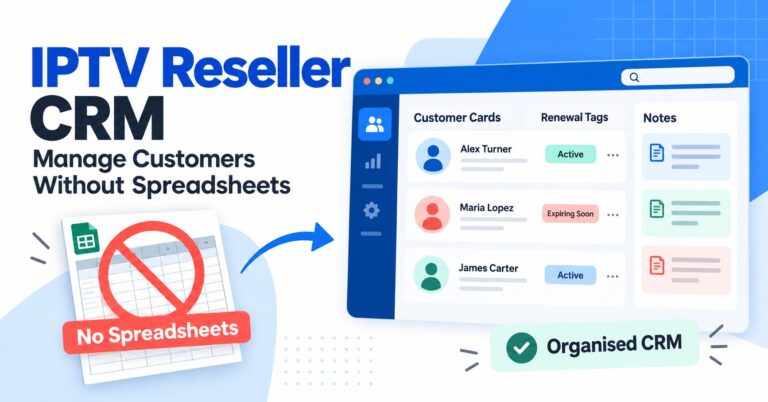
It also helps to add a simple tag in your customer notes for why someone left, when you know. “No reply”, “moved to another seller”, “price”, “technical” and “no longer needed” are enough. After a few months those tags show you where to spend your effort far more reliably than guesswork.
There is no trustworthy public benchmark for churn across IPTV resellers, so do not chase a number someone quoted in a forum. Your own trend over time is the figure that matters.

The First Week Decides More Than You Think
1. Send setup instructions for the device the customer actually owns
Sending a generic “download an app and enter these details” message is where many early cancellations start. A customer on a smart TV, a customer on an Android box and a customer on a phone need different steps, different apps and sometimes different login formats.
Ask what device they are using before you send credentials, then send instructions written for that device only. Keeping a device-specific installation guide ready to share saves you from rewriting the same steps in chat every day, and it gives the customer something to go back to when they set up a second screen.
2. Check in once, around 48 hours after activation
Most unhappy new customers do not complain. They just stop using the service and let it expire. A short message two days in, asking whether everything is working and whether they found the guide useful, catches problems while they are still easy to fix.
Keep it to one message. The point is to open a door, not to start a sales conversation.
Pro tip: Ask a specific question in that check-in, such as “Is the guide loading properly on your TV?”, rather than “Is everything okay?”. Specific questions get honest answers, while general ones get polite silence.
3. Set expectations honestly at the point of sale
A surprising number of complaints come from things that are normal behaviour rather than faults. Live streams delivered over the internet usually run behind a traditional broadcast. Connection limits mean a second device may disconnect the first. Scheduled maintenance happens.
Customers who hear this before they pay treat it as ordinary. Customers who discover it on their own treat it as a broken service. The guidance on managing subscriptions and live-stream delay expectations covers how to phrase this in a welcome message without scaring anyone off.
The Middle Months: Staying Visible Without Being a Nuisance
4. Tell customers about problems before they find them
If your upstream provider announces maintenance or is dealing with an outage, pass that on quickly and plainly. A short broadcast message saying what is happening and roughly when it should be resolved turns a frustrating evening into a minor inconvenience.
This only works if your provider actually communicates with you. If you regularly learn about outages from your own customers, that is a supply problem, and no amount of good messaging on your side will fully cover it.
5. Make support predictable rather than instant
IPTV Resellers often assume customers leave because replies are slow. More often they leave because replies are unpredictable. A customer who knows you answer between set hours on one channel is usually content. A customer who sometimes gets a reply in two minutes and sometimes waits a day starts to feel ignored.
Publish your support hours, stick to one main channel, and build a small library of saved replies for the questions you answer every week. Consistency builds more trust than speed.
6. Price plan lengths so longer terms make sense
Customers on longer plans renew less often, which gives them fewer chances to leave. That does not mean pushing everyone onto a 12-month plan on day one, because a new customer who has not yet trusted you will often refuse, or will buy it and then resent it.
A better path is to start new customers on a short plan and offer a longer term at their first renewal, once the service has proved itself. Understanding how reseller credits map to plan lengths helps you price those longer plans so the saving is real for the customer while still leaving you a sensible margin.
The Renewal Window and What Happens After
7. Remind in stages, not once
A single reminder on the expiry date is too late for many people. They see it at a busy moment, mean to deal with it, and forget.
A staged approach works better: one message about a week before expiry, one a day or two before, and one on the day itself. Your dashboard’s expiry column is the tool for this, so sort by expiry date as part of a routine check, not only when you remember.
The table below covers signals that tend to appear before a customer leaves, and what each one usually calls for.
| Signal you notice | What it often means | Sensible response |
|---|---|---|
| The same question asked twice in a month | Setup never fully worked | Send device-specific steps and confirm it is fixed |
| No reply to the first renewal reminder | Busy or undecided, not necessarily lost | Follow up closer to expiry with a direct payment option |
| Asking about extra connections | Household usage has grown | Offer a suitable multi-connection plan before they look elsewhere |
| Complaints clustered around one evening | A wider service issue, not a single user | Check with your provider and message affected customers together |
8. Make renewing easier than leaving
Every extra step at renewal is a chance to lose someone. If renewing means new credentials, a fresh app setup or a long chat about plan options, some customers will decide it is simpler to try someone else.
Extend the existing account wherever your panel allows it, so login details stay the same and nothing needs reinstalling. Send a clear message with the plan, the price and one way to pay. If you use an automated checkout, make sure the renewal link goes straight to the right plan rather than a general storefront.

9. Talk to people who left, then choose who to win back
A customer who lapsed is still reachable. A week or two after expiry, send one message asking a single question: what made them stop? Many will not reply. The ones who do give you the most useful feedback you will get all year.
Not every lapsed customer is worth chasing. Someone who left over price and always pushed for discounts may cost more in support than they bring in. Someone who left because of a setup problem you have since solved is well worth a friendly offer to come back.
Pro tip: Keep a separate lapsed list with the date and reason for leaving. Contacting that list after you improve something specific, such as a new setup guide for a device that caused trouble, converts far better than a general “we miss you” message.
What Retention Work Cannot Fix
Everything above assumes the underlying service is stable. If your provider suffers frequent unannounced outages, credits that behave unpredictably or support that disappears when problems pile up, your customers will leave however well you communicate. In that case the honest fix is evaluating your supply, not writing better reminders.
It is also worth being clear with customers about what IPTV is. It is a delivery technology, and what can legitimately be offered through it depends on content rights and the rules in each market. Resellers who build around authorised content and transparent terms are far less exposed to sudden service withdrawals, which are one of the few churn causes nothing else on this list can recover from.
Retention and acquisition also work together. A steady base of renewing customers is what makes spending on the growth strategies for IPTV Panel resellers worthwhile, because every new customer you win is more likely to stay.
Questions Resellers Ask About Churn
What is a normal churn rate for an IPTV reseller?
There is no reliable published benchmark, and figures passed around online are rarely based on real data. Plan mix, market and customer source all change the number a great deal. Track your own renewal rate by cohort and aim to improve it over time.
Should I offer a discount to stop someone cancelling?
Occasionally, for a long-standing customer with a genuine reason. As a habit, it teaches customers that threatening to leave earns a lower price. A better offer is usually a longer plan at a fair saving, which rewards commitment rather than complaints.
Do free trials increase churn?
Trials themselves do not cause churn, but trials without setup help often do. A trial customer who struggles with installation rarely converts, and one who converts without ever getting comfortable often leaves after the first paid period. Treat trial users with the same first-week care as paying ones.
How long after expiry should I keep contacting a customer?
One reminder on the day of expiry and a single follow-up a week or two later is usually enough. Beyond that, move them to your lapsed list and only get back in touch when you have something specific and relevant to offer.
Keeping Customers Is Mostly a Process Problem
IPTV Reseller Churn comes down to two moments you can plan for: the first week, when setup either works or quietly fails, and the renewal window, when customers either get a timely, easy nudge or drift away. Device-specific instructions, one early check-in, honest expectations, staged reminders and effortless renewals handle most of it. What they cannot handle is an unreliable upstream service, so if churn stays high after you have tightened your own process, look at your provider next. A sensible first step today is simply sorting last quarter’s expired accounts into early leavers and later leavers, then picking the one fix that suits the bigger pile.
Renewal Week Checklist for Resellers
- Sort your dashboard by expiry date and list everyone due in the next seven days
- Send first reminders with the plan, the price and one payment option
- Check notes for anyone who had setup trouble and confirm it is resolved before asking them to renew
- Offer a longer term to customers renewing for the first time
- Extend existing accounts rather than issuing new credentials where your panel allows it
- Tag anyone who does not renew with a reason, even if the reason is “no reply”
- Confirm your credit balance covers expected renewals so nothing stalls at the last minute