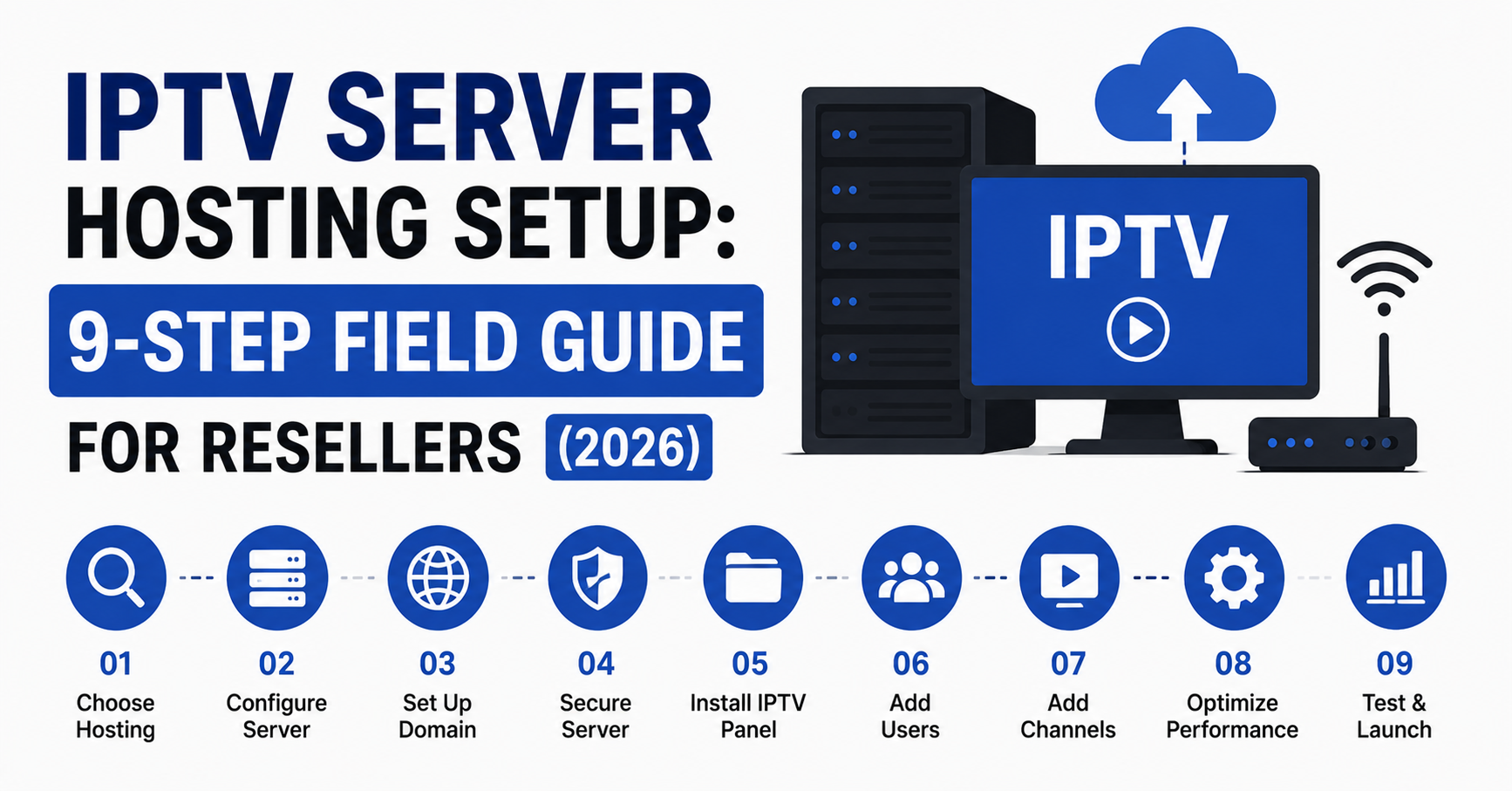

The Infrastructure Nobody Talks About Until It Breaks
Most resellers enter this game backwards. They grab a panel, buy credits, start selling and only think about IPTV server hosting setup after their first major outage tanks their reputation overnight. By then, the damage is done. Subscribers vanish. Refund requests flood in. And the reseller blames the provider when, truthfully, the architecture was rotten from day one.
Here’s the uncomfortable reality: your panel provider’s default infrastructure was never designed to handle your growth. It was designed to onboard you quickly. Those are two very different engineering goals. A proper IPTV server hosting setup is the difference between a reseller who survives twelve months and one who quietly disappears after three.
This isn’t theory. This is the playbook that comes from rebuilding after failures crashed transcoders during cup finals, DNS blocks rolling across entire ISP regions, and customer churn rates that spike the moment buffering hits ten seconds. If you’re serious about running a sustainable IPTV reseller operation in 2026, your infrastructure decisions matter more than your pricing page.
What IPTV Server Hosting Setup Actually Means for Resellers
Let’s kill a misconception early. When people search for IPTV server hosting setup, most assume it means renting a VPS and installing Xtream UI. That’s maybe fifteen percent of what’s actually involved.
A complete IPTV server hosting setup covers several interconnected layers. You’ve got your main application server running the panel software. Behind that, load balancers distribute connections across multiple streaming nodes. Then there’s your database server handling subscriber authentication, EPG data, and session management. DNS configuration sits on top of everything, routing users to the nearest or least-congested node.
Pro Tip: Never run your database and streaming service on the same server. A single subscriber authentication spike during prime time can choke your stream delivery if they’re sharing resources.
The architecture breaks down like this:
- Panel Server: manages reseller accounts, credit allocation, playlist generation
- Streaming Nodes: dedicated machines that actually deliver HLS or MPEG-TS streams to end users
- Database Layer: handles logins, token validation, EPG scheduling
- Load Balancer: distributes viewer connections to prevent any single node from saturating
- DNS Layer: resolves your service domain to the correct node cluster
Each layer fails differently, and each demands its own monitoring approach.
Picking Server Locations That Match Your Subscriber Base
This is where most resellers make their first real infrastructure mistake. They choose hosting based on price per month instead of latency to their actual viewers.
If eighty percent of your subscribers sit in the UK and Western Europe, your primary streaming nodes need to be in London, Amsterdam, or Frankfurt. Running a bargain server in a US data centre and pushing streams across the Atlantic adds 80–140ms of latency before a single frame renders. Under normal load, viewers might not notice. During a major live sporting event with thousands of concurrent connections, that latency compounds into buffering spirals that destroy your service reputation.
Your IPTV server hosting setup should follow a simple geography rule: primary nodes within 20ms of your largest subscriber cluster, and secondary failover nodes in a different physical region.
| Decision | Budget Approach | Professional Approach |
|---|---|---|
| Server Location | Cheapest available region | Mapped to subscriber density |
| Node Count | Single server | 3+ regional nodes |
| Failover | None | Automated DNS failover |
| Latency Target | Ignored | Sub-30ms to core audience |
| Bandwidth | Shared / metered | Unmetered dedicated port |
That table isn’t academic it’s the exact split between resellers who retain subscribers for six months and those who churn through their entire base every sixty days.
Why Cheap Bandwidth Destroys IPTV Operations
Bandwidth is the silent killer. A reseller can have perfect panel configuration, solid channel lineups, and aggressive pricing and still bleed subscribers because they cheaped out on transit.
Here’s the maths nobody does upfront. A single HD stream consumes roughly 5–8 Mbps. A 4K stream jumps to 20–35 Mbps depending on codec efficiency. If you have 200 concurrent viewers on HD content, that’s a sustained 1–1.6 Gbps of outbound traffic. Most budget VPS providers throttle or shape traffic well before that threshold. Some advertise “unmetered” but enforce fair-use policies buried in their terms that cap burst capacity at exactly the moment you need it most.
Pro Tip: Always run a sustained throughput test during peak hours before committing to any host. Spin up a test instance, push traffic for 4–6 hours straight during evening prime time, and watch for throttling patterns. The results during a Tuesday afternoon mean nothing.
A proper IPTV server hosting setup demands dedicated bandwidth with guaranteed port speeds not “up to” promises. You want 1Gbps dedicated at minimum per streaming node, with 10Gbps options available for scaling. Shared bandwidth plans are fine for web hosting. They are catastrophic for live stream delivery.
The Backup Uplink Problem Nobody Plans For
Every experienced operator has a horror story about a single upstream provider going down and taking their entire service offline. It happens more than hosting companies admit — peering disputes, fibre cuts, DDoS attacks on the data centre’s transit providers. Your streams stop, your subscribers panic, and your resellers start looking for alternatives before you’ve even opened a support ticket.
Your IPTV server hosting setup needs redundant uplinks. That means your hosting provider should connect to multiple Tier 1 transit carriers not just one. If their upstream is solely Cogent, and Cogent has a peering dispute or an outage, your service goes dark regardless of how powerful your actual server is.
- Check your host’s network page reputable providers list their upstream carriers
- Prefer hosts with 3+ transit providers and at least one major IX (Internet Exchange) peering
- Ask explicitly whether failover between uplinks is automatic or requires manual intervention
- Test traceroute paths from multiple subscriber locations to confirm diverse routing
How DNS Configuration Makes or Breaks Your IPTV Server Hosting Setup
DNS is the front door of your entire operation. Every subscriber connection starts with a DNS lookup. If that lookup is slow, blocked, or pointed at the wrong node, nothing else matters the viewer never reaches your stream.
In 2026, ISP-level DNS manipulation has become significantly more sophisticated. Major UK and European ISPs now deploy AI-driven DNS filtering that identifies IPTV traffic patterns and blocks resolution at the ISP level. This isn’t the crude blanket blocking of 2019. Modern systems analyse query frequency, domain age, associated IP reputation, and even time-of-day access patterns to flag and intercept IPTV-related domains.
Your defensive DNS strategy should include several layers:
- Short TTL Values: keep DNS TTL between 60–300 seconds so you can rapidly redirect traffic if a node goes down or a domain gets flagged
- Multiple DNS Providers: don’t rely solely on Cloudflare or a single provider; distribute across at least two independent DNS services
- Domain Rotation Planning: maintain backup domains already configured and tested, ready to deploy within minutes if your primary gets blocked
- Encrypted DNS Support: encourage subscribers to use DoH (DNS over HTTPS) or DoT (DNS over TLS) to bypass ISP-level interception
Pro Tip: Register backup domains under different TLDs and different registrars. If an enforcement action targets your registrar, having domains spread across multiple providers prevents a single takedown from killing your entire namespace.
A rock-solid IPTV server hosting setup treats DNS as a critical infrastructure component, not an afterthought you configure once and forget.
Load Balancing: The Skill That Separates Hobbyists from Operators
Running a single streaming node is fine when you have fifty subscribers. The moment you cross two hundred concurrent connections, you’re gambling with every viewer’s experience on every peak evening.
Load balancing in an IPTV server hosting setup isn’t just about distributing traffic evenly. It’s about distributing traffic intelligently. Round-robin DNS where each request cycles to the next server in the list is the most basic approach, and it’s dangerously crude for live streaming. It doesn’t account for server health, current load, geographic proximity, or whether a particular node is already struggling under its existing connections.
Proper load distribution considers:
- Current CPU and RAM utilisation on each node
- Active connection count versus the node’s tested ceiling
- Geographic proximity of the incoming viewer to each available node
- Health check status is the node actually serving streams, or is it up but functionally broken?
If a node’s CPU hits 80%, new connections should automatically route elsewhere. If a node fails a health check, it should be pulled from the pool within seconds not minutes.
| Method | Complexity | Effectiveness for IPTV |
|---|---|---|
| Round-Robin DNS | Low | Poor no health awareness |
| Weighted Round-Robin | Medium | Acceptable static weights |
| Least Connections | Medium | Good dynamic distribution |
| Geographic + Health-Aware | High | Optimal considers location + load |
Investing time into proper load balancing is investing directly into subscriber retention.
Panel Credit Management and Server Resource Allocation
Here’s something most IPTV server hosting setup guides completely ignore: the relationship between panel credits and actual server capacity.
Resellers buy credits to activate subscriber lines. Each active line represents a potential concurrent connection. If you’ve sold 500 credits worth of lines but your infrastructure can only handle 200 concurrent streams without degradation, you’re relying on the statistical hope that not everyone watches at once. During regular weekday afternoons, that gamble works. During a major live event on a Saturday evening, it collapses spectacularly.
The professional approach maps credits to capacity with a realistic concurrency ratio. Industry experience puts typical peak concurrency at 35–50% of total active lines. So 500 active subscribers means you need infrastructure comfortable handling 175–250 concurrent streams without any performance degradation.
Pro Tip: Track your actual peak concurrent connections weekly. If your concurrency ratio starts creeping above 50%, you’ve either got a very engaged subscriber base (good) or you’re undersized on infrastructure (dangerous). Either way, it’s time to add a node before the next big event forces the issue.
This credit-to-capacity mapping is a fundamental part of sustainable IPTV server hosting setup and it’s the metric most resellers only discover after their first catastrophic overload.
HLS Latency Tuning and Transcoder Optimisation
Latency in IPTV streaming isn’t just about internet speed. The transcoding pipeline the process that converts raw stream input into the HLS segments your subscribers’ devices actually play introduces its own delays, and poorly configured transcoders amplify those delays into visible buffering.
Default transcoder settings on most panel software prioritise compatibility over performance. They output large segment sizes (typically 10 seconds), high buffer depths, and conservative bitrate profiles. For a subscriber watching a recorded film, that’s fine. For live sports where a goal celebration needs to arrive within seconds, those defaults create a 15–30 second delay that makes your service feel broken compared to traditional broadcast.
Tuning your IPTV server hosting setup for lower HLS latency involves:
- Reducing segment duration to 2–4 seconds (balanced against increased HTTP request overhead)
- Adjusting the playlist window to hold 3–5 segments instead of the default 10+
- Ensuring your transcoder has dedicated CPU cores never share with database or panel processes
- Using hardware-accelerated encoding (NVENC or QuickSync) if your host supports GPU passthrough
The trade-off is real: shorter segments mean more frequent HTTP requests, which increases server overhead per viewer. But subscribers notice latency. They don’t notice request counts. Tune for the experience they can see.
ISP Blocking Trends in 2026 and How They Affect Your Setup
The enforcement landscape has shifted dramatically. Crude IP blocking where an ISP simply blackholes a known server IP still exists, but it’s no longer the primary threat.
In 2026, AI-driven deep packet inspection analyses traffic patterns even on encrypted connections. ISPs examine packet timing, flow characteristics, connection duration, and metadata signatures to identify IPTV traffic without needing to decrypt it. A subscriber connecting to a single IP for three straight hours with consistent high-bandwidth UDP or TCP flow gets flagged automatically. The connection isn’t dropped it’s throttled, often to speeds that make HD streaming impossible while leaving standard browsing unaffected.
This changes how you think about IPTV server hosting setup fundamentally:
- CDN-style distribution spreading streams across multiple IPs makes traffic patterns less identifiable
- Protocol obfuscation wrapping streams in HTTPS to blend with normal web traffic
- Port randomisation avoiding known default ports that trigger pattern matching
- Connection rotation architectures that periodically shift subscriber connections between nodes
Pro Tip: Monitor subscriber complaints geographically. If buffering reports suddenly cluster around a specific ISP or region, that’s likely targeted throttling not a server issue. Your response should be network-level (new IPs, routing changes), not hardware-level (bigger server).
Staying ahead of ISP enforcement isn’t optional. It’s a core requirement of any IPTV server hosting setup built to last beyond a few months.
Customer Churn Psychology and Infrastructure Trust
Technical resellers often overlook something critical: subscriber churn is rarely about channels. It’s about reliability perception. A subscriber who experiences two buffering incidents during important live events will leave even if your channel list is twice the size of your competitor’s.
The psychological threshold is surprisingly tight. Research into streaming service abandonment consistently shows that viewers tolerate roughly 5–6 seconds of buffering before their satisfaction drops sharply. Beyond 10 seconds, a significant percentage will close the app entirely. If it happens twice in a week, they start shopping for alternatives.
This means your IPTV server hosting setup isn’t just a technical exercise. It’s a retention tool. Every infrastructure decision server location, bandwidth quality, load balancing sophistication, failover speed directly maps to a subscriber’s emotional experience of your service.
- First buffering event: subscriber notices, continues watching
- Second event same session: frustration begins, internal comparison to other services starts
- Third event: subscriber actively considers switching, may contact reseller
- Repeated across multiple sessions: subscriber leaves, rarely returns
Understanding this chain helps you prioritize infrastructure spending. The most cost-effective investment isn’t more channels it’s eliminating that second buffering event entirely.
Scaling from 100 to 1,000 Subscribers Without Rebuilding Everything
The worst time to redesign your architecture is when you’re growing. But that’s exactly when most resellers face it their initial IPTV server hosting setup was built for a hundred subscribers, and now they’re at four hundred and everything’s creaking.
Scalable architecture starts with separation of concerns from day one. Your panel, your database, and your streaming nodes should be independent services from the beginning even if they technically could run on one machine at small scale. When growth arrives, you simply add streaming nodes without touching your panel or database configuration.
The scaling playbook looks like this:
- Phase 1 (0–200 subscribers): 1 panel server, 1 streaming node, 1 database instance separate but on modest hardware
- Phase 2 (200–500): Add a second streaming node in a different data centre, implement basic load balancing
- Phase 3 (500–1,000): Introduce geographic node distribution, automated health monitoring, dedicated load balancer, database replication
- Phase 4 (1,000+): Full CDN-style multi-region deployment, automated scaling triggers, dedicated NOC monitoring
Each phase should be planned before it’s needed. Reactive scaling adding servers in a panic during a peak event costs more money, introduces more errors, and creates more downtime than proactive expansion ever would.
Pro Tip: Build your initial IPTV server hosting setup as if you’ll have 500 subscribers within six months, even if you currently have 30. The marginal cost of a properly separated architecture at small scale is tiny compared to the cost of rebuilding under pressure later.
Frequently Asked Questions
How much does a proper IPTV server hosting setup cost per month?
A basic but professional setup starts around £80–150 monthly for a dedicated panel server and one streaming node with unmetered bandwidth. Scaling to three nodes with load balancing and failover typically lands between £250–500 monthly. Cutting costs below these thresholds usually means shared resources or metered bandwidth both of which degrade performance under real subscriber load.
Can I run my IPTV server hosting setup on a standard VPS?
You can at very small scale under 50 subscribers. Beyond that, a standard VPS shares CPU, RAM, and network with other tenants. During peak hours, your streams compete for resources you don’t control. Dedicated servers or bare-metal instances give you predictable, isolated performance that VPS environments simply cannot guarantee for sustained high-bandwidth streaming workloads.
What operating system works best for IPTV server hosting setup?
Ubuntu 22.04 LTS or Debian 12 are the most widely supported by major panel software and community tooling. CentOS was historically popular, but Red Hat’s licensing changes pushed most operators toward Debian-based distributions. Whichever you choose, keep the OS minimal strip unnecessary services to reduce attack surface and free resources for streaming.
How do I protect my IPTV server hosting setup from DDoS attacks?
Layer your defences. Use a hosting provider with built-in DDoS mitigation at the network edge. Place Cloudflare or a similar reverse proxy in front of your panel’s web interface. For streaming nodes, ensure your host offers at minimum 10Gbps DDoS scrubbing. Keep your actual streaming node IPs hidden from public-facing DNS records wherever architecturally possible.
Does IPTV server hosting setup require a CDN?
Not at smaller scales, but a CDN or CDN-like architecture becomes essential beyond 500 concurrent viewers. Traditional CDNs designed for website content aren’t optimised for live stream delivery. Instead, operators build pseudo-CDN setups with geographically distributed streaming nodes managed through health-aware load balancing effectively a purpose-built content delivery layer tailored to IPTV workloads.
How often should I monitor server performance in my IPTV server hosting setup?
Automated monitoring should run continuously checking CPU, memory, bandwidth, and active connections every 30–60 seconds. Manual review of trends and capacity planning should happen weekly. Before any major live event expected to drive high viewership, run a manual infrastructure check at least two hours beforehand to confirm all nodes, failover paths, and DNS configurations are functioning correctly.
What’s the biggest mistake resellers make with IPTV server hosting setup?
Overselling capacity. Resellers activate far more subscriber lines than their infrastructure can handle concurrently, banking on not everyone watching at once. This works until a popular live event pushes concurrency past the server’s ceiling. The resulting mass buffering creates a churn event that’s far more expensive than the additional server node would have been.
Can I use cloud hosting like AWS or Azure for IPTV server hosting setup?
Technically yes, but the bandwidth costs at IPTV scale become prohibitive quickly. Cloud providers charge per GB of outbound data transfer. A single HD stream to one viewer for one hour consumes roughly 2–3.5 GB. Multiply across hundreds of subscribers, and monthly bandwidth bills can dwarf the cost of dedicated servers with unmetered ports. Most operators use dedicated or bare-metal hosting for streaming nodes and reserve cloud instances only for lightweight panel or database services.
Success Checklist: Your IPTV Server Hosting Setup Action Plan
- Audit your current server architecture confirm panel, database, and streaming nodes are on separate instances, not sharing resources on a single machine
- Map your subscriber geography and verify your primary streaming nodes sit within 20ms latency of your largest viewer cluster
- Run a sustained 4-hour bandwidth test during peak evening hours on every hosting provider you’re considering reject any that throttle
- Confirm your host has 3+ upstream transit providers and at least one IX peering arrangement for uplink redundancy
- Configure DNS with TTL values under 300 seconds and prepare at least two backup domains on different registrars, fully tested and ready to deploy
- Implement health-aware load balancing that pulls failing nodes from rotation within 30 seconds, not round-robin guesswork
- Calculate your credit-to-capacity ratio if peak concurrency exceeds 40% of active lines, provision an additional streaming node before the next major event
- Tune HLS segment duration to 2–4 seconds on all transcoders and dedicate CPU cores exclusively to encoding processes
- Set up geographic complaint tracking to detect ISP-level throttling patterns before they become service-wide crises
- Build your scaling roadmap now document exactly which hardware and configuration changes trigger at 200, 500, and 1,000 subscriber milestones
For detailed panel credit structures and reseller onboarding resources, visit British Iptv Reseller platform to explore infrastructure-grade IPTV reseller packages built for operators who take hosting seriously.