
There’s a satellite dish bolted to the side of nearly every terraced house in Britain. Weathered, tilted slightly from last winter’s wind, pointing at a sky full of signals most households no longer care about. That dish tells a story not of technology thriving, but of technology clinging on.
The IPTV vs Satellite TV debate isn’t theoretical anymore. It stopped being theoretical around 2022. By 2026, it’s a post-mortem dressed up as a comparison. Households have moved. Resellers have moved faster. The infrastructure economics alone tell you everything: one model scales with a server rack, the other with a crane and a rooftop bracket.
If you’re a IPTV reseller trying to figure out where to park your investment or a family wondering whether that dish is worth keeping this is the breakdown nobody sugarcoats. IPTV vs Satellite TV isn’t about loyalty. It’s about arithmetic.
The Infrastructure Gap Between IPTV and Satellite TV Has Become a Canyon
Satellite TV relies on transponder bandwidth leased from geostationary satellites orbiting roughly 35,000 kilometres above the equator. That infrastructure is decades old in design philosophy. Uplink stations beam content skyward, satellites relay it earthward, and your dish catches the signal. It works. It has always worked. But “working” and “competing” are different conversations.
IPTV operates on terrestrial internet infrastructure fibre backbones, CDN nodes, HLS streaming protocols, and load-balanced server clusters that can be spun up or migrated in hours. When you compare IPTV vs Satellite TV from an infrastructure standpoint, one system requires launching objects into orbit. The other requires a VPS and competent panel management.
Pro Tip: If you’re evaluating IPTV vs Satellite TV as a reseller, ask one question can I scale this in 48 hours? Satellite says no. IPTV says yes, if your uplink servers and DNS routing are properly configured.
The cost curve is equally brutal. Satellite transponder leases run into millions annually. IPTV server clusters, even at premium tier, cost a fraction and the reseller doesn’t touch that cost directly. The panel credit system absorbs it.
Why Households Are Abandoning Dishes Faster Than Installers Can Remove Them
Here’s what satellite providers won’t publish in their quarterly reports: churn isn’t gradual. It’s generational. Households under 40 don’t install dishes. They don’t want hardware on their property that does one thing. IPTV vs Satellite TV for the average household comes down to a question of flexibility and satellite has none.
A satellite subscription locks you into a fixed channel grid. You watch what’s scheduled, when it’s scheduled. There’s no catch-up built into the signal. No multi-device streaming without additional hardware. No portability when you travel.
IPTV flips every one of those limitations:
- Multi-device access: watch on a Firestick, phone, tablet, or smart TV simultaneously
- EPG integration: electronic programme guides that mirror traditional TV but with on-demand layers
- Catch-up and VOD: most IPTV services bundle 24–72 hour replay windows
- Portability: your subscription follows your internet connection, not your postcode
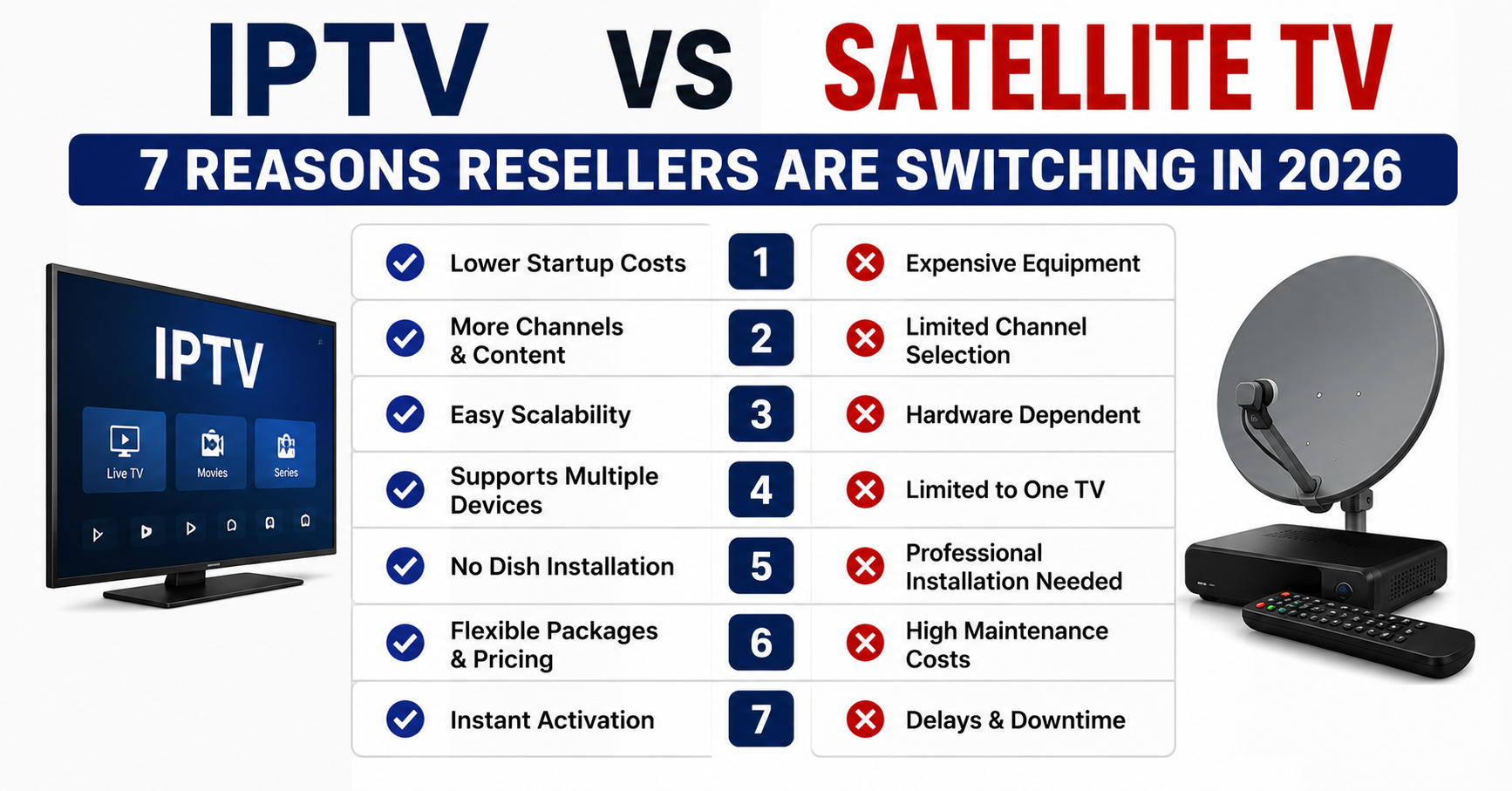
The IPTV vs Satellite TV comparison for households isn’t close. One platform adapts to how people actually consume content in 2026. The other asks them to adapt to a broadcast schedule designed in 1995.
The Reseller Economics That Killed the Satellite Middleman
Satellite TV never had a true reseller ecosystem. It had authorized dealers people who sold installation packages, earned a commission, and moved on. There was no recurring passive income model. No credit system. No panel where you could provision a customer in thirty seconds and earn margin on every renewal.
IPTV changed the entire distribution model. The reseller sits between the provider’s server infrastructure and the end user, managing subscriptions through panel credits. Buy credits in bulk at wholesale, sell connections at retail, keep the spread. It’s margin-positive from day one if your provider’s infrastructure holds.
Pro Tip: The single biggest factor that separates profitable IPTV resellers from struggling ones isn’t marketing it’s provider uptime. A provider with redundant uplink servers and proper load balancing across geographic nodes will keep your churn under 8%. Anything above 15% monthly churn means your infrastructure source is the problem, not your pricing.
IPTV vs Satellite TV from a reseller’s perspective isn’t even a fair fight. Satellite offers zero infrastructure for independent resellers. IPTV offers a turnkey ecosystem panels, credits, multi-tier sub-reseller structures, and real-time connection monitoring.
Content Delivery: Latency, Buffering, and the 2026 ISP Problem
Let’s be honest about IPTV’s weakness, because ignoring it makes this article useless. ISP-level blocking and DNS poisoning have become significantly more sophisticated in 2026. Major broadband providers now deploy AI-driven deep packet inspection that can identify and throttle IPTV streams in real time.
Satellite TV doesn’t face this problem. The signal travels through space, not through your ISP’s network. No throttling. No DNS interference. No buffering caused by peak-hour congestion on shared fibre lines.
But here’s the counterpoint that matters: IPTV infrastructure has adapted.
| Factor | Satellite TV | IPTV (Premium Infrastructure) |
|---|---|---|
| Delivery Path | Transponder → Dish | CDN → ISP → Device |
| ISP Throttling Risk | None | Mitigated with VPN/DNS strategies |
| Latency | 600ms+ (geostationary delay) | 2–5 seconds (HLS protocol) |
| Buffering During Peak | Rare | Managed via load balancing |
| Content Flexibility | Fixed grid | On-demand + live + catch-up |
| Multi-Device Support | Limited (extra hardware needed) | Native (app-based) |
| Scalability for Resellers | Non-existent | Panel credit system |
The IPTV vs Satellite TV latency conversation is nuanced. Satellite has inherent signal delay from orbital distance roughly 600 milliseconds round-trip. IPTV’s HLS latency sits lower but is subject to network conditions. Neither is perfect. But only one is improving year on year.
What AI-Driven ISP Blocking Means for the IPTV vs Satellite TV Debate
This is the section most comparison articles skip entirely, and it’s the one that matters most for resellers operating in 2026.
The current enforcement landscape uses machine learning models trained on traffic patterns not just destination IPs. These systems can flag IPTV streams based on packet timing, payload signatures, and connection persistence patterns, even when traffic is encrypted.
For the IPTV vs Satellite TV comparison, this is satellite’s last remaining structural advantage. It operates outside the ISP’s network entirely. No amount of deep packet inspection can touch a signal from space.
Pro Tip: Resellers who survive ISP crackdowns in 2026 run providers with backup uplink servers in jurisdictions where enforcement is lighter. Geographic server diversity isn’t optional anymore it’s the difference between a business and a hobby.
However, the IPTV ecosystem has responded with countermeasures that are increasingly effective: DNS-over-HTTPS routing, server-side load balancing that rotates endpoint IPs, and client-side VPN integration that tunnels traffic past inspection layers. The cat-and-mouse game continues, but IPTV’s adaptability is its defining trait.
Satellite TV’s Decline Isn’t Coming It Already Happened
The numbers are publicly available for anyone willing to read annual reports from major broadcasters. Satellite subscriber counts across Europe have declined year over year since 2019. New dish installations in the UK specifically have cratered. The demographic that sustains satellite 55+ households who value simplicity and don’t stream is not a growth market.
IPTV vs Satellite TV in 2026 isn’t a prediction exercise. The migration already occurred. The question resellers should be asking isn’t “which is better” but “how much runway does satellite have left as a reference point?”
For households still on satellite, the transition barriers are remarkably low:
- A stable broadband connection of 25 Mbps or higher
- A compatible streaming device (Firestick, Android box, smart TV app)
- An IPTV subscription provisioned through a reseller’s panel
- Basic EPG configuration for a familiar channel-surfing experience
That’s it. No installation appointment. No drilling into brickwork. No twelve-month contract with an early termination penalty. The IPTV vs Satellite TV switching cost is almost zero for the end user which is exactly why satellite’s remaining subscribers are a shrinking, aging pool.
Panel Management: The Reseller Skill Satellite Never Required
Running an IPTV reseller operation demands skills that satellite distribution never touched. You’re managing a panel Xtream Codes or equivalent where every subscriber is a live connection you can monitor, suspend, extend, or migrate. You’re watching server health dashboards. You’re tracking credit burn rates against revenue.
This is where IPTV vs Satellite TV becomes a business-model conversation, not just a technology one. Satellite dealers sold a box and walked away. IPTV resellers run ongoing operations with real infrastructure dependencies.
The skills that matter:
- Credit management: buying wholesale, pricing retail, maintaining margin across volume tiers
- Customer churn analysis: identifying why subscribers leave (usually buffering, not pricing)
- Sub-reseller recruitment: building distribution layers below you using tiered panel access
- Provider evaluation: stress-testing uplink reliability before committing credits
Pro Tip: Never evaluate an IPTV provider during off-peak hours. Test during Saturday evening premier league windows and major sporting event nights. That’s when load balancing either holds or collapses and that’s when your subscribers decide whether to renew.
Cost Breakdown: What a Household Actually Pays in 2026
Forget the marketing brochures. Here’s what a typical UK household faces when comparing IPTV vs Satellite TV on pure cost.
Satellite packages from major broadcasters start around £26/month for basic tiers and climb past £50 for bundles including premium sports and cinema. Add a multi-room fee, equipment rental, and the 18-month lock-in, and you’re looking at annual costs between £400 and £800. Installation adds another £50–£100 if you’re outside a promotional window.
IPTV subscriptions through established resellers the kind operating from platforms like britishseller.co.uk typically range from £5 to £15 per month. Annual plans drop this further. No equipment rental. No installation fee. No lock-in. Multi-device access included by default in most packages.
The IPTV vs Satellite TV cost gap isn’t marginal. It’s a factor of four to ten. For a household watching the same content live channels, sports, entertainment, international programming the financial argument is overwhelming.
The Reliability Question Nobody Answers Honestly
Both platforms fail. Let’s stop pretending otherwise.
Satellite fails during heavy rain, snow, and high wind the dish loses alignment or the signal degrades through atmospheric interference. It also fails when transponder capacity is reallocated or orbital slots are repositioned, though this is rarer.
IPTV fails during server overload, ISP throttling, provider-side outages, and DNS disruptions. Peak-event buffering is the most common complaint from subscribers.
The honest IPTV vs Satellite TV reliability comparison comes down to failure type. Satellite failures are environmental and largely outside anyone’s control. IPTV failures are infrastructural and largely within the provider’s control which means they’re fixable, upgradeable, and improvable.
That distinction matters enormously for resellers. You can’t call the weather. You can call your provider and demand better uplink redundancy.
Frequently Asked Questions
What is the main difference between IPTV and satellite TV delivery?
Satellite TV delivers content via signals from geostationary satellites to a physical dish on your property. IPTV streams content over your broadband internet connection to an app or device. The core distinction is delivery path orbital signal versus internet protocol. This affects everything from setup cost to multi-device access and portability.
Is IPTV vs Satellite TV a fair comparison for UK households in 2026?
For most households with stable broadband above 25 Mbps, IPTV offers significantly more flexibility and lower cost than satellite. Satellite retains an advantage in rural areas where broadband speeds are unreliable. The comparison favours IPTV in urban and suburban settings where fibre or fast cable is available.
Can IPTV resellers offer the same channel range as satellite providers?
Most established IPTV providers carry thousands of live channels including international, entertainment, and premium sports streams often exceeding satellite channel counts. The key difference is that IPTV bundles VOD and catch-up alongside live channels, while satellite typically charges extra for on-demand content.
How does ISP blocking affect IPTV reliability compared to satellite?
ISP-level blocking and DNS poisoning target IPTV streams specifically because they travel through broadband networks. Satellite signals bypass ISP infrastructure entirely. However, VPN usage and DNS-over-HTTPS configurations effectively mitigate most IPTV throttling for end users willing to configure their devices accordingly.
What makes IPTV vs Satellite TV more profitable for resellers?
IPTV operates on a panel credit system where resellers buy bulk access at wholesale and sell individual subscriptions at retail margin. Satellite has no equivalent reseller infrastructure only authorized dealer commissions with no recurring revenue. IPTV’s model generates passive monthly income that scales with subscriber count.
Do I need technical skills to switch from satellite TV to IPTV?
Minimal. Installing an IPTV app on a Firestick or smart TV takes under ten minutes. Entering a subscription code from your reseller activates the service. EPG setup is usually automatic. The technical barrier is dramatically lower than mounting and aligning a satellite dish and there’s no ongoing hardware maintenance.
How does IPTV handle peak-time buffering that satellite doesn’t experience?
Premium IPTV provider manage peak-time loads through server-side load balancing, geographic CDN distribution, and backup uplink servers. Buffering during high-demand events is an infrastructure quality issue, not an inherent protocol limitation. Resellers should stress-test providers during peak windows before committing credits.
Is satellite TV still worth keeping alongside an IPTV subscription?
For households in areas with inconsistent broadband or frequent outages, keeping a satellite dish as a backup has practical value. However, running both long-term doubles your content spend without doubling your content access. Most households find that once IPTV is configured properly, the satellite subscription becomes redundant within weeks.
Your IPTV Reseller Success Checklist
- Stress-test your provider during peak sporting events: not Tuesday afternoons. Evaluate load balancing and buffering under real pressure before buying bulk credits.
- Verify backup uplink server locations: your provider should operate redundant servers across at least two geographic jurisdictions to survive ISP enforcement waves.
- Set up churn tracking from day one: monitor monthly subscriber drop-off and correlate it with provider outage logs. If churn exceeds 12%, the problem is upstream.
- Build a sub-reseller tier into your pricing model: don’t just sell subscriptions, recruit resellers beneath you. Panel credit arbitrage across tiers is where real margin lives.
- Educate your subscribers on VPN and DNS configuration: proactive setup guides reduce support tickets from ISP throttling complaints by over half.
- Price against satellite, not against other IPTV resellers: your real competitor is the £40/month satellite package, not the reseller undercutting you by £1. Position on value, not on race-to-bottom pricing.
- Source your panels and credits from a tested provider: platforms like britishseller.co.uk operate with infrastructure transparency that lets you verify uptime before you commit capital.
- Rotate your DNS and server endpoints quarterly: static configurations are the first casualty of AI-driven ISP blocking in 2026. Stay ahead of detection patterns.