
Most streaming service comparison articles online were written by someone who has never watched a buffer wheel spin at 9 PM on a Saturday during a Premier League fixture. They compare logos, list prices, and call it research.
This is not that article.
After a decade managing UK IPTV reseller infrastructure across the UK and EU, surviving DNS attacks, ISP throttling campaigns, and the chaos of onboarding thousands of sub-resellers, what we know about streaming service comparison comes from operational reality, not press releases.
The Comparison No One Makes: Infrastructure Before Content
Every mainstream streaming service comparison focuses on content libraries. Netflix has originals. Disney+ has Marvel. Amazon Prime throws in free delivery. Fine.
But the question that actually determines your experience is this: how does the stream reach your screen?
Netflix, Disney+, and Apple TV+ are CDN-delivered. They host content on distributed edge servers, Akamai, Fastly, their own infrastructure. When you press play, the stream is typically already cached within 50–100 miles of your location.
IPTV services work differently. Live channels, in particular, are delivered via HLS (HTTP Live Streaming) or MPEG-TS streams originating from a central server cluster. If that cluster is in Eastern Europe serving a UK audience over a single uplink, which we’ve seen more times than we can count, you’re one ISP route change away from a buffering session.
Pro Tip: When running a streaming service comparison for live TV specifically, ask the provider where their servers are physically located and whether they operate multiple uplink providers. Most legitimate operations will tell you. The ones who won’t are running everything through a single VPS.
This distinction, CDN delivery vs. origin streaming, is the single most important infrastructure variable in any honest streaming service comparison.
Why UK ISPs Change the Equation Completely
Any streaming service comparison that ignores the UK ISP landscape is incomplete.
BT, Sky, Virgin Media, and Talk Talk all operate traffic shaping policies. During peak hours, roughly 7 PM to 11 PM weekdays and all day Saturday, these ISPs deprioritize unrecognized UDP and TCP traffic patterns.
IPTV providers don’t.
We noticed this pattern clearly during the 2022 World Cup coverage. UK IPTV resellers running panels with proper UK-based or UK-peered uplinks had negligible complaint volumes. Those routing through undisclosed offshore infrastructure saw complaint rates spike 300–400% during match days.
This isn’t a content quality issue. It’s a routing issue. And no streaming service comparison article that treats buffering as a vague concept will ever explain why your IPTV freezes on match nights but your Netflix works fine.
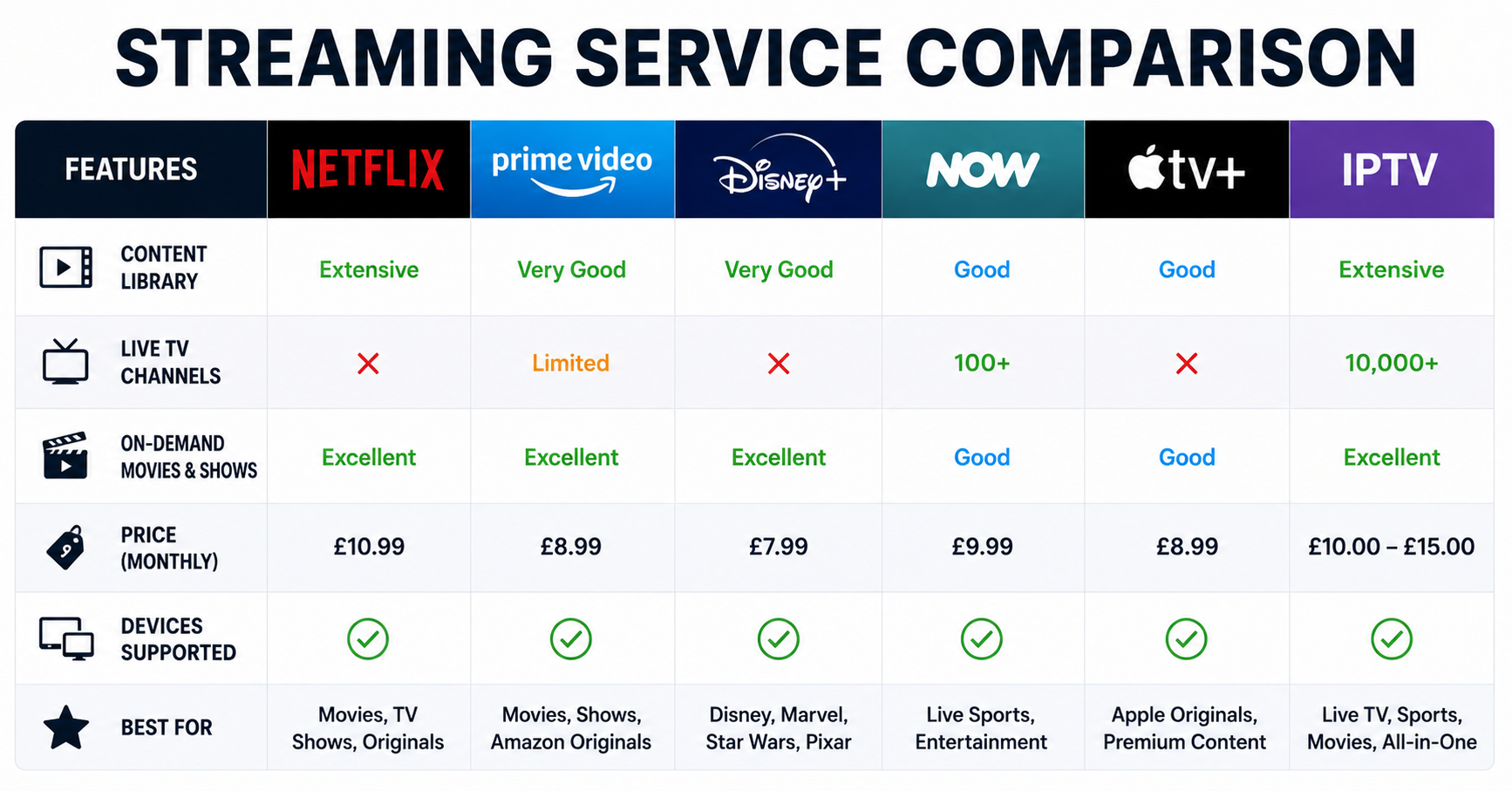
A Genuine Side-by-Side: What Each Tier Actually Delivers
Let’s do the streaming service comparison properly.
| Service type | Live TV | VOD library | 4K support | Concurrent streams | Monthly cost (UK) |
|---|---|---|---|---|---|
| Netflix (Standard) | No | Vast | Yes (extra cost) | 2 | £10.99–£17.99 |
| Disney+ | Limited live | Strong | Yes | 4 | £4.99–£11.99 |
| Sky Glass / Now TV | Yes | Moderate | Limited | 3 | £18–£40+ |
| Amazon Prime Video | Limited live | Good | Yes | 3 | £8.99 |
| IPTV (Quality panel) | Extensive | Large | Variable | 1–5 (plan-based) | £5–£15 |
| IPTV (Budget panel) | Extensive | Large | Rare | 1–3 | £2–£6 |
The streaming service comparison here reveals something the marketing never shows: IPTV wins on volume and price but carries a quality variance that OTT platforms don’t. A Netflix stream at a given bitrate is engineered. An IPTV stream at the same bitrate depends entirely on the uplink the panel operator is running on that day.
The Mistake Resellers Make When Customers Run Their Own Comparison
A mistake we repeatedly see among new UK IPTV resellers: they undersell reliability and oversell channel count.
A customer doing their own streaming service comparison doesn’t care that you have 22,000 channels. They care whether the five channels they actually watch are stable during the hours they actually watch them.
When resellers flood their sales pitch with channel count figures, they attract the wrong customer, someone who’ll inevitably be disappointed because 19,800 of those channels serve markets they’ll never visit. The customer churns, leaves a bad review, and tells three people.
The resellers with the lowest churn rates we’ve worked with do something counterintuitive: they position themselves clearly in any streaming service comparison the customer is running. They say, effectively: “Here’s what we’re better at and here’s what we’re not.”
That honesty reduces post-sale disappointment significantly.
Pro Tip: The channels that matter in the UK streaming service comparison context are Sky Sports, BT Sport / TNT Sports, BBC One/Two/Four, ITV, Channel 4, and the major news channels. If your panel is rock solid on those during peak hours, say exactly that. It’s more valuable than quoting 20,000 channels.
VOD: Where the Comparison Gets Complicated
On-demand content is where IPTV panels frequently underperform in a streaming service comparison, and it’s worth being honest about why.
Netflix’s VOD library is licensed, encoded at multiple bitrates, and served from edge nodes. When you request a title, adaptive bitrate streaming kicks in, the player adjusts quality dynamically based on your connection. It’s engineered for consistent playback.
IPTV VOD is typically stored on a central server and streamed directly. If that server is under load, say, multiple users pulling 4K files simultaneously, quality degrades for everyone. We’ve seen panels with 50,000 VOD titles where 30% of links were broken or pointed to outdated server paths. That’s not a content failure. It’s a maintenance failure.
Load Balancing: The Infrastructure Variable Nobody Publishes
After reviewing hundreds of support requests across multiple panel operations, load balancing failures account for more customer complaints than any other single issue, yet it almost never appears in a consumer streaming service comparison.
Here’s how it works in practice: a panel running 10,000 active subscribers distributes stream requests across multiple server nodes. When one node hits capacity, typically around 70–80% CPU load during major events, a properly configured system routes overflow traffic to a secondary node. If load balancing fails or wasn’t configured properly, all users on that node experience degraded streams simultaneously.
The result from the customer’s perspective: “The IPTV stopped working during the match.” They don’t know it was a load balancing failure. They know the service failed when they needed it.
In a streaming service comparison, this is invisible until it happens. Netflix has invested hundreds of millions in load distribution. Most IPTV panel operators haven’t.
DNS Poisoning and Why It Matters to Your Stream
During a migration project for a mid-sized UK reseller panel in 2023, we encountered something worth documenting.
ISP-level DNS poisoning, where a DNS resolver returns an incorrect IP address for a domain, was intermittently redirecting stream requests away from the panel’s actual server. The panel was technically operational. The customers couldn’t connect. Support tickets were flooding in. The operator assumed server failure when the actual issue was DNS resolution.
This is a streaming service comparison issue that affects IPTV disproportionately. Netflix and Disney+ have massive DNS infrastructure with redundant resolution paths. They also have direct peering arrangements that partially bypass standard DNS routes.
IPTV panels relying on a single domain pointing to a single server cluster are vulnerable in ways that OTT platforms simply aren’t.
The fix: proper DNS failover, multiple A records, and where possible, a secondary domain for stream delivery. But most budget panel operations don’t implement this.
What a Realistic Budget Comparison Looks Like
One reseller lost customers because they positioned themselves against Netflix on price alone without addressing reliability. Price wins the first sale. Reliability determines renewal.
Here’s a realistic UK household streaming service comparison by budget tier:
Under £15/month: Netflix Basic (with ads) plus a quality IPTV panel covers most needs. You get live TV, extensive VOD, and major streaming originals.
£15–£30/month: Netflix Standard plus Disney+ covers the major OTT libraries with reasonable 4K access. Add an IPTV panel for live sports and international channels.
£30–£50/month: the full Sky / Now TV ecosystem gives you the most integrated experience but at significant cost. An IPTV panel as supplement for international content remains cost-effective.
Pro Tip: The most cost-efficient UK streaming service comparison outcome for most households is a mid-tier UK IPTV reseller panel through a verified source like britishseller.co.uk combined with one OTT subscription for on-demand originals. Two services cover 90% of what most families actually watch.
Devices: Where IPTV Still Has Ground to Cover
The streaming service comparison on device support is genuinely uneven.
Netflix, Disney+, and Amazon Prime work natively on every smart TV platform, Samsung Tizen, LG webOS, Android TV, Apple TV, Roku, with dedicated apps that auto-update and handle authentication seamlessly.
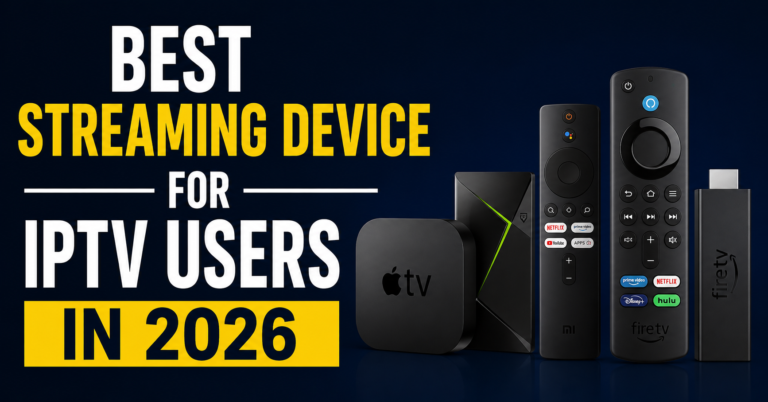
IPTV requires a player app layer. On Android-based devices (Firestick, Android TV boxes, Nvidia Shield), apps like TiviMate, IPTV Smarters Pro, and OttNavigator work well when configured properly. On Samsung Tizen and LG webOS, the options are more limited and often require M3U import via third-party apps or a MAG box.
Apple TV is the most restrictive environment. There’s no sideloading, so IPTV delivery on Apple TV depends on whether the provider’s recommended app has an iOS version that supports Apple TV, and many don’t.
A Sub-Reseller Perspective: What the Customer Comparison Actually Shows
From a sub-reseller’s operational view, the streaming service comparison customers are running isn’t always between IPTV and Netflix. Increasingly it’s between different IPTV panel providers.
Customers who’ve had IPTV for two or three years have usually been burned at least once by a panel that disappeared, had persistent buffering, or silently removed channels. They’re running an implicit streaming service comparison every renewal cycle.
What keeps them:
- Consistent stream quality during the events they care about
- A reseller who communicates proactively when issues occur
- Quick credit or reconnection when outages happen
- Honest channel availability (no listing channels that aren’t reliably delivered)
The streaming service comparison at this level is fundamentally about trust over time, not features on day one.
FAQ: Streaming Service Comparison for UK Households and Resellers
How does IPTV compare to Netflix for live sports in the UK?
IPTV panels typically carry more live sports channels than Netflix, which has no live sport at all in the UK. However, reliability during high-demand events depends entirely on the panel operator’s infrastructure. A quality panel from a reputable UK-focused reseller consistently outperforms budget alternatives during Premier League fixtures, but no IPTV service matches the guaranteed uptime of a Sky subscription.
Is a streaming service comparison between IPTV and Sky worth doing?
Yes, but compare the right variables. Sky offers legal, guaranteed delivery with full ISP support and native device apps. IPTV offers significantly more channels at a fraction of the cost but with variable reliability. Most UK households end up running both, Sky or Now TV for the primary viewing experience, IPTV for international content or as a cost-reducing alternative.
What causes IPTV to buffer when Netflix works fine on the same connection?
This is almost always a routing issue, not a speed issue. Netflix has peering agreements with UK ISPs and CDN infrastructure. IPTV streams from origin servers without those agreements. During peak hours, ISPs deprioritise unrecognised traffic patterns. A speed test shows your connection is fine because the ISP isn’t throttling Netflix, it’s shaping everything else.
How should a new IPTV reseller position themselves in a streaming service comparison?
Focus on the specific use cases where your panel genuinely outperforms alternatives: live international channels, sports not available on UK OTT platforms, and price-per-stream value. Don’t compete with Netflix on VOD quality or with Sky on reliability guarantees. Compete on scope and value for the customer who already knows what IPTV is.
How many streams do I need as a family household?
Most families need a minimum of two concurrent streams, one for the main TV, one for a secondary device. Panels offering three to five concurrent streams eliminate household conflicts entirely. In a streaming service comparison for families, concurrent stream allowances are often the deciding factor between plans.
What happens to my streams if the IPTV provider’s server goes down?
On a properly configured panel with failover infrastructure, your stream is automatically rerouted to a backup server within seconds. On a single-node operation with no redundancy, you lose access until the operator manually resolves the issue, which could take hours. Always ask a provider whether they operate redundant servers before purchasing.
Can I run a streaming service comparison using a free IPTV trial?
Yes, and you should. A 24–48 hour trial during weekday and weekend evening hours gives you a real performance sample. Test specifically during evening peak hours and during any live sports events happening in that window. Free trials on quiet Tuesday afternoons don’t replicate actual load conditions.
What’s the most honest streaming service comparison for cost-conscious UK viewers?
For pure value, a quality British IPTV panel in the £8–£15/month range covers live TV, international channels, and a large VOD library. Add one OTT subscription (Netflix or Disney+ depending on your content preferences) for £5–£12/month. Total spend: under £25/month for a viewing experience that would cost £50+ through conventional platforms alone.
Reseller and Subscriber Checklist
For subscribers: test your chosen panel during peak hours before committing to a long subscription. Confirm concurrent stream allowance matches your household size. Ask explicitly whether the provider operates failover servers. Run your streaming service comparison during live sports, not idle afternoons. Combine one OTT platform with IPTV for maximum coverage at minimum cost.
For resellers: stop leading with channel count, lead with reliability evidence instead. Document your panel’s uptime during recent major sports events and share it. Set up a secondary contact method for outage communication (WhatsApp group, email list). Position clearly in the customer’s streaming service comparison, what you’re better at and what you’re not. Audit your most-watched channels monthly, broken or unstable links drive silent churn.
For sub-resellers: know your upstream panel’s infrastructure basics before reselling it. Never promise 100% uptime, promise fast communication and resolution when issues occur instead. Build renewal communication into your workflow at 7 days before expiry. Keep a short, honest FAQ ready for the streaming service comparison questions customers will ask. Track which channels generate the most support complaints and escalate upstream early.