
Here’s something most subscribers never see: the moment Mohamed Salah lines up a penalty at Anfield, somewhere a panel operator is watching a graph spike vertically and quietly praying their backup uplink holds. That single instant, tens of thousands of concurrent viewers slamming the same stream, is where Premier League UK IPTV either proves itself or falls apart in front of everyone.
I’ve sat through enough of those nights to tell you the buffering you blame on your Firestick usually has nothing to do with your Firestick. The real story lives upstream, in the infrastructure decisions made months before kickoff. And almost nobody writing about Premier League UK IPTV explains what’s actually happening behind that spinning wheel.
So let’s do that instead.
The Matchday Load Curve Nobody Plans For
Football traffic doesn’t behave like normal streaming. A film gets watched across an evening; a Premier League match gets watched by everyone at exactly the same second. The load curve isn’t a gentle hill, it’s a wall.
During one Liverpool-Manchester City fixture we watched concurrent connections on a single source jump roughly 4x in under ninety seconds. Servers that idled comfortably all week simply fell over. The lesson stuck: capacity that looks generous on a Tuesday is dangerously thin at 5:30pm on a Saturday derby.
Pro Tip: Judge any Premier League UK IPTV Reseller Panel service by its behaviour during a title-deciding fixture, never a midweek dead rubber. Anyone can stream Burnley vs Bournemouth. The big six clashes are the real stress test.
This is why a cheap service can feel flawless for three weeks and then humiliate you the one night you actually invited friends over.
Why the Saturday 3pm Blackout Still Causes Problems
The UK has a peculiarity no other Premier League market shares: the Saturday 3pm broadcast blackout. Domestically, those matches aren’t legally televised live, which historically pushed huge demand toward unofficial streams clustered in a tight window.
That concentration matters technically. Instead of demand spreading across staggered kickoffs, a chunk of it compresses into the same blacked-out slot, and unlicensed streams of those fixtures attract the most aggressive enforcement attention of the week. So the exact matches people most want are the ones running on the thinnest, most-targeted infrastructure.
Understanding that one quirk explains more about UK matchday instability than any device tutorial ever will.
How ISP Blocking Has Quietly Changed
A few years ago, blocking meant a static list of banned IP addresses. Simple to dodge. That era is over.
UK ISPs now run dynamic, time-boxed blocking that activates around kickoff windows and lifts afterwards, coordinated specifically against live sport. The blocking is event-aware. Add deep packet inspection and traffic fingerprinting, and the network can increasingly recognise the shape of a video stream even without knowing its destination.
| Old-era blocking | Modern matchday blocking |
|---|---|
| Static IP restricted | Dynamic, time-windowed blocks |
| Always-on | Activates around kickoff |
| DNS-level only | DNS + DPI + fingerprinting |
| Easy to circumvent | Adapts within the same match |
| Generic | Sport-event targeted |
We’ve watched a stream run perfectly until 12:29pm, drop dead at 12:30 kickoff, and resurrect at full-time. That isn’t your provider being lazy. That’s a network actively hunting live football the moment it goes live.
What Buffering Is Really Telling You
Subscribers treat buffering as one problem. It’s at least three, and they need different fixes.
Source-side collapse happens when the provider’s server is overwhelmed by matchday concurrency, affecting everyone on that stream at once. Route-side interference is your ISP throttling or blocking the path during the kickoff window, and it often fixes itself the moment the match ends. Last-metre issues come from your own Wi-Fi, an overheating Firestick, or a congested home network at peak evening hours.
Here’s the diagnostic shortcut: if buffering hits only during big matches and clears afterward, suspect source or route, not your hardware. If it happens on a quiet Netflix night too, look at your own setup first.
Pro Tip: Before you blame any Premier League UK IPTV provider, run a quick wired test on one device during a non-match hour. Isolating the variable saves you weeks of pointless provider-hopping.
The Legal Side Most UK Viewers Underestimate
This part gets glossed over, so I’ll be direct. In the UK, accessing Premier League matches through unauthorised IPTV streams sits firmly on the wrong side of the law, and enforcement has shifted from chasing operators to occasionally warning end users. Premier League legal action against unlicensed streaming has expanded considerably, and that’s a verifiable, ongoing trend rather than scaremongering.
The legitimate routes, Sky, TNT Sports, Amazon Prime for selected fixtures, are expensive and fragmented, which is precisely why the unofficial market exists. I’m not going to pretend that frustration isn’t real. But anyone selling you “100% legal Premier League UK IPTV for £10 a year” is lying, and the gap between that promise and reality is where people lose both money and data.
Pro Tip: If a service advertises full live Premier League coverage at an impossibly low annual price, treat the price itself as the red flag. Sustainable infrastructure for matchday load is genuinely expensive, nobody runs it as a loss leader out of generosity.
For Resellers: The Night Your Reputation Is Decided
If you run a reseller panel, forget your quiet-week numbers. Your entire reputation as an IPTV operator is built or destroyed across roughly fifteen Saturdays a season.
After reviewing hundreds of support tickets across panels, the pattern is brutally consistent: churn doesn’t spike when service is mediocre on a Wednesday. It spikes when a customer’s stream dies during a match they’d been looking forward to all week. Emotional context multiplies the complaint.
Where panel owners get caught out: provisioning panel credits against average load, not peak concurrency. Relying on a single upstream source with no failover. No backup uplink or geo-routing when the primary path gets throttled. Zero live monitoring, so you learn about an outage from angry customers. Onboarding new sub-resellers right before a big-six weekend, stacking untested load.
One reseller we knew lost a meaningful share of his subscriber base in a single weekend, not from a hack, but from a derby-day outage he hadn’t provisioned for. He’d grown his distribution network faster than his infrastructure could carry it.
Reseller Pricing Psychology
Credit resellers chronically underprice, then can’t fund redundancy. The cheapest panel in a WhatsApp group wins signups and loses them just as fast when matchday exposes the thin backend. Customers will quietly pay more for a service that simply works when Arsenal kick off. Reliability, not price, is the retention engine, and most panel owners learn that the expensive way.
| Cheap panel setup | Matchday-ready panel setup |
|---|---|
| Single upstream source | Multiple sources with failover |
| Priced on average load | Provisioned for peak concurrency |
| No monitoring | Active real-time monitoring |
| One uplink | Backup uplinks + geo-routing |
| Churn spikes on big games | Stable through derbies |
Trial Conversions and the Football Calendar
Here’s a counterintuitive one. Most operators offer trials whenever a customer asks. Wrong timing.
A trial during a quiet week shows nothing, the service looks identical to every competitor. A trial that spans a high-profile fixture lets a strong service prove itself exactly when it matters. We’ve consistently seen higher trial-to-paid conversion when the trial window deliberately includes a marquee match. Let your infrastructure do the selling on the one night rivals fall over.
If you’re weighing where to source reliable upstream capacity, established UK IPTV reseller-focused providers such as iptvvendors.com build specifically around UK matchday demand, which is a different engineering problem from generic 24/7 streaming.
Which Devices Actually Survive Peak Load
Hardware matters more at peak load because a struggling stream gives a weak device no margin.
Amazon Firestick (older models) is the UK’s most common IPTV device and the most common to thermally throttle during long, high-bitrate matches. The 4K Max handles HEVC far better. Android TV boxes with decent RAM are generally the most forgiving for football because they manage buffer and codec load better. Smart TVs (Tizen/WebOS) are convenient, but onboard apps often handle stream switching poorly when a source fails mid-match. MAG boxes are stable for straightforward setups, less flexible when you need to fail over fast.
Pro Tip: For Premier League UK IPTV specifically, prioritise a device with proper H.265/HEVC hardware decoding. Football’s constant motion is bitrate-hungry, and software decoding is the quiet cause of “it only buffers during fast play” complaints.
Why H.265 and Bitrate Decide Your Matchday
Fast-moving sport is the hardest content to compress cleanly. A panning camera following a counter-attack generates far more data than two people talking in a drama. That’s why a stream that looks crisp on a film can smear into mush during a quick break.
HEVC/H.265 compresses that motion more efficiently, but only if your device decodes it in hardware. Pair an HEVC stream with a device that falls back to software decoding and you get stutter precisely during the most exciting passages, the worst possible moment.
Frequently Asked Questions
Is Premier League UK IPTV legal in the United Kingdom?
Licensed services that hold broadcast rights, Sky, TNT Sports, and Amazon for selected fixtures, are legal. Accessing live Premier League matches through unauthorised IPTV streams is not, and UK enforcement against unlicensed live-sport streaming has intensified. Any service promising full live coverage at an implausibly low price is operating outside the law.
Why does my Premier League UK IPTV stream buffer only during big matches?
Because big-match concurrency overwhelms thinly provisioned sources, and UK ISPs run time-windowed blocking around kickoff. If buffering appears only during marquee fixtures and clears at full-time, the cause is upstream, source overload or route interference, not your device or home Wi-Fi.
What’s the single biggest mistake new IPTV resellers make with football traffic?
Provisioning panel credits and capacity against average weekday load instead of peak matchday concurrency. The service feels flawless midweek, then collapses during a derby. Reputation and churn are decided across roughly fifteen high-profile Saturdays a season, not the quiet nights in between.
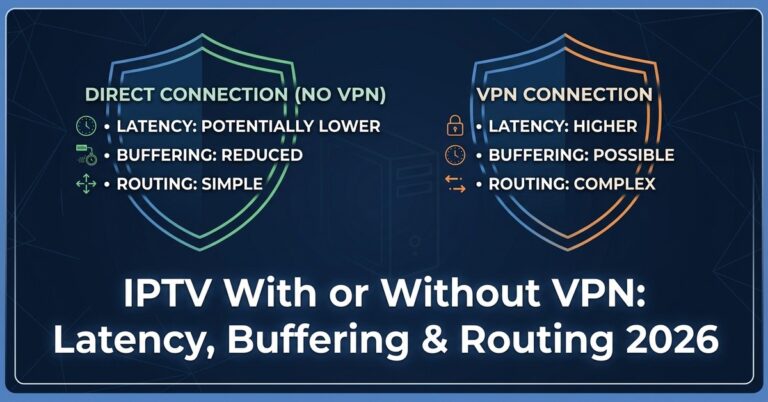
Does a VPN fix matchday buffering?
Sometimes, but not reliably. A VPN can route around ISP-level blocking or throttling, which helps with route-side interference. It does nothing for source-side collapse. If the provider’s server is overwhelmed by concurrent viewers, a VPN just gives you a clearer view of an overloaded stream.
Why is the Saturday 3pm slot specifically unstable in the UK?
Those matches aren’t broadcast live domestically, concentrating demand into one window and drawing the heaviest enforcement of the week. The fixtures people most want sit on the thinnest, most-targeted infrastructure, a UK-specific quirk that explains a lot of weekend instability.
Which device handles Premier League streams best?
An Android TV box with adequate RAM or a Firestick 4K Max, both with hardware HEVC decoding. Football’s high motion demands efficient compression, and devices relying on software decoding stutter during fast play. Avoid older Firesticks for long, high-bitrate matches, they thermally throttle.
How can a reseller reduce churn around big fixtures?
Provision for peak concurrency, run multiple sources with automatic failover, add backup uplinks, and monitor in real time so you catch outages before customers do. Avoid onboarding new sub-resellers right before a big-six weekend, since untested load stacked onto matchday demand is a common collapse trigger.
Is cheap Premier League UK IPTV ever worth it?
Rarely for football. Matchday-ready infrastructure is genuinely expensive to run, so the cheapest panels almost always cut redundancy. They feel fine until peak load exposes the thin backend. For sport specifically, reliability during marquee fixtures matters far more than saving a few pounds.
For Resellers: Matchday Checklist
Provision capacity against peak matchday concurrency, not weekday averages. Run multiple upstream sources with automatic failover. Add backup uplinks and geo-routing for kickoff-window throttling. Deploy real-time monitoring so you detect outages before customers report them. Confirm your upstream panel’s failover before a big-six weekend, not after. Don’t stack new customer load onto an untested source right before a derby. Price for reliability, funding redundancy rather than chasing the lowest WhatsApp-group rate. Offer trials that deliberately span a high-profile fixture to lift conversions. Keep a record of which fixtures triggered complaints to spot capacity ceilings. Set honest expectations with customers about Saturday 3pm volatility, and escalate source-side issues upstream fast rather than absorbing the churn yourself.
The One Lesson Worth Keeping
Premier League UK IPTV doesn’t get judged on the 340 quiet hours of the week, it gets judged on the fifteen-odd Saturdays when everyone watches the same stream at the same second. Build, buy, and price for that moment, and everything else takes care of itself.
The cheapest service and the most reliable one look identical until kickoff. The entire difference shows up in the ninety minutes that matter most, which is exactly why matchday, not the marketing page, is the only honest test there is.