
If you want to follow Open Qualifying in 2026 through an IPTV setup, the honest answer is this: the cleanest, safest route is to use a properly licensed broadcaster app or website for the event itself, and to treat IPTV as the technical delivery layer for content you are legally allowed to access. This Open Qualifying 2026 Live IPTV Streaming Guide walks you through how the streaming actually works, what gear you need, how to avoid buffering, and where the legal lines sit, all in plain language without dressing anything up.
A lot of people type that phrase into Google expecting a magic link. There isn’t one, and anyone selling you a “guaranteed feed” of a live event is usually skating on thin ice. What this guide gives you instead is the real mechanics: how streaming protocols move a picture from a server to your screen, why some setups stutter and others don’t, and how the reseller side of the industry works if you’re curious about the business end of it. By the end you’ll understand the whole picture, not just one shortcut.
What the Open Qualifying 2026 Live IPTV Streaming Guide Actually Covers
Let’s set expectations first, because that saves everyone time. This guide is about infrastructure and access, not about handing you a stream of a specific copyrighted event. The Open Qualifying 2026 Live IPTV Streaming Guide explains how IPTV technology delivers video, how to set it up properly on your devices, and how to point yourself toward broadcasters who actually hold the rights.
Think of it like learning how a kitchen works before you cook. You need to know how the stove, the pans, and the heat interact. Once you understand that, you can cook anything you’re allowed to cook. The same logic applies here. Understanding the delivery system means you can watch any content you have legitimate access to, cleanly and without the usual headaches.
We’ll cover the protocol basics, the hardware that matters, the apps that behave well, and the part of the industry where people buy and sell access wholesale. If you’ve ever wondered why one setup looks crisp and another looks like a slideshow, that’s in here too.
Pro tip: Before you spend a penny on any setup, confirm which broadcaster holds the rights to the event you care about in your country. That single check saves you from buying access you can’t legally use.
How IPTV Streaming Works Behind the Scenes
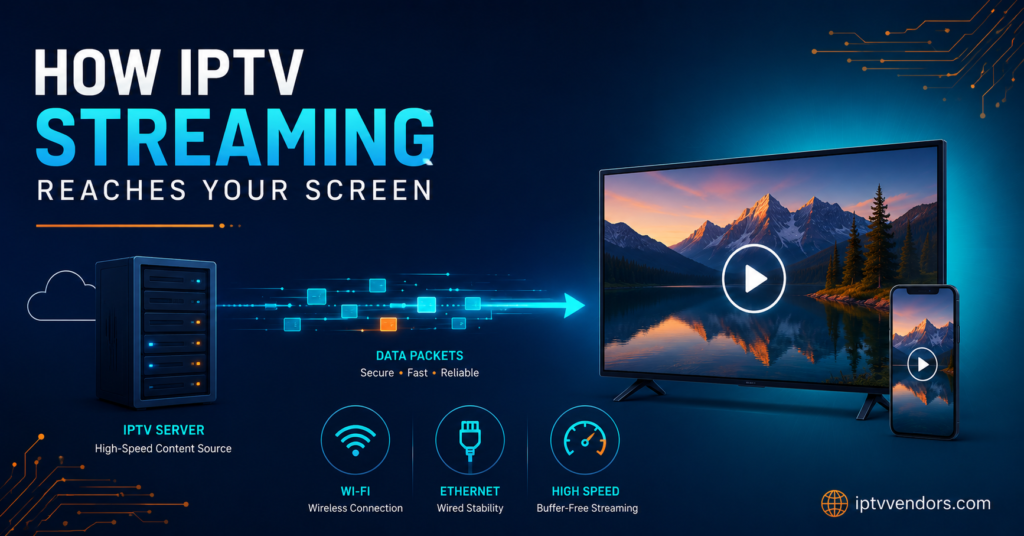
IPTV stands for Internet Protocol Television. In plain terms, instead of a signal arriving through an aerial or a satellite dish, the video arrives as data packets over your internet connection, the same way a website or a video call does. Your device reassembles those packets into a moving picture in real time.
The reason this matters for live content is timing. A live feed can’t buffer for thirty seconds the way a film can, because “live” means now. So the system leans on streaming protocols that prioritise a steady, low-delay flow. When that flow is healthy, the picture is smooth. When it’s choppy, you get the dreaded spinning wheel.
Most modern IPTV setups rely on a handful of formats to carry the stream. Here’s how the common ones compare in everyday use.
| Protocol | Best For | Typical Delay |
|---|---|---|
| HLS | Stable playback on most devices | 6 to 30 seconds |
| MPEG-DASH | Adaptive quality on changing connections | 5 to 20 seconds |
| RTMP | Lower-latency feeds, older setups | 2 to 5 seconds |
None of these is “the best” in every case. HLS is the workhorse because it plays nicely with almost everything. The point is that the protocol your provider uses shapes how live and how stable your experience feels.
Why the Open Qualifying 2026 Live IPTV Streaming Guide Stresses Your Connection First
People blame the app, the provider, or the device when playback stutters. Nine times out of ten, the real culprit is the connection between the server and your screen. That’s why this Open Qualifying 2026 Live IPTV Streaming Guide puts your internet setup ahead of everything else.
For a smooth standard-definition feed you want at least 10 Mbps of steady download. For high definition, aim for 25 Mbps or more. The word “steady” is doing heavy lifting there. A connection that averages 50 Mbps but drops to 3 Mbps every few minutes will buffer constantly, while a rock-solid 20 Mbps line will sail through.
Wired beats wireless every time for live content. If you can run an Ethernet cable to your streaming box, do it. If you’re stuck on Wi-Fi, sit close to the router and avoid the 2.4 GHz band when you can, because it’s slower and more crowded. Small changes here fix more buffering complaints than swapping providers ever does.
Pro tip: Run a speed test at the exact time of day you plan to watch, not at a quiet hour. Evening congestion is real, and your 8 p.m. speed is the number that actually matters.
Choosing Devices for Open Qualifying 2026 Live IPTV Streaming
Your hardware decides how good the whole thing feels. You can have a flawless feed and still ruin it with a sluggish, underpowered box. For reliable Open Qualifying 2026 Live IPTV Streaming, the device needs enough processing power to decode modern video formats without straining.
Streaming sticks are the popular entry point because they’re cheap and small, but not all of them handle high-bitrate live feeds well. A mid-range or higher stick with at least 2 GB of RAM handles things far better than the bargain-bin option. Android TV boxes give you more flexibility and app choice. A dedicated set-top box, often supplied through UK IPTV reseller setups, tends to be the most stable because it’s purpose-built.
Here’s a quick comparison of the common choices.
| Device Type | Strength | Watch Out For |
|---|---|---|
| Streaming stick | Cheap, portable | Weak on high-bitrate feeds |
| Android TV box | Flexible, app-rich | Quality varies by brand |
| Dedicated set-top box | Most stable playback | Less app freedom |
Whatever you pick, keep the firmware updated and don’t overload the device with background apps. A clean, current box is half the battle won.
The Apps That Make Open Qualifying 2026 Live IPTV Streaming Behave
The player app sits between your stream and your eyes, and a good one quietly fixes problems a bad one creates. For dependable Open Qualifying 2026 Live IPTV Streaming, you want a player that buffers intelligently, supports the common protocols, and lets you adjust settings when things get rough.
Several well-known players handle M3U playlists and Xtream-style logins, which are the two formats most setups use. The better ones let you tweak the buffer size, switch audio tracks, and force a quality level if your connection is wobbling. That last feature alone can turn a stuttering mess into a watchable picture.
Avoid apps that bury you in adverts or ask for permissions that have nothing to do with playback. Those are usually a sign of a cheap, unstable product. Stick with players that have a clear reputation and regular updates. If you’re sourcing your access through a reseller panel, they’ll often recommend a player they’ve tested against their own servers, which is worth listening to.
Pro tip: Set your player’s buffer slightly higher than the default for live feeds. You trade a couple of seconds of delay for a much smoother picture, and for live content that’s almost always the right swap.
Where to Watch Legally Without Crossing Any Lines
Here’s the part that keeps you out of trouble. The rights to any major live event are sold to specific broadcasters in each country. The legitimate way to follow Open Qualifying in 2026 is to find which official broadcaster or streaming service holds those rights where you live, and watch through them.
That might be a national broadcaster’s own app, a paid sports streaming service, or an official platform tied to the event itself. These services are the ones that paid for the rights, which means your viewing is clean, the quality is reliable, and nobody’s going to send anyone a takedown notice. It’s genuinely the path of least resistance once you stop looking for shortcuts.
I’ll be straight with you about the grey area, because pretending it doesn’t exist helps nobody. A lot of IPTV services advertise access to live events they don’t hold rights to. Using those puts you on the wrong side of copyright law, and the feeds tend to be unstable anyway because they’re often shut down mid-event. The technology itself is perfectly legal. What you point it at is where the legal line sits, and that distinction is the whole game.
Understanding the Reseller Side of Open Qualifying 2026 Live IPTV Streaming
A big chunk of the industry isn’t viewers at all, it’s resellers. These are people who buy access wholesale and sell subscriptions to their own customers. If you’ve been reading this Open Qualifying 2026 Live IPTV Streaming Guide and wondering how the business actually runs, this is it.
A reseller buys credits in bulk from a provider, then converts those credits into subscriptions for customers through a dashboard. They set their own prices and keep the margin. There’s no app to build and no servers to run on their end, because the infrastructure sits with the wholesale provider. It’s closer to running a shopfront than building a factory.
If this appeals to you, the responsible version of it means dealing only in legitimate content and being upfront with customers about what they’re actually buying. Plenty of operators run clean businesses this way, focusing on the technology and infrastructure rather than promising access to things they have no right to sell.
People exploring this route often start by comparing a wholesale IPTV reseller panel against the entry-level packages on offer, since that decides how much margin room you have from day one.
What a Reseller Panel Looks Like in Practice
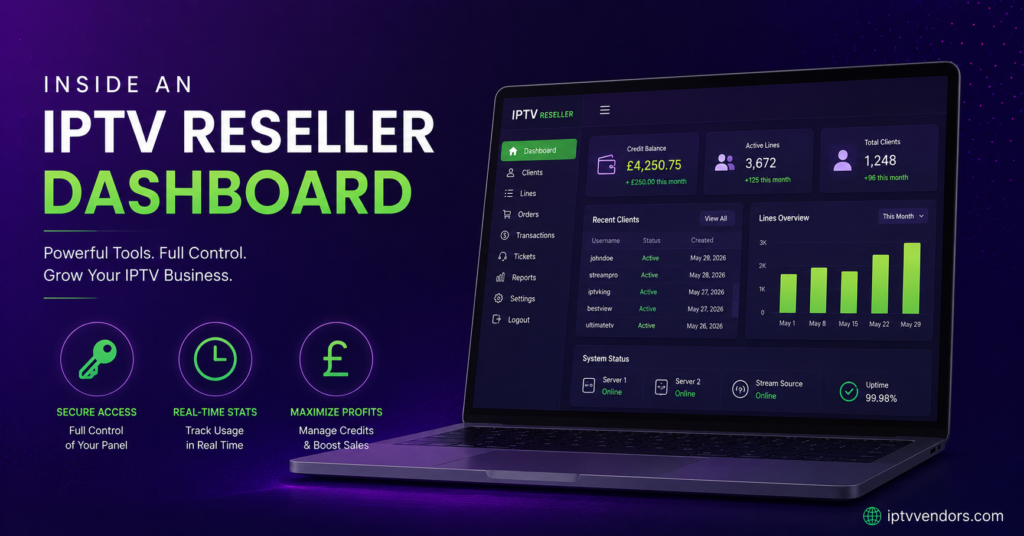
If you’ve never seen one, a reseller dashboard is just a control panel in your browser. You log in, see your credit balance, and create customer accounts. Each account gets a subscription length, a login, and an expiry date that you control.
The appeal is that everything runs from one screen. You can see who’s active, how many credits you’ve got left, and when each customer is due to renew. Good panels also show you which connections are live, which helps you spot if an account is being shared beyond what you allow. It’s simple enough that anyone comfortable with a basic web tool can run it.
The skill in the reseller game isn’t technical, it’s commercial. Finding customers, pricing sensibly for your market, and keeping people renewing is where the real work sits. Anyone weighing up how to start an IPTV business usually finds the dashboard is the easy part, and the customer side is what takes effort.
Common Open Qualifying 2026 Live IPTV Streaming Problems and Quick Fixes
Even a good setup hiccups sometimes. The trick is knowing which knob to turn. Most Open Qualifying 2026 Live IPTV Streaming problems fall into a few familiar buckets, and almost all of them have a fast fix.
Buffering is usually a connection issue, so check your speed and switch to a wired connection before blaming anything else. A frozen picture often means the server is overloaded or the stream has dropped, and a quick app restart usually clears it. If audio and video drift out of sync, closing and reopening the player resets the timing.
If channels won’t load at all, your playlist or login details may have expired, which is common when a subscription lapses. And if everything looks grainy, your player may have auto-dropped the quality to cope with a weak connection, so forcing a higher setting, if your speed allows, sharpens it back up. None of these need a technician. They’re five-minute fixes once you know where to look.
Pro tip: Keep a second player app installed as a backup. If one app chokes on a stream, the other often plays it fine, and switching takes seconds instead of a frustrating evening of troubleshooting.
Keeping Your Open Qualifying 2026 Live IPTV Streaming Setup Secure
Security gets ignored until something goes wrong, and by then it’s a hassle. A few simple habits keep your Open Qualifying 2026 Live IPTV Streaming setup safe and your details out of the wrong hands.
Use a strong, unique password for any account tied to your service, and never reuse the same one across multiple sites. If a provider asks you to disable your firewall or grant odd permissions, treat that as a red flag and walk away. Legitimate setups never need you to lower your defences like that.
A VPN is worth considering for privacy, though it can sometimes slow your connection, so test your speed with it on before committing to it for live viewing. Above all, stick to providers and apps with a track record. The cheapest, newest, most aggressive deal is often the one that vanishes with your money. A little caution here protects both your wallet and your data.
Conclusion
The whole point of this Open Qualifying 2026 Live IPTV Streaming Guide is to give you the real picture instead of a false shortcut. IPTV is simply a way of delivering video over the internet, and it’s perfectly legal technology. The smooth, trouble-free experience comes from a steady connection, a capable device, a sensible player, and pointing all of it at content you actually have the right to watch.
For the event itself, the clean route is always the official broadcaster who holds the rights in your country. That keeps your viewing reliable and keeps you on the right side of the law, which matters more than any temporary saving. If the business side caught your eye, the reseller model is a legitimate way in, as long as you build it on real content and honest dealing. Get those foundations right and the Open Qualifying 2026 Live IPTV Streaming experience, whether you’re watching or running a panel, works the way it should.
Surprise Section: Checklists for Every Type of User
Different people read this guide for different reasons, so here are three quick checklists to send you off in the right direction.
Subscriber Checklist
- Confirm which official broadcaster holds the rights in your country before paying for anything
- Test your internet speed at your actual viewing time, not a quiet hour
- Use a wired connection where possible for live content
- Install a reliable player and a backup player
- Set a slightly larger buffer for live feeds
- Keep your device firmware updated
Reseller Checklist
- Choose a credit package that matches your expected customer volume
- Deal only in legitimate, rights-cleared content
- Be upfront with customers about exactly what they’re buying
- Learn the dashboard before you take on your first customer
- Price sensibly for your local market
- Keep track of renewals to protect your recurring income
Sub-Reseller Checklist
- Understand the margin left after your upstream reseller’s cut
- Confirm what support your supplier actually provides
- Test the service yourself before reselling it to anyone
- Keep clear records of your own customers and their expiry dates
- Don’t overpromise on content you can’t verify
- Build a small, reliable customer base before scaling up