
Ask any cricket fan who has watched a death over freeze at the worst possible second, and you’ll get the same haunted look. The wicket falls on the radio in the next room before your screen even catches up. That single moment, more than any pricing chart, is where most people start quietly comparing IPTV vs traditional sports channels for cricket fans.
Here’s the short answer before the long one. Traditional broadcast channels almost always win on raw reliability and lowest delay, especially for big live events. IPTV wins on flexibility, multi country access, and watching obscure bilateral series that local broadcasters never bother to license. Most serious cricket viewers don’t pick one. They keep a broadcast option for finals and a streaming option for everything else.
Why the gap exists comes down to how the signal travels. Satellite and cable push the same feed to millions through dedicated infrastructure built for one job. Streaming chops video into small chunks, sends them over the open internet, and reassembles them on your device. More steps, more places to stall.
The latency problem nobody warns cricket fans about
Delay is the dealbreaker. On satellite, you might sit five to eight seconds behind the live action. On many IPTV streaming setups, that stretches to thirty seconds or more, depending on the chunk size the service uses for HLS delivery.
For a film, nobody cares. For cricket, thirty seconds is brutal. Your phone buzzes with a notification. The neighbour shouts. The group chat erupts. You’re still waiting for the bowler to run in.
Pro Tip:
If your stream sits more than 20 seconds behind, mute every cricket notification and leave the room chats. The spoiler gap, not the buffering, is what ruins live cricket on a slow feed. Half the “lag” complaints we see are really notification spoilers, not video stalls.
We learned this during a World Cup semi final a few seasons back. Customers weren’t actually angry about buffering. They were angry that Twitter knew the result before they did. After reviewing hundreds of support requests that week, the pattern was unmistakable. People will tolerate a slightly soft picture. They will not tolerate learning the score from someone else.
What actually breaks during a big match
Cricket traffic is spiky in a way ordinary viewing isn’t. A Tuesday night drama pulls a steady, predictable audience. An India Pakistan game pulls a tidal wave into a few hours, then nothing.
That spike is where weak setups fall apart. A service that streams perfectly on a quiet weekday can crumble the moment a marquee fixture starts and concurrent viewers triple.
| Quiet weekday viewing | Major cricket event |
|---|---|
| Steady, predictable load | Sudden concurrent surge |
| Single source usually fine | Needs backup uplinks |
| Buffering rare | Buffering common on weak setups |
| Support quiet | Support floods within minutes |
| Latency stable | Latency drifts under pressure |
Traditional broadcast doesn’t flinch here. The satellite feed reaches ten people or ten million identically, because the delivery model was never tied to how many devices tuned in. Streaming load, by contrast, scales with every viewer, and the infrastructure behind the service has to actually absorb that.
Why your internet matters more than the service
A frustration we run into constantly. People blame the streaming service when the real culprit is their own connection during peak hours. Around 8pm, when an entire neighbourhood is online, your ISP is congested, and cricket suffers first because live video has zero tolerance for jitter.
A few things genuinely help:
- Use a wired connection for the main screen instead of Wi Fi during important matches
- Close background devices quietly eating bandwidth in other rooms
- Restart your router before play starts, not after it stalls
- Avoid peak hour 4K if your line is marginal; 1080p holds far steadier
- Test your real speed during the evening, not at noon when everything looks fine
One viewer swore his service was broken every single evening. It worked flawlessly at midnight. His connection, not the platform, collapsed under household demand the moment everyone got home.
The coverage gap that pushes fans toward streaming
Here’s where traditional channels lose ground hard. Your local broadcaster shows the cricket it paid for. A West Indies tour of Bangladesh, a domestic T20 league halfway across the world, a warm up series before a major tournament; often, none of it appears on the channels you already pay for.
This is the quiet engine behind the whole IPTV vs traditional sports channels for cricket fans debate. It usually isn’t about price at all. It’s about a die hard who wants every match their team plays, not just the ones a regional rights deal happened to cover.
Pro Tip:
Before committing to any streaming option for cricket, check the actual fixture list for the next six months against what your current broadcaster shows. The gap between “matches I want” and “matches I get” is the only comparison that matters for your situation.
Cost, compared like an adult
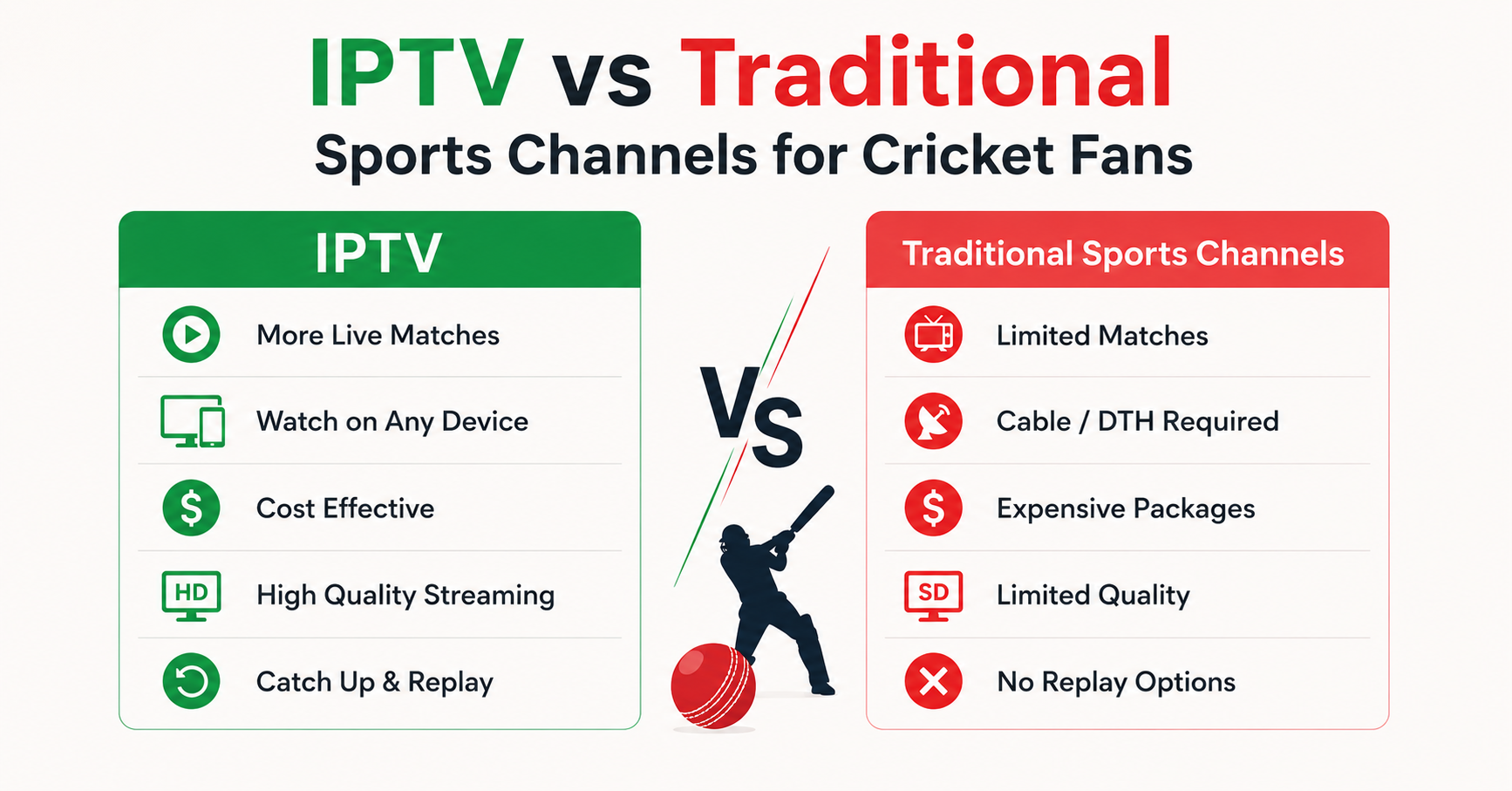
Money matters, but the headline price misleads. A broadcast sports package looks expensive monthly, yet it bundles reliability, official commentary, and zero technical fuss. A streaming option looks cheap until you count a stronger router, the occasional missed over, and evenings spent troubleshooting.
| Factor | Traditional sports channels | IPTV streaming |
|---|---|---|
| Upfront cost | Higher monthly | Often lower |
| Reliability | Very high | Depends on setup |
| Match coverage | Limited to rights deals | Frequently broader |
| Latency | Lowest | Higher, variable |
| Setup effort | Plug and play | Some configuration |
| Multi country access | Rare | Common |
The honest takeaway: if you only watch the marquee fixtures your local channel already carries, traditional broadcast is usually the calmer, safer choice. If you chase global cricket your broadcaster ignores, streaming starts earning its place. The right answer in IPTV vs traditional sports channels for cricket fans depends entirely on which kind of fan you are.
A note for resellers serving cricket audiences
If you run an IPTV reseller panel and your customers are cricket heavy, your busiest hours aren’t evenly spread. They cluster violently around the fixture calendar. A reseller who ignores the cricket schedule gets blindsided every single tournament.
A mistake we see repeatedly: a new IPTV reseller signs customers in a quiet month, everything looks stable, and then a major series lands and the panel buckles under concurrent load nobody planned for. The panel owner who survives that night is the one who treated the cricket calendar as an infrastructure planning document, not a marketing afterthought.
Practical habits that separate a steady IPTV operator from a struggling one:
- Map your panel credits and capacity against the upcoming cricket fixture calendar, not against an average month
- Brief sub resellers before marquee fixtures so support load is shared, not dumped on one person
- Watch concurrent viewer numbers as the toss approaches, because that single hour exposes every weak link
- Keep an honest reliability message with customers; an IPTV reseller who overpromises during a final loses them permanently
- Set credit reseller pricing with peak demand in mind, since the cheapest panel rarely survives a real spike
Pro Tip:
The single most useful number for any IPTV business owner serving cricket fans is concurrent viewers at peak, not total subscribers. Total subscribers flatter your ego. Concurrent peak tells you whether your distribution network actually holds when it matters. Every serious reseller panel should be watching it live during finals.
The resellers who keep customers season after season aren’t the ones with the flashiest panel. They’re the ones whose service simply didn’t stutter when the wicket fell. For operators weighing infrastructure seriously, reliability during peak events is the differentiator, and platforms like britishseller.co.uk position around exactly that kind of peak load resilience rather than headline pricing alone.
How blocking and routing quietly shape your experience
Worth understanding, even as a viewer. ISPs increasingly use traffic fingerprinting and DNS level interference to throttle or block certain streaming patterns, and this has sharpened noticeably into 2026. The result on your end looks like random buffering that mysteriously clears when you switch networks.
This is why a stream can run flawlessly on mobile data yet stutter on home broadband, or the reverse. It isn’t always the service failing. Sometimes it’s the path between you and the service being quietly squeezed. Multi uplink redundancy and sensible DNS routing on the provider side are what separate a platform that shrugs this off from one that collapses every time an ISP tightens the screws.
Frequently asked questions
Is IPTV or traditional better for watching live cricket?
For pure reliability and the lowest delay on major matches, traditional sports channels usually edge ahead. In the IPTV vs traditional sports channels for cricket fans comparison, IPTV wins on coverage breadth and multi country access. Most committed fans run both, using broadcast for finals and streaming for series their local channel ignores.
Why does my cricket stream lag behind live action?
Streaming breaks video into small chunks sent over the open internet, which adds delay compared with satellite. Larger chunk sizes mean smoother playback but more lag. The real annoyance is usually spoilers from notifications arriving before your feed catches up, so muting alerts during play helps enormously.
Does IPTV vs traditional sports channels for cricket fans come down to cost?
Less than people assume. Broadcast packages cost more monthly but bundle reliability and zero setup fuss. Streaming can be cheaper yet may need a better router and some troubleshooting. The deciding factor is usually coverage, whether your local broadcaster actually carries the cricket you care about.
Why does my stream buffer only during big matches?
Cricket traffic spikes hard around marquee fixtures, tripling concurrent viewers in minutes. Weak setups that handle quiet weekdays fine collapse under that surge. Your own ISP congestion during evening peak hours often makes it worse, since live video has no tolerance for jitter or sudden bandwidth drops.
What should an IPTV reseller prepare before a major cricket series?
Map panel credits and capacity against the fixture calendar, not an average month. Brief your sub resellers ahead of marquee games so support is shared. Watch concurrent viewers as the toss nears. A UK IPTV reseller panel that overpromises reliability during a final loses customers permanently, so set honest expectations early.
Will a faster internet plan fix my cricket buffering?
Sometimes, but not always. If your line genuinely chokes at peak, more speed helps. Often the issue is evening ISP congestion or DNS level throttling, which raw speed won’t cure. Try a wired connection, lower the resolution from 4K to 1080p, and test your actual speed during evening hours.
Can I watch cricket series my local channel doesn’t show?
This is exactly where streaming pulls ahead. Local broadcasters only show cricket they hold rights to, leaving many bilateral tours and overseas leagues uncovered. A streaming option with broad multi country access often fills those gaps, which is the main reason coverage hungry fans switch in the first place.
Conclusion
Strip away the noise and the IPTV vs traditional sports channels for cricket fans question isn’t really about which technology is superior. It’s about which kind of cricket watcher you are. If you live for the marquee fixtures your local broadcaster already carries, traditional sports channels give you the lowest latency and the fewest headaches. If you chase every series your team plays across the globe, streaming earns its keep on coverage alone. The technically honest position in IPTV vs traditional sports channels for cricket fans is that the smartest fans refuse to choose, pairing a rock solid broadcast feed for finals with a flexible streaming option for everything in between.
Execution checklist
subscribers:
- Test your real internet speed during evening peak, not at noon
- Wire your main screen for important matches instead of relying on Wi Fi
- Mute cricket notifications when your feed runs more than 20 seconds behind
- Drop from 4K to 1080p if your line wobbles under load
- Check the six month fixture list against what your broadcaster actually shows
resellers:
- Map panel credits and capacity to the cricket calendar, not an average month
- Watch concurrent viewers as the toss approaches during marquee fixtures
- Set honest reliability expectations before finals, never after
- Price credit reseller packages with peak demand factored in
- Treat the fixture calendar as an infrastructure planning document
sub resellers:
- Confirm with your panel owner which big fixtures are coming before they land
- Warn your own customers about peak hour congestion ahead of major games
- Keep a direct support line open to the IPTV operator above you during spikes
- Don’t oversell capacity you haven’t seen tested during a real surge
- Track which matches drive your support tickets and plan staffing around them
A final thought worth keeping. The best cricket viewing setup isn’t the cheapest or the most expensive; it’s the one that doesn’t stutter at the exact moment the wicket falls. Reliability during that single second is what every fan actually pays for, whether they realise it or not. Build your choice around peak performance, not headline price, and the rest sorts itself out.