
IPTV Panel credits are the operational currency of every reseller business, and if you misunderstand how they work, you will feel it in your first busy renewal week. The credit system sounds simple in theory, buy in bulk, spend per activation, but the practical reality involves timing, buffer management, and package planning that no provider dashboard tutorial actually explains well.
What IPTV Credits Mean for Resellers
Credits are not just a billing mechanism. They represent your available inventory. Every time you activate a new user or process a renewal, the panel deducts the corresponding credit value from your balance automatically. One credit typically equals one month of service for one user, though this ratio varies depending on the package structure your provider uses.
The key distinction is that credits are pre-purchased. You are buying capacity in advance, not paying per transaction after the fact. This means your cash flow planning needs to account for credits as a stock level, not as a variable cost.
How the IPTV Credit System Works in Practice
When you log into your UK IPTV reseller dashboard for the first time, your credit balance sits prominently at the top of the screen. Below it, you will see your active user count and a list of accounts with their expiration dates. Every account you create draws from that balance at the moment of activation.
The panel handles the deduction automatically. You select the subscription length, confirm the account details, and the software pulls the matching number of credits from your balance. A three-month account costs three credits. A twelve-month account costs twelve. There is no ambiguity in the transaction, which is one of the things that makes this system straightforward once you understand the base rate.
What the dashboard does not warn you about is renewal clustering. If you sign up ten customers in the same week, all ten renewals arrive simultaneously four weeks later. I have had my balance drop by forty credits in a single afternoon during a renewal cluster, while new customer enquiries were still coming in. Plan for peaks, not averages.
Managing Your Credit Balance Across Busy Periods
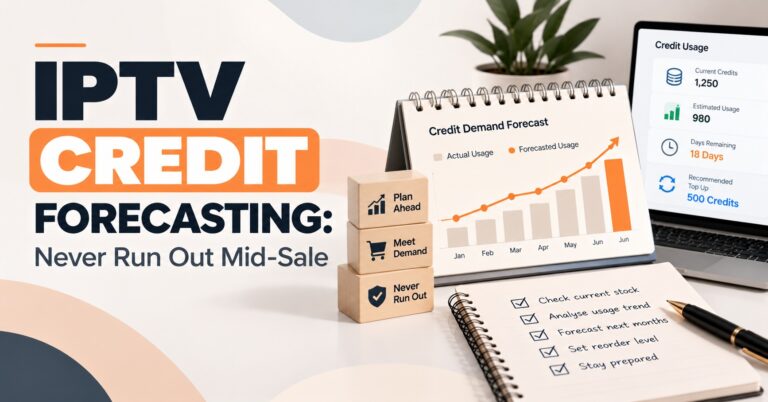
Credit discipline is the skill that separates operators who grow steadily from those who hit service interruptions. The practical rule I follow is to maintain a buffer of at least twenty-five percent above my projected monthly usage at all times. This covers unexpected renewals, trial activations, and any customer who wants to upgrade mid-cycle.
Your credit system top-up guide will show you the minimum purchase quantities available on your plan. Most providers offer better per-credit rates at higher volumes, so there is a legitimate reason to buy in larger batches once you know your monthly consumption pattern. In your first month, buy conservatively. In your second month, use the dashboard’s credit history to calculate exactly what you need.
The dashboard’s statistics section also shows credit usage trends over time. If you are not checking this weekly, you are missing the most useful planning tool the panel gives you.
Package Structures and Credit Allocation
Not all reseller businesses use the same package structure, and this directly affects how credits flow through your balance. Some operators offer only monthly plans, which creates a predictable and frequent renewal cycle. Others offer three-month, six-month, and twelve-month plans, which locks in revenue but depletes credits in larger single transactions.
The comparison below shows how credit consumption differs across common package lengths and what that means for balance management.
| Package length | Credits used | Renewal frequency | Balance impact |
|---|---|---|---|
| 1 month | 1 | Monthly | Frequent, small draws |
| 3 months | 3 | Quarterly | Moderate, predictable |
| 6 months | 6 | Twice yearly | Larger single deductions |
| 12 months | 12 | Annual | High upfront, low maintenance |
Longer packages are attractive because they reduce your renewal workload. The trade-off is that a batch of annual activations can clear a significant portion of your balance at once. Build your reseller panel plans around the package mix your customers actually prefer, not the one that looks best on a pricing page.
Common Mistakes to Avoid with IPTV Credits
Running the balance to zero is the most damaging mistake, and it happens more often than most new operators admit. When your credit balance hits zero, you cannot activate new accounts or process renewals. Customers get service interruptions. They leave. Rebuilding that trust takes longer than the credit top-up itself.
Buying too many credits too early is the second mistake worth watching for. Operators who load up on credits before they have the customer base to justify it tie up cash unnecessarily and sometimes overpay because they locked into a volume tier that does not match their actual usage. Start small, measure your consumption, then scale your purchases accordingly.
Misunderstanding the trial credit mechanism rounds out the list. Most panels allow you to create short-term test accounts that expire automatically without consuming a full credit. New resellers often skip this and use full credits for customer demos, which is an avoidable cost. Learn how your panel handles trial account setup before you start onboarding customers.
What to Look for When Choosing a Credit-Based Reseller Panel
The credit rate is the obvious factor, but it is not the only one. Start by checking whether the provider offers transparent per-credit pricing at different volume tiers. A provider who obscures this information before you buy is not easier to deal with after you buy.
Next, check whether the panel gives you real-time credit balance visibility and usage history. Some basic panels only show your current balance, not the transaction log behind it. Without transaction history, you cannot audit your own account or identify unusual deductions. That matters more than it sounds once your volume grows.
Also confirm how automated renewal notification systems work within the panel. The best panels send alerts when your balance drops below a threshold you set. This removes the need to monitor manually and prevents the zero-balance scenario that disrupts your customers.
Finally, review how the sub-reseller credit allocation system works if you plan to build a network beneath you. Allocating credits to sub-resellers from the same balance requires clear tracking, and not every panel handles this with enough granularity to be useful at scale.
Author Note: Written from direct experience running IPTV panel operations across UK and European markets.
Frequently Asked Questions
How many credits should I buy when I first start out?
Buy enough to cover your realistic first month of activations, plus a twenty-five percent buffer. If you expect ten customers in your first month on monthly plans, buy fifteen credits to start. This gives you room to activate everyone without running dry while you wait to collect payments. After the first month, your dashboard’s usage history will tell you exactly what to order next.
What happens if my credit balance runs out mid-month?
Any accounts already active will continue running until their expiration date, since the credit was already spent when they were created. The problem is that you cannot create new accounts or process renewals until you top up. This means customers due for renewal during a zero-balance period will experience service interruption. The only fix is to top up immediately and process overdue renewals as quickly as possible.
Do credits expire if I do not use them?
This depends entirely on the provider. Some platforms allow credits to roll over indefinitely. Others apply expiry windows, particularly at lower pricing tiers. Read the terms before you buy in bulk. If your provider applies expiry dates, large pre-purchases carry risk unless you have a customer base large enough to consume them within the window.
Can I give credits to a sub-reseller under my account?
Yes, if your panel supports sub-reseller functionality. You allocate a portion of your main credit balance to a sub-reseller’s panel, and they draw against that allocation when activating their own customers. Your main balance decreases as they use credits. This is why clear credit tracking at the main account level is so important when you are managing multiple sub-resellers simultaneously.
Is there a way to test the service without using full credits?
Most panels include a mechanism for short-duration trial accounts that use a fraction of a credit or no credit at all. The exact implementation varies by provider, but the option is usually in the user creation section of the dashboard, labelled as a trial or demo account type. Always confirm how your specific panel handles this before offering demos to potential customers, the cost difference adds up quickly if you are running trials incorrectly.
Before you buy your next batch of credits, open your dashboard’s usage history and calculate your actual consumption over the past thirty days. That number, not an estimate, is what your next order should be based on.