
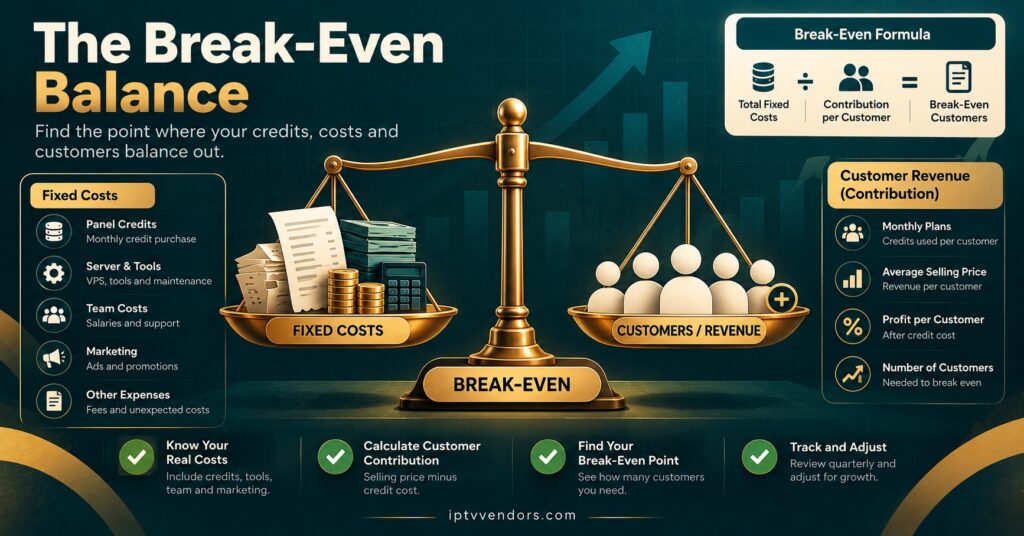
An IPTV Reseller Break-Even Calculator answers one question: how many paying subscribers you need before the business stops costing you money. Take your fixed monthly costs, divide them by what each subscriber leaves behind after credits, payment fees and refunds, then round up. With £87 a month in fixed costs and £7.20 left over from each £10 subscriber, you need 13 active customers to break even.
Most IPTV panel resellers get the arithmetic right and the inputs wrong. The usual slip is counting a bulk credit purchase as this month’s expense, which makes a healthy month look like a loss, or forgetting the payment processor’s cut, which makes a thin margin look comfortable. Getting those two lines right matters more than any spreadsheet template, and the rest of the calculation follows from them.
The Four Inputs an IPTV Reseller Break-Even Calculator Needs
Every version of the calculation, from a napkin sum to a full spreadsheet, runs on the same four numbers. If any of them is a guess, label it as a guess and come back to it once you have a month of real data.
Fixed monthly costs
These are the bills you pay whether you have three subscribers or three hundred: website hosting, the domain spread across twelve months, business messaging or helpdesk tools, accounting software, and any advertising budget you have committed to. If your panel provider charges a monthly platform fee on top of credits, it belongs here too.
Some resellers add a wage for their own time. That is a sensible choice if you want the calculator to tell you when the business pays you properly, rather than when it merely stops losing money. Just be consistent about which version you are looking at.
Variable cost per subscriber
This is what each active customer costs you per month. The largest part is the credit. Most panels work on one credit per month of service, as explained in this guide to how IPTV credits work inside IPTV reseller panels, so a monthly customer consumes one credit and an annual customer consumes twelve, spread across the year.
Add the payment processor’s fee, which is usually a percentage of the sale plus a small fixed charge. Then add an allowance for refunds, chargebacks and the occasional goodwill extension. Without that allowance, your calculator assumes every sale sticks, which no real customer base does.
Price per subscriber
Use the monthly equivalent of what customers actually pay. A £80 annual plan is £6.67 a month, not £80, and it should be treated that way in the formula.
The cost that is not a cost
Credits sitting unused in your panel balance are stock, not expenses. If you buy 200 credits in one go, that money has moved from your bank account into inventory. It only becomes a cost when a credit is spent activating or renewing a customer. Treating the whole purchase as a monthly expense is the single most common reason a break-even figure comes out wrong.
Turning the Inputs Into a Subscriber Target
The calculation has two steps.
First, work out the contribution per subscriber: price minus variable cost. This is the amount each customer contributes towards your fixed costs.
Second, divide your fixed monthly costs by that contribution and round up to the next whole subscriber. You cannot have 12.08 customers, and rounding down would leave you slightly short.
Written out:
- Contribution per subscriber = monthly price minus (credit cost + payment fee + refund allowance)
- Break-even subscribers = fixed monthly costs divided by contribution per subscriber, rounded up
A third figure is worth adding once the business is past break-even: payback on startup costs. Divide one-off setup spending, such as a website build, by the monthly profit you earn above break-even. That tells you how many months it takes to recover what you put in before the first customer arrived.
Three Worked Scenarios Using the Same Panel
The figures below are illustrative. They are not quotes from any provider. Swap in your own credit price, fees and costs, and the method stays the same. All three scenarios assume a credit cost of £2.00 per month of service, a payment fee of 3% plus 20p per transaction, and a refund allowance of 30p per subscriber per month.
Scenario one: monthly plans at £10
Fixed costs are £87 a month: £15 hosting, £2 domain, £10 for messaging and helpdesk tools, and £60 in advertising.
The payment fee on £10 is 30p plus 20p, so 50p. Variable cost is £2.00 + £0.50 + £0.30 = £2.80. Contribution is £10.00 minus £2.80 = £7.20.
Break-even is £87 divided by £7.20 = 12.08, rounded up to 13 subscribers. At 13 customers the business makes £6.60 a month. At 25 customers it makes £93 a month, so a £300 website build would be recovered in just over three months.
Scenario two: competing on price at £6
Same panel, but this reseller charges £6 a month and doubles the advertising budget to £120 to win customers from cheaper competitors. Fixed costs rise to £147.
The payment fee falls to 38p because it is partly a percentage, but the credit cost does not move. Variable cost is £2.68 and contribution is £3.32.
Break-even is £147 divided by £3.32 = 44.28, rounded up to 45 subscribers. That is three and a half times as many customers as scenario one, each needing setup help, renewal reminders and support. The reseller is doing far more work for a business that only just covers itself.
Scenario three: a mix of monthly and annual plans
Fixed costs return to £87. Sixty per cent of customers pay £10 monthly and forty per cent take an £80 annual plan.
For the annual plan, the monthly equivalent price is £6.67. The single payment fee of £2.60 spreads to about 22p a month. Variable cost is £2.00 + £0.22 + £0.30 = £2.52, giving a contribution of £4.15 a month.
The blended contribution is (0.6 × £7.20) + (0.4 × £4.15) = £5.98. Break-even is £87 divided by £5.98 = 14.55, rounded up to 15 subscribers.
| Scenario | Contribution per subscriber | Break-even subscribers |
|---|---|---|
| Monthly at £10 | £7.20 | 13 |
| Monthly at £6, higher ad spend | £3.32 | 45 |
| 60% monthly at £10, 40% annual at £80 | £5.98 blended | 15 |
The annual mix needs two more customers than the pure monthly model, but that is not the whole story, as the next section explains.
Where Break-Even and Cash Flow Part Company
A break-even calculator works on monthly averages. Your bank account does not.
When an annual customer pays £80, you receive the full amount on day one and spend 12 credits (£24 in this example) straight away. On paper the subscription contributes £4.15 a month. In cash terms, you are £53.40 ahead immediately after fees. That is why annual plans can carry a newer IPTV Panel reseller through slow months even though their monthly contribution is lower.
The reverse also applies. A month in which you top up 200 credits will look painful in your bank statement and perfectly normal in your break-even figures. Keep the two views separate: the calculator tells you whether the business model works, and a cash forecast tells you whether you can pay for the next credit top-up. Your choice of retail, wholesale or niche operation also changes this balance, which this overview of IPTV business models and how resellers earn margin covers in more depth.
Refunds on annual plans need particular care. A refund in month three of an annual plan returns cash you have already counted, while the credits are usually gone. If you offer annual plans, keep your refund allowance realistic and your refund policy clear.
Churn Moves the Finish Line
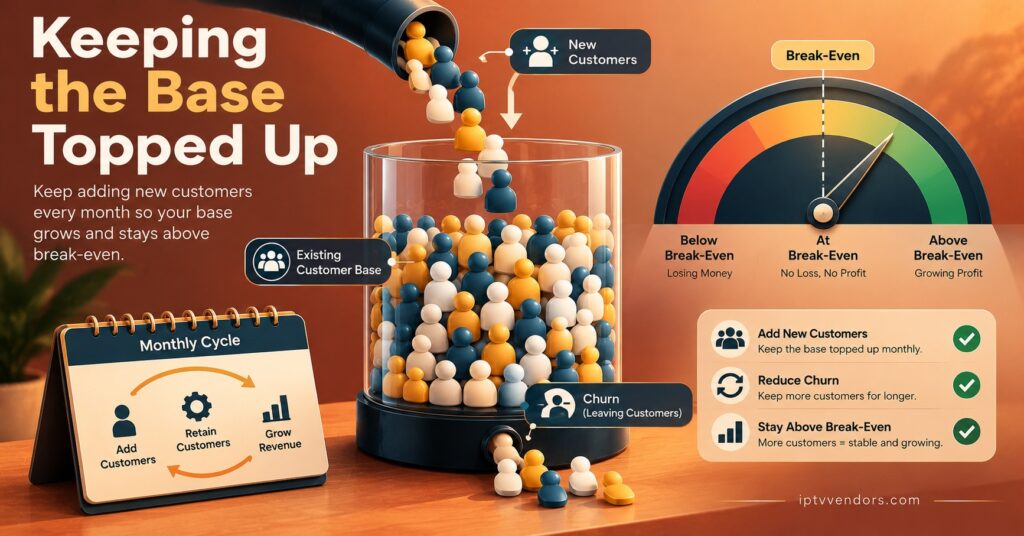
Reaching 13 subscribers once is not the same as staying at 13. If one customer in ten leaves each month, a 13-customer base loses about 1.3 people a month, so you need one or two new sign-ups every month simply to stay at break-even.
This is where acquisition cost comes in. If your advertising brings in new customers at £15 each and every customer contributes £7.20 a month, each customer needs to stay for just over two months before they have paid back what it cost to acquire them. Customers who leave after one month lose you money, however good the headline margin looks.
Two numbers are worth adding to any calculator, then:
- Monthly replacements needed = active subscribers × monthly churn rate
- Months to recover acquisition cost = cost per new customer divided by contribution per subscriber
If the second figure is longer than your typical customer stays, the fix lies in retention rather than pricing. Clear onboarding, timely renewal reminders and quick support responses usually do more for break-even than another round of ads. The renewal and grace-period practices in this IPTV subscription management guide are a practical place to start.
Stress-Testing Your Result
A single break-even number hides how fragile it is. Change one input at a time and see how far the target moves. Using scenario one as the base (13 subscribers):
- Credit price rises by £1.00: contribution falls to £6.20 and break-even rises to 15.
- Retail price drops from £10 to £8: contribution falls to £5.26 and break-even rises to 17.
- Advertising doubles to £120: fixed costs reach £147 and break-even rises to 21.
The price cut is the most useful lesson. A 20% discount raises the break-even point by roughly 30%, because the credit cost stays the same while the margin shrinks. Before matching a cheaper competitor, run this test and check whether you can realistically find the extra customers.
If your provider offers tiered pricing on larger credit purchases, use the effective per-credit price you actually pay in the variable cost line. Credit packages and their structure vary between providers, so check current terms directly, for example on these reseller panel credit packages, rather than relying on figures quoted elsewhere.
One point no calculator can settle: margins say nothing about whether a service is lawful. IPTV is a delivery technology, and any reseller model should be built on content that is properly licensed for distribution in the markets you sell to.
Building the Calculator in a Spreadsheet: Step by Step
You do not need special software. A single sheet with labelled input cells is enough, and it is easier to audit than a web tool whose assumptions you cannot see.
- Create an inputs block at the top: fixed monthly costs (one row per item), credit cost per month of service, payment fee percentage, payment fee fixed charge, and refund allowance per subscriber.
- Add a plans block with one row per plan length: price, months covered, and the share of customers who choose it.
- For each plan, calculate the monthly equivalent price (price divided by months) and the monthly payment fee (percentage × price, plus the fixed charge, all divided by months).
- Calculate contribution per plan: monthly price minus credit cost, monthly fee and refund allowance.
- Multiply each plan’s contribution by its customer share and add them up to get the blended contribution.
- Divide total fixed costs by the blended contribution and wrap the result in a ROUNDUP function to give whole subscribers.
- Add churn rate and cost per new customer as inputs, then calculate monthly replacements needed and months to recover acquisition cost.
- Copy the sheet to a second tab and change one input at a time to keep a record of your stress tests.
- Each month, replace your estimates with real figures from your payment processor statements and panel credit history.
Questions Resellers Ask About Break-Even
Should my own time count as a fixed cost?
That depends on what you want to know. Without a wage line, break-even tells you when the business stops losing money. With one, it tells you when the business pays you a fair rate for the hours you put in. Many resellers keep both versions side by side.
Does buying credits in bulk lower my break-even point?
Only if the per-credit price falls. The bulk purchase itself is stock. A cheaper effective rate per credit lowers your variable cost and therefore your break-even target, but the size of the top-up on its own changes nothing.
How should sub-resellers be handled in the calculation?
Treat credits sold to a sub-reseller as a separate product line. Your contribution is the difference between what they pay you per credit and what you pay your provider, minus payment fees. Their customer churn affects you indirectly, because they buy fewer credits when their base shrinks.
Do free trial accounts affect break-even?
Trials that consume no credits still cost support time, and any paid advertising that drives trials sits in your fixed costs. If very few trials convert, your effective cost per new customer rises, which shows up in the acquisition cost figure rather than the core formula.
How often should I re-run the numbers?
Monthly is enough for most IPTV panel resellers, and also whenever a single input changes: a new credit price, a different payment processor, a change in ad spend or a retail price adjustment. Small changes compound quickly when contribution margins are thin.
Where do tax and VAT fit in?
Base the formula on prices excluding any VAT you have to pay over, because that money is not yours to keep. Thresholds and obligations vary by country and change over time, so check current guidance from your tax authority, which is HMRC in the UK, or take advice from an accountant.
Making the IPTV Reseller Break-Even Calculator Earn Its Keep
An IPTV Reseller Break-Even Calculator is only as honest as the four inputs you give it: real fixed costs, the true variable cost per subscriber including fees and refunds, the monthly equivalent price, and credits treated as stock until they are spent. Get those right and the formula is simple division.
The figure that matters most is often not the break-even number itself but how quickly it moves when one input changes. Build the sheet, run the three stress tests above against your own numbers, and check two figures before you change your prices or ad budget: how many customers you lose each month, and how many months a new customer takes to pay back what it cost to win them.