
IPTV Reseller Profit Leakage is the gap between the profit your reseller dashboard suggests and the money that actually stays with you. It usually comes from four places: refunds, payment fees, support time nobody pays for, and credits that are bought or spent without producing income. None of these appear when you multiply customers by your margin per credit, which is why a month can look healthy in the panel and noticeably thinner in the bank.
Finding it is a reconciliation job before it is a pricing job. Put one closed month of panel activity next to your payment records and your support log, then attach a cost to every refund, every fee, every hour and every credit that earned nothing. The leak you suspect is not always the largest one, and part of what looks like lost money may be cash sitting in an idle credit balance, which needs a different fix from a genuine loss.
A Month on Paper Against a Month in the Bank
The clearest way to see leakage is to run the numbers for a single month. The example below is illustrative. The prices, credit cost and fee rate are round assumptions chosen to make the arithmetic easy to follow, not figures from any particular provider or business. Swap in your own numbers and the method still works.
Imagine a reseller who, in one month, records 100 monthly subscriptions at £12 and 10 annual subscriptions at £100. Monthly accounts use one credit each and annual accounts use twelve, so the month consumes 220 credits. At an assumed wholesale cost of £2 per credit, the margin calculation looks like this: £2,200 in sales, £440 in credits, £1,760 profit.
That £1,760 is the figure most IPTV panel resellers carry in their heads. Here is what happens when the same month is checked against the payment account and the support log.
| Line | Amount | What it represents |
|---|---|---|
| Sales recorded in the panel | £2,200 | 100 monthly at £12, 10 annual at £100 |
| Credits used for those sales | minus £440 | 220 credits at an assumed £2 each |
| Profit on paper | £1,760 | What the margin calculation shows |
| Refunds paid out | minus £108 | Four monthly refunds, one partial annual refund of £60 |
| Payment fees | minus £66 | Illustrative 3% blended rate across payment methods |
| Credits spent on unpaid activations | minus £12 | Six accounts switched on before payment cleared |
| Support time | minus £210 | 14 hours valued at £15 an hour |
| Profit actually kept | £1,364 | 22.5% below the paper figure |
Nearly a quarter of the expected profit never arrives. No single line is dramatic. Together, they amount to £396.
There is a second figure the table does not show. At month end this reseller still holds 60 unused credits from a bulk purchase and has 15 credits parked with a sub-reseller who has not activated anyone in weeks. That is £150 of wholesale spend sitting idle. It is not a loss in the same sense as a refund, because the credits may still be used, but it is money that cannot pay a bill this month. Keeping lost profit and trapped cash in separate columns stops you trying to solve one with the remedy meant for the other.

What Each Leak Is Really Costing You
The totals matter less than the mechanism behind each one, because the mechanism tells you whether the leak can be closed, reduced or only monitored.
Refunds that cost twice
A refund returns the customer’s money, but the credit used to create their account is usually already gone. Some panels return credits if an account is deleted within a short window after creation; many do not, and the rules vary by provider. Unless you have that policy confirmed in writing, assume a refunded account has cost you both the sale and the credit.
Partial refunds on longer packages need extra care. In the example, an annual customer received £60 back after a couple of months, yet all twelve credits had been spent on day one. Whether you refund pro rata, offer a fixed partial amount or refund nothing after a set period is a business decision, but it should be written down before the request arrives rather than settled under pressure in a chat window.
Card disputes are a harsher version of the same problem. If a customer disputes a payment with their bank rather than asking you for a refund, many processors reverse the money and add a separate dispute fee on top. Check your own processor’s published fee schedule, because that charge belongs in this line too.
Fees spread across too many methods
Payment fees rarely look large on a single transaction, which is exactly why they go unnoticed. The real cost depends on your method mix: card payments, online wallets, bank transfers and digital currency conversions all charge differently, and some add a fixed amount per transaction that hurts low-value monthly sales far more than annual ones.
Currency conversion is the quieter part of this. If customers pay in pounds while you buy wholesale credits in another currency, you may lose a margin on conversion at both ends. Processors also differ on whether they return the original fee when you refund a payment, so a refunded sale can still leave a fee behind.
Support hours nobody invoices
Support is the leak most owners leave out, particularly when they handle it themselves. An hour spent walking someone through an app configuration is an hour not spent on sales, sub-reseller management or anything else that produces income. Valuing that time at a fixed hourly rate, even a modest one, turns an invisible cost into a number you can track.
The useful detail is where the hours go. If most support time clusters around first-week setup, the fix is better onboarding material. If it clusters around a small group of customers on your cheapest plan, the question becomes whether that plan is priced to carry its support load. A clear picture of how subscriptions are created and managed inside a IPTV reseller panel also helps you spot which steps in your own process generate repeat questions.
Credits that leave without a sale
Credits can disappear through ordinary operational slips. Accounts activated before payment clears and then never paid for, test lines created and forgotten, duplicate accounts made for the same customer, and a twelve-month duration selected when the customer paid for one month are all common sources. Trials may also draw from your balance depending on how your provider configures them.
Dormant credits are different again. A large unused balance, or credits allocated to sub-resellers who have gone quiet, represent spend that has left your account without yet producing revenue. If you run a tiered operation, it is worth understanding how retail and wholesale reseller models differ, because credits pushed down to sub-resellers move out of your direct control the moment you allocate them.
Measuring IPTV Reseller Profit Leakage in One Sitting
You do not need accounting software to run this check. A spreadsheet, your panel history and your payment statements are enough. Set aside a couple of hours and work through one closed calendar month in this order:
- Choose the most recent complete month, so no payments or renewals are still pending.
- Export or screenshot the panel activity for that month: accounts created, renewed and deleted, with the credits each one used. If your reseller dashboard has no export, a dated screenshot of the activity log will do.
- Download every payment received and every refund issued for the same dates, from every payment method you accept, with fees shown as separate lines where the statement allows.
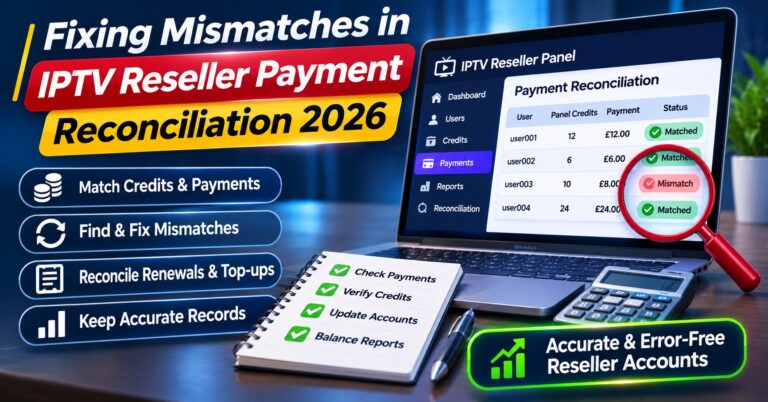
- Match each panel activation to a payment. Activations with no matching payment are unpaid credits. Payments with no matching activation need checking too, because they may point to a missed renewal or a manual credit adjustment.
- Count credits spent on trials, tests, duplicates and wrong durations, and give each its wholesale cost.
- Add up support time from chat and ticket timestamps. If you have no log, record your time for one typical week, multiply it out, and mark the figure as an estimate.
- Choose an hourly rate for your time and apply it to the total.
- Note your credit balance at the start and end of the month, plus each sub-reseller’s balance and the date of their last activation.
- Express the total leakage as a percentage of paper profit, and list trapped cash separately.
The first month gives you a baseline rather than a verdict. There is no reliable public benchmark for what a “normal” leakage rate is, so the trend in your own figures matters more than comparison with anyone else’s. Run the same check the following month and see which lines moved.
Deciding Which Leak to Close First
Rank each leak by two things: how much it cost and how much of it you control. In the example, support time was the largest single loss and also one of the most controllable, so it would be a sensible starting point. Payment fees were smaller and partly outside your control, though steering customers towards lower-cost methods or longer packages can still reduce them.
Unpaid activations are usually the easiest fix of all. A simple rule that no paid account is switched on until payment has cleared, with trials handled under a separate and clearly limited process, closes most of that line immediately. It may slow a handful of sign-ups, which is a trade-off worth weighing honestly rather than ignoring.
Refunds respond best to work done before the sale. A short trial on the customer’s actual device, a written refund policy shared at checkout, and a quick setup check before payment all reduce the number of people who pay and then ask for their money back within days.

Dormant credits involve a genuine trade-off. Larger packs often carry a lower price per credit, which improves paper margin, but every unused credit is cash you cannot spend elsewhere. Compare the saving per credit against how long the balance will realistically take to use, based on your observed monthly consumption rather than hoped-for growth. When reviewing IPTV reseller panel plans and credit packages, that usage figure is a more useful guide than the headline discount.
Pro tip: When you allocate credits to a sub-reseller, agree a review date at the same time. If nothing has been activated by then, you have an agreed moment to discuss pulling the balance back or pausing further allocations, rather than raising it awkwardly months later.
Leaks You Can Reduce but Not Remove
Some leakage comes from decisions upstream of you. If your IPTV provider changes credit rules, raises wholesale prices or suffers an outage, you may face refund requests for a problem you did not cause, and credits held in a balance are only as secure as the provider holding them. Keeping the balance proportionate to your real usage limits how much is exposed at any one time.
The legitimacy of the service you resell matters here too. IPTV is a delivery technology, and lawful use depends on the content being properly licensed for distribution. A polished website, smooth payment process or capable panel does not establish that a provider holds those rights. A service operating without them carries a real risk of sudden closure, which would turn every unused credit into a total loss and every active customer into a refund request.
Questions Resellers Ask About Leakage
Is an unused credit balance a loss?
Not on its own. It is wholesale spend that has not produced revenue yet, so it reduces your available cash rather than your profit. It becomes a loss if the credits expire under your provider’s terms, cannot be used, or are stranded because the provider stops operating.
Should I count my own time if I run everything alone?
Yes, if you want an accurate picture. Leaving it out makes support-heavy customers and plans look more profitable than they are, and it hides the point at which hiring help or changing your onboarding would pay for itself.
How often should I run the check?
Monthly is a sensible rhythm while you are building your baseline or changing prices, payment methods or providers. Once the figures settle, a quarterly review may be enough, with a fresh monthly check whenever something changes.
Can I get credits back for refunded accounts?
Only if your provider’s panel supports it. Some return credits when an account is deleted within a short period after creation; others never do. Ask your provider directly and keep their answer in writing.
Do longer packages reduce leakage?
They can reduce per-transaction payment fees and repeat renewal handling, because one larger payment replaces several small ones. They also raise the stakes of a refund request, since more credits are committed upfront, so a clear partial-refund policy becomes more important.
Turning a Guess Into a Monthly Number
IPTV Reseller Profit Leakage is rarely one dramatic failure. It is a steady loss spread across refunds, fees, unrecorded hours and credits that leave without earning, and it stays invisible until you set the panel, the payment statements and the support log side by side. The figures in this article are illustrative, and your own percentage could be higher or lower. The method does not change: pick last month, run the reconciliation, separate lost profit from trapped cash, and fix the largest controllable line first. Do it again a month later, and you will know whether your IPTV reseller panel business is actually keeping more of what it sells.