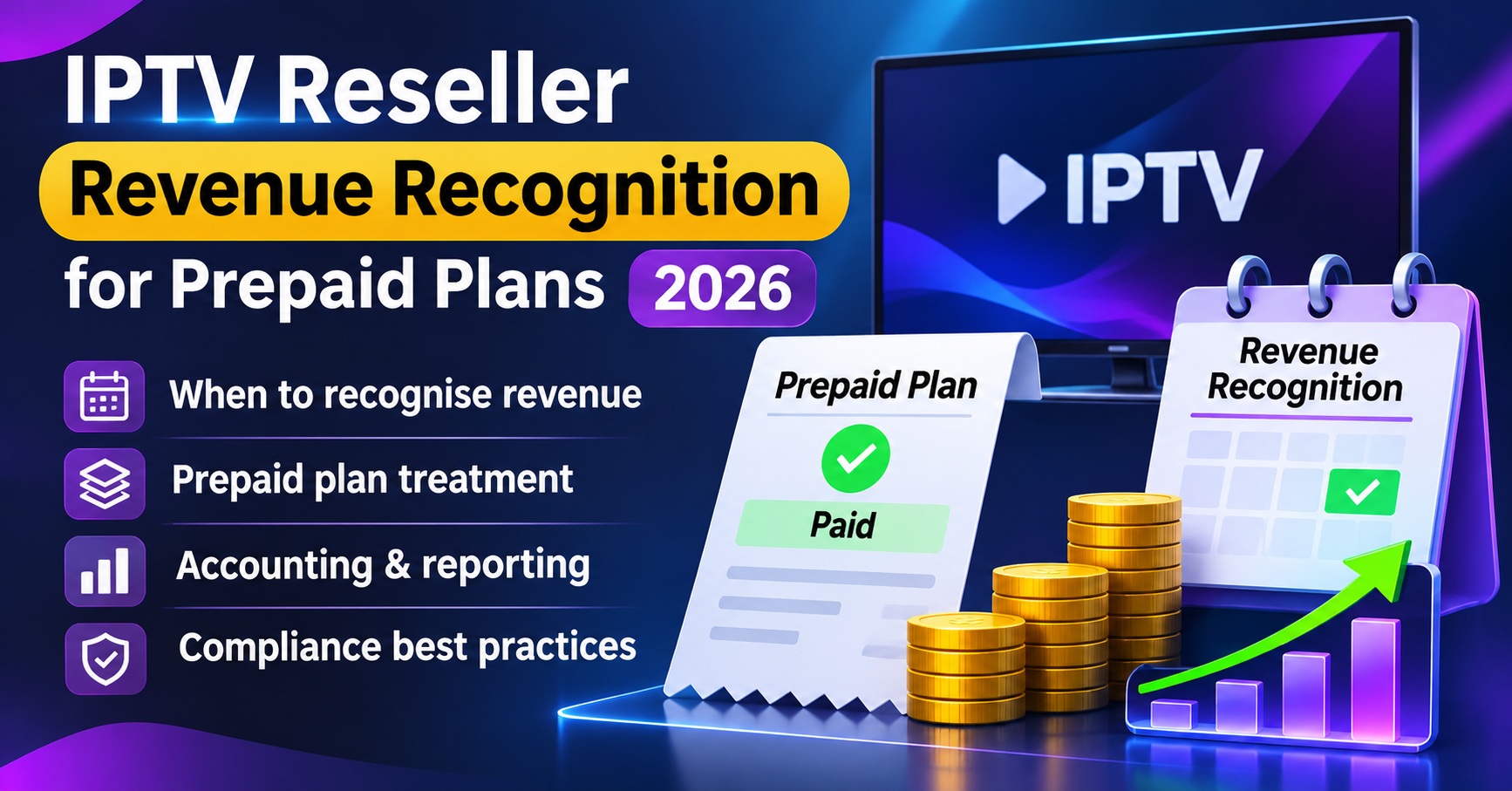

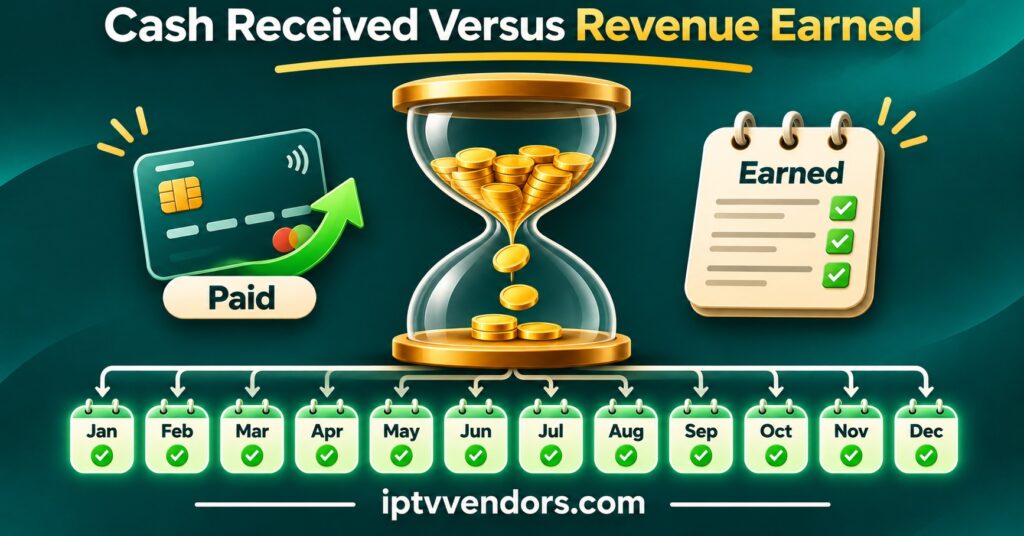
IPTV Reseller Revenue Recognition comes down to one rule: money a customer prepays for a subscription is earned as the service period runs, not on the day it lands in your account. A £96 annual plan sold on 1 April becomes £8 of revenue each month, while the unearned remainder sits on your balance sheet as deferred income, a liability, until those months have passed.
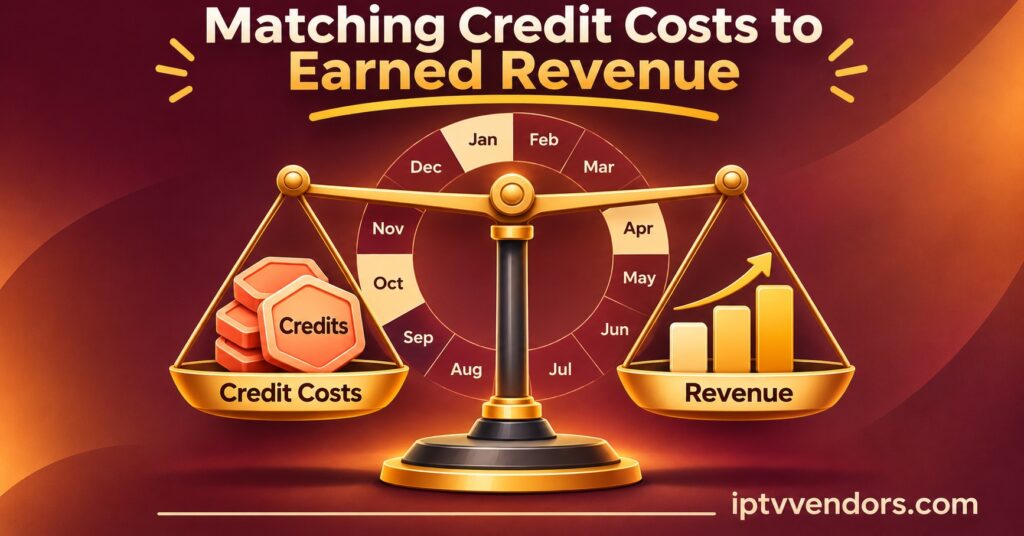
The credits you spent activating that plan follow the same calendar. Twelve credits used on an annual account are the cost of twelve months of service, so expensing them all on activation day flatters one month and quietly starves the next eleven. If you trade through a limited company, accruals accounting is required regardless. If you are a UK sole trader, cash basis may be your default for tax, yet a simple deferral schedule still tells you how much of the money in the bank is genuinely yours to spend.
[ez-toc]
The Cash You Collect Is a Promise, Not Income Yet
A prepaid subscription is a debt in reverse. The customer has paid, and you now owe them a service for a fixed period. Until each slice of that period has been delivered, the matching slice of their payment has not been earned.
Modern accounting standards frame this around performance obligations. Under IFRS 15, revenue is recognised when a performance obligation is satisfied rather than when payment arrives, so subscription revenue is earned gradually across the service period. A streaming subscription fits the “over time” category neatly, because the customer receives and uses the service continuously from day one to the expiry date.
The mechanics are simple once you see them as two movements:
- When the customer pays, cash goes up and a deferred income liability is created for the full amount.
- As each month of service is delivered, that month’s share moves out of the liability and into revenue.
This matters more for resellers than for most small businesses because of how plans are sold. Annual and six-month plans concentrate cash into a handful of weeks, often around renewal waves. Without deferral, a busy January looks like a record month and a quiet March looks like a collapse, when in reality you are delivering roughly the same amount of service in both.
Who Has to Follow These Rules in 2026
The answer depends on your legal structure and where you trade.
UK limited companies. Accruals accounting is mandatory, and the revenue rules have just tightened. The Financial Reporting Council overhauled Section 23 of FRS 102 for accounting periods beginning on or after 1 January 2026, replacing the old risks-and-rewards approach with a five-step model closely aligned with IFRS 15. For a straightforward IPTV subscription reseller the practical outcome is similar to before (revenue spread over the term), but the new section expects clearer policies and better disclosure of judgements. FRS 105 for micro-entities is also being amended to reflect the change. The ICAEW summary of the five-step model is a sensible place to read the official framing.
UK sole traders and partnerships. From 6 April 2024, cash basis became the default method for working out taxable profit, with an opt-out for those who want traditional accounting, and limited companies and LLPs cannot use it. Cash basis taxes money when it is received, so a £96 annual plan counts in full when paid. That is perfectly legitimate for tax, but it is a poor management view of your business, for the reasons covered below.
Other English-speaking markets. Most follow IFRS 15 or a local equivalent built on the same five steps, and US businesses applying GAAP use ASC 606, which reaches the same answer for a plain subscription. Smaller private-company frameworks vary by country, so a local accountant should confirm which applies to you.
Gross or Net: The Question to Settle Before Any Numbers
Before you schedule anything, decide whether you are selling the subscription yourself or arranging it on someone else’s behalf. This is the principal versus agent test, and it changes the size of your reported revenue dramatically.
A principal records the full price the customer pays as revenue and the credit cost as a cost of sale. An agent records only its commission. The deciding question is control: did you control the service before it reached the customer? The indicators that point to principal status are being primarily responsible for fulfilling the promise, carrying inventory risk, and having discretion over the price.
Applied to a typical credit-based reseller:
- You set your own retail prices, which points towards principal.
- You buy credits in advance and usually cannot return unused ones, which is a form of inventory risk. The IFRS Interpretations Committee examined a similar pattern in its software reseller agenda decision, where non-returnable licences created inventory risk for the IPTV panel reseller.
- The customer buys from you, contacts you for setup and support, and sees you as the party responsible for the service.
Against that, the upstream provider runs the servers and authentication systems behind the panel, so you do not physically deliver the stream. On balance, many credit resellers will look like principals and report gross revenue. A referral arrangement where the provider bills the customer and pays you a fee is the clearer agent case.
It is worth saying plainly that none of this accounting says anything about whether the service is lawful. That depends on the upstream provider holding proper distribution rights for the content it delivers, and a tidy set of books does not change that.
IPTV Reseller Revenue Recognition Worked Through One Annual Plan
The figures below are illustrative, chosen to keep the arithmetic clean. They are not market prices.
A UK limited company with a calendar year end (31 December 2026) is not VAT registered. On 1 March it buys 24 panel credits at £3.00 each, paying £72. On 1 April it sells a 12-month plan to a new customer for £96 and activates the account using 12 credits.
On 1 March (credit purchase): the £72 becomes an asset, a prepaid credit balance. Nothing hits the profit and loss account yet.
On 1 April (sale and activation):
- Bank increases by £96 and deferred income is credited with £96.
- 12 credits (£36) move from the general credit balance to a prepaid service cost for this customer. Still an asset.
At each month end, April to December:
- £8 moves from deferred income to revenue (£96 ÷ 12).
- £3 moves from prepaid service cost to cost of sales (£36 ÷ 12).
| Period in 2026 | Revenue recognised | Deferred income at period end |
|---|---|---|
| April to June | £24 | £72 |
| July to September | £24 | £48 |
| October to December | £24 | £24 |
The final £24 is released between January and March 2027.
Now compare three views of the same 2026 year:
- Bank movement: £96 in, £72 out for credits, so the account is up £24.
- Cash-receipts thinking: £96 sale less £36 of credits used, so the sale “made” £60.
- Accruals: £72 revenue less £27 cost, so £45 gross profit was earned in 2026, with the remaining £15 earned in early 2027.
The year-end balance sheet carries £24 of deferred income (a liability), £9 of prepaid service cost and £36 of unused credits (both assets). Only the accruals view tells you what the business actually earned this year and what it still owes its customer.
Pro tip: Keep one spreadsheet row per account with the start date, term in months, net price and credit cost, plus a formula that calculates the monthly release. Twelve columns for the months of the year make the month-end total a single SUM, and the row automatically drops to zero when the term ends.
Credits Are the Other Half of the Ledger
Most of the attention in revenue recognition goes on the sales side, but resellers tend to make their bigger errors on the cost side.
Credits sitting unused in your panel are stock, not an expense. Your provider’s guide to how credits move through a IPTV reseller panel describes them as pre-purchased capacity, and that is exactly how the ledger should treat them: an asset recorded at what you paid. Once spent on an activation, the cost relates to the full subscription term, so it is released in step with the revenue it supports. That matching is what makes your gross margin meaningful month by month.
Two checks keep this honest. First, reconcile the panel’s credit balance against the ledger at every month end: unused credits multiplied by your average purchase cost should equal the credit asset. A gap usually means an activation was missed, a trial consumed credits nobody recorded, or a sub-reseller allocation was never posted. Second, review whether those credits are still worth their book value. If a provider changes its terms, withdraws a package or stops operating, credits you cannot use should be written down to what you can realistically recover.
If you buy credits in tiers at different prices, a weighted average cost per credit is the simplest consistent method. The way credit packages shape your margin is worth understanding before choosing a tier, because bulk discounts lower the cost released against each future month of revenue.
Situations That Bend the Schedule
The straight-line pattern above covers most plans. These are the cases that need a moment’s thought.
Bonus months
A “12 months plus 1 free” offer is a 13-month obligation for one price. Spread the £96 across all 13 months (about £7.38 a month), not across 12 with a free month at the end. The free month is part of what the customer paid for.
Plans starting mid-month
If accounts start on any day of the month, a daily rate is more accurate. A £96 annual plan works out at roughly £0.263 per day, so an account activated on 15 April earns 16 days, about £4.21, in April. Whatever method you choose, apply it consistently.
Upgrades and extra connections
When a customer pays to add a connection partway through a term, the extra charge generally covers the remaining months only, so spread it from the upgrade date to the existing expiry. Do not rewrite revenue already recognised.
Cancellations and refunds
Suppose the annual customer cancels on 1 June and your policy refunds £60. By then £16 has been recognised and £80 sits in deferred income. The £60 refund comes out of deferred income, and the remaining £20, which you keep with no further service owed, is released to revenue straight away. If the provider will not return the unused credits, the £30 of unreleased cost is expensed immediately too. For that customer, revenue and cost both end at £36.
A non-refundable policy, by contrast, does not let you recognise everything upfront. You still owe the service, so the deferral stands.
Trials
A free trial brings in no consideration, so there is no revenue to recognise. If trials consume credits, treat that cost as an acquisition or marketing expense in the month it happens.
Credits sold to sub-resellers
Selling credits to a sub-reseller is a different transaction. Once credits are transferred and the sub-reseller controls them, revenue is often recognised at that point, provided you have no significant ongoing obligation such as bundled support. Check this one with your accountant, because panel arrangements vary.
VAT Runs on a Separate Clock
VAT timing and revenue timing are unrelated, and confusing them is a common source of trouble at quarter end.
For both goods and services, receiving a payment or issuing a VAT invoice before the basic tax point creates a tax point for the amount paid or invoiced. In plain terms, a VAT-registered reseller who receives £115.20 for an annual plan (£96 plus £19.20 VAT) accounts for the full £19.20 output VAT in the return covering the date of payment, even though only £8 of the £96 is revenue in that first month.
The £19.20 never belongs in revenue at all. It is money collected on HMRC’s behalf, held as a liability until paid over. Your deferral schedule should always work from VAT-exclusive prices.
A Month-End Routine That Keeps the Numbers Honest
- Export every new activation, renewal, upgrade and cancellation from the panel for the month, with start date, term and VAT-exclusive price.
- Add new accounts to the deferral schedule and stop any that were cancelled or refunded.
- Post the month’s total release from deferred income to revenue as one journal.
- Post the matching release of credit cost from prepaid service cost to cost of sales.
- Reconcile panel credit balance multiplied by unit cost against the credit asset, and investigate any difference.
- Tie the deferred income balance to the sum of unexpired months on the schedule.
- Record trial credits and sub-reseller credit sales separately from customer subscriptions.
- Confirm VAT on all receipts in the month sits in the correct return period.
- Note any plan with bonus months, bundles or unusual terms so next month’s figures do not surprise you.
Questions Resellers Ask About Deferred Income
My plans are non-refundable. Can I record the full payment as revenue straight away?
No. Refund terms affect what happens if a customer cancels, not when the money is earned. While you still owe months of service, the unearned share remains deferred income.
Do unused panel credits reduce my profit?
Not while they are unused. They are an asset at cost. They only reach the profit and loss account when spent on an account (released over its term), used on trials, or written down because they can no longer be used.
What happens to deferred income if my provider stops delivering service?
The obligation to your customers remains. Expect to recognise refund liabilities for unexpired months and to write off any credits and prepaid costs you cannot recover. This is exactly why the deferred income balance is worth watching: it is the amount you would owe if everything stopped tomorrow.
I am a sole trader on cash basis. Do I need any of this?
Not for your tax return. But a deferral schedule shows how much of your bank balance is still owed in future service, which is the number that protects you from spending next year’s obligations this year.
Do monthly plans need deferring?
Usually very little. If renewals fall mid-month, part of each payment belongs to the following month, but for small operations the difference is often immaterial. Annual and six-month plans are where deferral really matters.
Where This Leaves Your Books
IPTV Reseller Panel Revenue Recognition is less about complex standards than about refusing to let cash flow pose as profit. Spread each prepaid plan across its term, release the matching credit cost alongside it, keep VAT out of revenue entirely, and settle the gross or net question once and document it. A limited company has no choice here, especially under the revised FRS 102 rules from 2026, while sole traders gain a clearer picture of what they actually own.
The useful next step is small: build the one-row-per-account schedule this month, starting with your annual plans, and reconcile it to the panel at the end of next month. Anything unusual, such as sub-reseller arrangements or bundled support, is worth a short conversation with an accountant, as this article explains general principles rather than advice for your specific business.