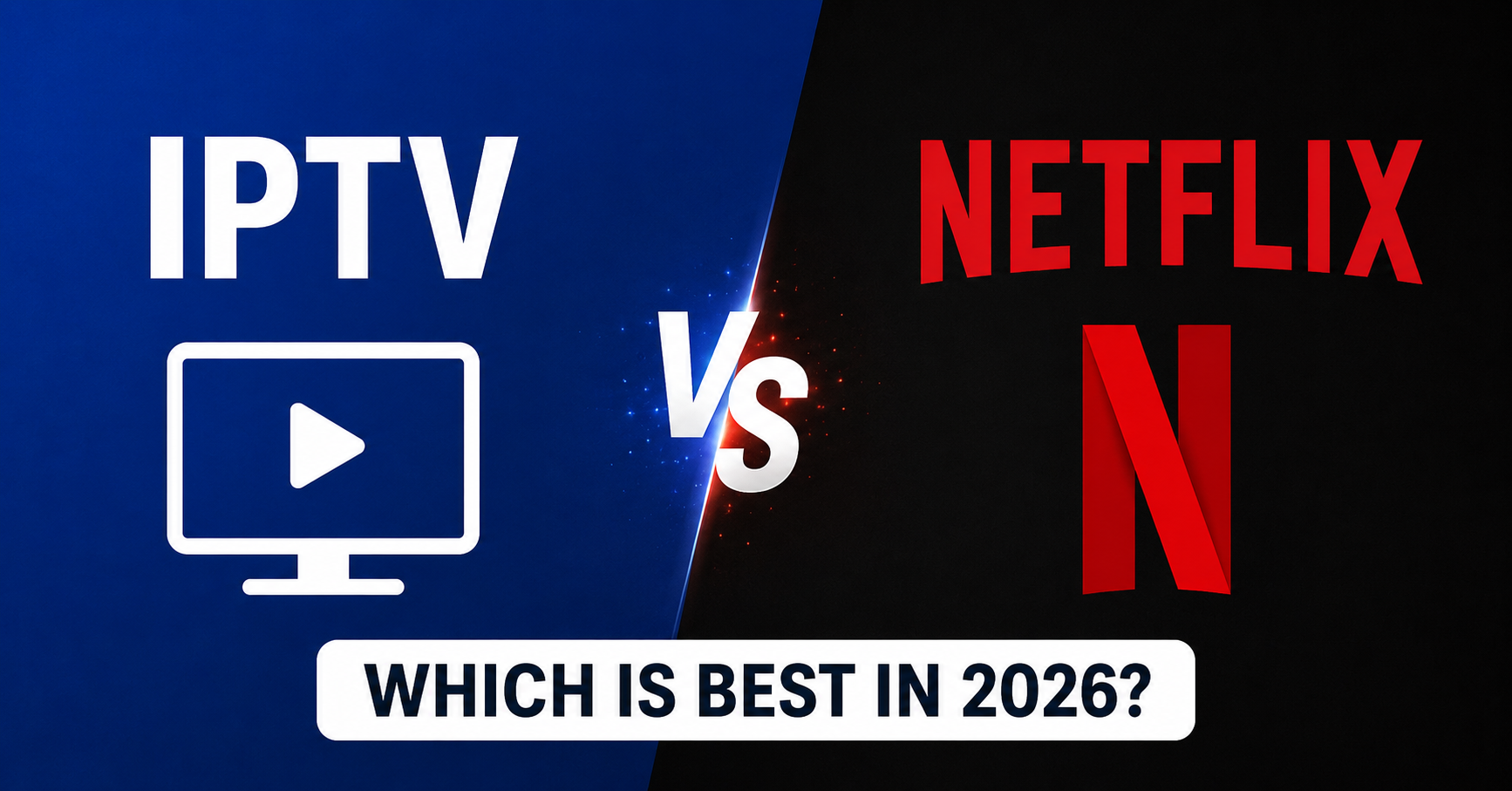

I have watched this argument play out in support tickets for nearly a decade, and the honest truth is that most people asking the wrong version of the question. They treat it like a championship match with one winner. It isn’t. The person who needs Netflix and the person who needs IPTV are often two completely different households with two completely different tolerance levels for tinkering.
So let me give you the short answer before anything else.
The Quick Answer
If you want zero maintenance, guaranteed uptime, original shows nobody else has, and you mostly watch films and series, Netflix wins. If you want live sports, hundreds of live channels from multiple countries, pay per connection rather than per profile, and you don’t mind the occasional buffering during a big match, IPTV wins. The deciding factor in IPTV vs Netflix Which is Best in 2026 isn’t quality. It’s what you actually watch and how much you hate troubleshooting.
That’s it. Everything below explains the reasoning, the trade offs, and the parts the marketing pages on both sides quietly avoid.
Why This Comparison Confuses So Many People
Netflix is a single company running a single, ferociously engineered platform. IPTV is not a company at all. It’s a delivery method used by thousands of independent operators, some excellent and some held together with tape. Comparing the two is like comparing a named restaurant chain to the entire concept of street food. One has consistent standards everywhere. The other ranges from extraordinary to genuinely awful depending on who you buy from.
This single distinction explains nearly every disagreement you’ll read online. When someone says IPTV is unreliable, they usually bought from a weak provider. When someone says Netflix is overpriced and limited, they’re usually a sports fan paying for content Netflix never carried in the first place.
What You Actually Pay, Once You Add Everything Up
Here is where the conversation gets interesting, because the sticker price lies to everyone.
| Cost Factor | Netflix | IPTV |
|---|---|---|
| Base monthly price | Mid to high tier | Usually lower per month |
| Live sports access | Limited or extra | Typically included |
| Number of services needed | Often 3 to 4 to cover everything | Usually one |
| Simultaneous streams | Tied to plan tier | Tied to connections bought |
| Hidden cost | Stacking subscriptions | Time spent troubleshooting |
The real Netflix expense isn’t Netflix. It’s that Netflix alone no longer covers a modern viewing diet. Households end up paying for Netflix plus a sports package plus one or two other platforms. By the time you total that monthly bill, the cost gap many people imagine simply disappears. IPTV consolidates a lot of that into one feed, which is exactly why families with mixed tastes drift toward it.
Pro Tip:
Before you compare prices, write down every streaming bill you currently pay across the whole house. Most people underestimate their real total by thirty to forty percent because the charges are scattered across different cards and dates.
Reliability Is Where The Two Genuinely Diverge
I’ll be blunt about this part because it’s the one IPTV sellers love to skip.
Netflix almost never goes down. Their infrastructure is geographically distributed, self healing, and monitored by teams whose entire job is preventing the exact outage you’d notice. You can go years without a single failed stream.
IPTV reliability depends entirely on the operator behind it. A serious IPTV operator runs multiple source servers, load balancing across them, automatic failover when one source dies, and backup uplinks so a single ISP problem doesn’t take everyone offline. A weak one runs a single source with no redundancy, and the first time a big match floods the system, everything stutters at once.
The Sports Event Stress Test
If you want to understand IPTV reliability in one scenario, watch what happens during a major football fixture or a championship fight. Traffic spikes hard and fast. Every customer hits the same channels in the same ten minute window.
During one heavyweight title night a few years back, we watched a smaller UK IPTV reseller setup buckle because all their traffic hit a single uplink at once. Customers who’d been happy for months suddenly flooded support with buffering complaints, all within the same hour. The lesson stuck. Sports traffic doesn’t arrive gently. It arrives like a wall.
Netflix never faces this problem in the same way, because their content is on demand and pre distributed across servers close to you. Nobody is fighting for a live feed at the same instant.
Content: The Part Where It Stops Being Close
This is genuinely two different products pretending to be rivals.
Netflix owns its catalogue. Original series, films, documentaries, the things people quote at work the next morning. You cannot get that library anywhere else legitimately, and the on demand experience, subtitles, audio tracks, profiles, recommendations, is polished to a shine.
IPTV’s strength is breadth and liveness. Live channels from multiple countries, sports, news as it happens, regional content that no mainstream platform bothers to carry. For an expat wanting channels from home, or a sports household that lives by the fixture list, nothing on demand replaces it.
Pro Tip:
Ask yourself how often you watch something live versus on demand. People who answer “mostly live” almost always regret a pure Netflix setup, and people who answer “mostly on demand” rarely stay happy with IPTV alone.
What Support Tickets Quietly Reveal
After reading through an enormous volume of customer messages over the years, a pattern emerges that the spec sheets never show you.
Netflix complaints are about content. “Why did they remove my show.” “Why isn’t this season here yet.” Almost never about the technology failing.
IPTV complaints are about delivery. Buffering, a dead channel, a device that won’t load the playlist, an app that needs reconfiguring after an update. The content is there. The plumbing is what frustrates people.
That contrast tells you exactly what kind of buyer each option suits. If technical hiccups ruin your evening, that matters more than any feature list.
Device Compatibility And The Setup Reality
Netflix installs in thirty seconds on essentially anything with a screen. Smart TVs, phones, consoles, browsers. There’s nothing to configure.
IPTV is more involved. You’re usually loading credentials into a player app, sometimes adjusting buffer settings, occasionally fighting with a router. It’s not hard once you’ve done it, but the first setup intimidates non technical users. A mistake we repeatedly see is a customer blaming the service for buffering when the actual culprit is their own home Wi Fi or an underpowered streaming stick.
Pro Tip:
A wired connection or a strong dual band router fixes a surprising share of IPTV buffering complaints. Before blaming any provider, test the same stream on a device plugged directly into the router.
The Reseller Angle Most Buyers Never See
Here’s a dimension the average viewer ignores, but it shapes the whole IPTV market.
Behind almost every IPTV service is a reseller. The IPTV reseller buys panel credits from a larger source, manages customers through an IPTV reseller panel, and handles the day to day support. Some operate as a full IPTV business owner with hundreds of clients. Others run small, serving friends and a local circle as a credit reseller or sub reseller under a bigger panel owner.
Why does this matter to you as a buyer? Because the quality you receive is downstream of how good that IPTV operator is. A diligent reseller monitors uptime, allocates panel credits responsibly, and migrates customers cleanly when a source has problems. A careless one oversells connections and vanishes when things break.
When you weigh IPTV vs Netflix Which is Best in 2026, you’re partly betting on the competence of the reseller behind your subscription. With Netflix, there is no middle layer. With IPTV, that middle layer is everything.
A Short Mini Case Study
One IPTV UK reseller we knew built a loyal base of around four hundred customers in a single city. He did one thing obsessively: he tested his streams every morning before his customers woke up. When a source degraded, he switched it before anyone noticed. His churn was almost nonexistent.
A competitor in the same area sold cheaper, oversold his capacity, and treated complaints as someone else’s problem. Within a year he’d lost most of his base, while the careful reseller absorbed them. Same technology. Completely different outcome. That gap is the whole story of IPTV quality in miniature.
So, IPTV vs Netflix Which is Best in 2026 For Your Home?
Let me make it concrete instead of diplomatic.
Choose Netflix if you mostly watch series and films, you want it to simply work forever, you value original content, and you’d rather pay a bit more than ever touch a settings menu.
IPTV if you want live sports and global channels in one place, you’re comfortable with a little setup, you buy from a reputable IPTV operator, and you accept that the occasional big night might stutter.
Choose both, honestly, if your household is mixed. Plenty of families run Netflix for the kids’ on demand library and a solid IPTV feed for live sport. They’re not enemies. They cover different gaps.
Frequently Asked Questions
Is IPTV vs Netflix Which is Best in 2026 really about quality or about content type?
It’s mostly about content type. Both can deliver excellent picture quality on a good connection. The decision in IPTV vs Netflix Which is Best in 2026 comes down to whether you mainly watch live channels and sports, which favours IPTV, or on demand films and original series, which favours Netflix. Quality follows your provider and your internet, not the format itself.
Why does IPTV buffer when Netflix never does for me?
Netflix pre distributes on demand content across servers near you, so nothing competes for a live feed. IPTV streams live, meaning thousands of viewers hit the same channel at once during popular events. A strong IPTV operator uses load balancing and failover to absorb that. Weak setups, or a poor home connection, buffer under the load.
Is Netflix cheaper than IPTV in 2026?
On its own, Netflix often looks cheaper, but it rarely covers everything a household wants. Once you add sports and other platforms to match what one good IPTV feed includes, the total frequently exceeds IPTV. Compare your full monthly streaming spend across the whole house, not a single base price.
As a reseller, which is easier to build a business around?
Netflix isn’t resellable, so there’s no business model there. IPTV is built around resellers. An IPTV reseller buys panel credits, manages clients through a reseller panel, and can grow into a serious IPTV business owner or stay small as a sub reseller. The opportunity is real, but reliability and honest capacity planning decide who survives.
Can I run IPTV and Netflix together?
Yes, and many households do exactly that. Netflix handles on demand originals and family viewing, while IPTV covers live sports, news, and international channels. They solve different problems, so running both eliminates the gaps each leaves on its own. It’s often the most complete setup for a mixed household.
Does the IPTV provider I choose really change my experience that much?
Enormously. Two customers paying similar prices can have wildly different experiences based purely on the operator behind the service. A diligent IPTV Panel reseller monitors streams, plans capacity, and fixes issues fast. A careless one oversells and disappears. With Netflix there’s no middle layer, so this variability simply doesn’t exist.
Which is better for live sports specifically?
IPTV, clearly, for breadth of live sport across multiple countries and competitions. Netflix has dabbled in live events but was never built as a comprehensive live sports destination. If your week revolves around fixtures, a reputable IPTV service backed by real infrastructure is the stronger pick. You can compare reputable options at britishseller.co.uk.
Will ISP blocking affect IPTV in 2026?
It can. Some ISPs throttle or interfere with certain traffic, and a good operator counters this with multiple uplinks, alternate routing, and backup sources. This is exactly why the competence of your IPTV operator matters so much. Netflix, being a mainstream sanctioned platform, doesn’t face this category of disruption.
Quick Checklists Before You Decide
Subscribers:
- List every streaming bill across the whole house and total it honestly
- Decide your live versus on demand ratio before choosing
- Test your home connection speed on the actual viewing device
- Prefer a wired connection or strong dual band router for IPTV
resellers:
- Run multiple source servers with automatic failover
- Test every stream before your customers wake up
- Allocate panel credits to match real capacity, never oversell
- Keep backup uplinks ready for sports night traffic spikes
- Track churn and tie it back to specific outage events
Sub resellers:
- Vet your upstream panel owner’s uptime before committing
- Start small and confirm reliability before scaling clients
- Set clear support hours so customers know your response window
- Keep a tested backup provider in case your source fails
Conclusion
When people ask IPTV vs Netflix Which is Best in 2026, they want a single trophy handed to one side. The field doesn’t work that way. Netflix is the safer, simpler, set and forget choice for on demand viewing. IPTV is the broader, livelier, sports first choice that rewards you for picking a competent IPTV operator and punishes you for picking a careless one. The right answer to IPTV vs Netflix Which is Best in 2026 is whichever one matches how your household actually watches, and for plenty of homes the honest answer is both.
The single lesson worth keeping is this: with Netflix you’re buying a platform, but with IPTV you’re buying an operator. Judge the platform on its catalogue and judge the operator on their infrastructure, and you’ll never feel cheated by either choice.