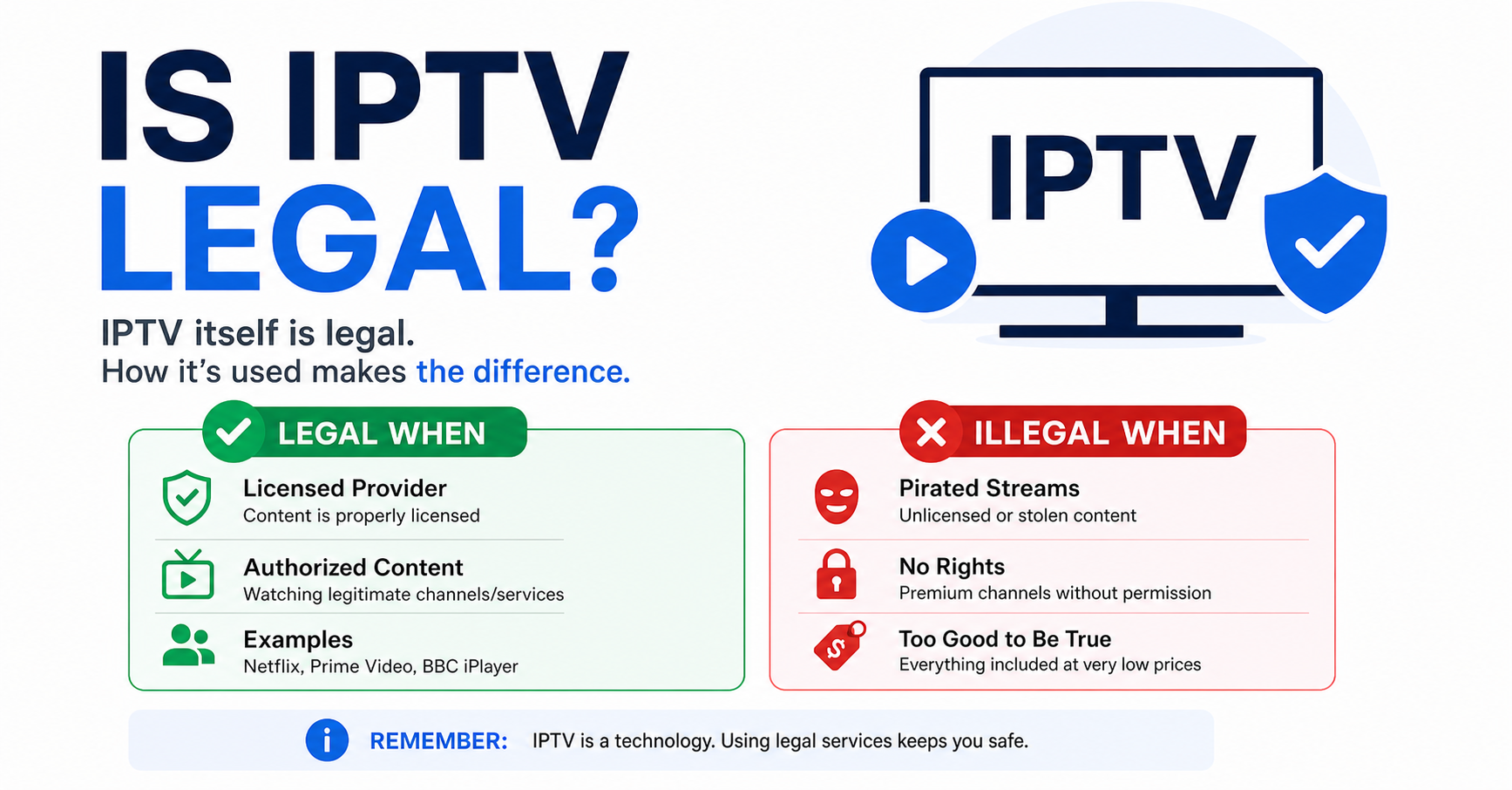

Most people asking “is IPTV legal” are not pirates. They’re parents trying to cut a sky-high cable bill, or small business operators running reseller panels who woke up one day wondering if they’re one enforcement wave away from losing everything. The question is legitimate. The answer, unfortunately, has never been simple, and in 2026, it’s gotten more layered than ever.
Let’s cut through the noise.
The Question Itself Is the Wrong Starting Point
Is IPTV legal? Yes. Also no. Also: it depends entirely on what is being streamed, who is distributing it, and where you’re sitting geographically when you press play.
IPTV (Internet Protocol Television) is a delivery mechanism. Streaming video over an IP network is no different technically than loading a YouTube video. The technology itself carries zero legal weight. What matters is the content licence attached to what’s being delivered through that pipe.
Licensed IPTV services like BBC iPlayer, DAZN, and Peacock are entirely legal. They own or license the content they distribute. When people ask “is IPTV legal,” they’re rarely asking about those. They’re asking about the grey and black market panel ecosystem, IPTV reseller operated services streaming premium sports and entertainment without paying for broadcast rights.
That’s where legality fractures.
How the Legal Line Actually Gets Drawn
Pro Tip: Enforcement doesn’t go after the viewer first. It targets the infrastructure, panel providers, upstream suppliers, and payment processors. If your supplier vanishes overnight, that’s not a coincidence.
In the UK, the legal framework is built around the Copyright, Designs and Patents Act 1988, the Digital Economy Act, and EU-derived rights still partially active post-Brexit. Receiving an unlicensed stream isn’t treated the same as distributing one, but receiving has become increasingly prosecutable under the “communication to the public” doctrine.
For resellers, the picture is starker. Operating a reseller panel that redistributes unlicensed premium content crosses into criminal copyright infringement territory in most jurisdictions, UK, EU, US, and Australia included. Is IPTV legal when you’re reselling unlicensed feeds? In that context: no, not even slightly.
What makes 2026 different is that enforcement has shifted upstream. Major broadcasters no longer just take down individual sites. They’re working with ISPs to implement DNS poisoning at scale, blocking entire IP ranges associated with IPTV server clusters. A single enforcement order can wipe hundreds of reseller panels simultaneously.
The Subscriber’s Position vs. The Reseller’s Position
These are two very different legal situations and conflating them causes panic in the wrong places.
Here’s how the risk profile shifts along the chain:
| Position | Legal exposure | Enforcement priority | Risk level |
|---|---|---|---|
| Subscriber (home viewer) | Low in most jurisdictions | Almost never targeted directly | Low to medium |
| Casual reseller (< 50 lines) | Moderate, civil risk mainly | Occasionally caught in raids | Medium |
| Active panel operator | High, criminal copyright possible | Active enforcement target | High |
| Upstream provider / supplier | Severe | Primary enforcement target | Critical |
Subscribers asking “is IPTV legal” are generally in the lowest-risk category. You are not the target. Your supplier is. That said, “low risk” is not “no risk,” and anyone building a household budget around an unlicensed IPTV subscription should understand the service can disappear without notice, because the infrastructure behind it operates in legally hostile territory.
How AI-Driven ISP Blocking Changed the Game in 2025 to 2026
This is where most IPTV legal conversations stop too early.
The enforcement mechanism has fundamentally changed. It’s no longer human investigators manually filing takedowns. Rights holders are now deploying AI-assisted monitoring systems that detect unlicensed streams in near real-time, matching fingerprints against licensed broadcast content and triggering automated blocking requests to ISPs within minutes of a stream going live.
Is IPTV legal to operate when the blocking infrastructure is this sophisticated? The question almost becomes academic. You can be technically operating in a legal grey area one moment and have your entire server cluster restricted the next.
For resellers, this means backup uplink servers are not optional infrastructure, they are survival infrastructure. A single-origin panel in 2026 is a panel that will fail publicly, visibly, and at the worst possible moment.
- Primary server: Main delivery, optimised for latency
- Failover server: Automated switchover on outage detection
- Cold backup: Manual activation, different IP range, different data centre
- DNS redundancy: Multiple DNS resolution paths to avoid poisoning cascades
If your supplier can’t explain their failover architecture, that tells you everything about how long they’ll last under pressure.
The Reseller’s Legal Grey Zone: What “Grey” Actually Means
Pro Tip: “Grey market” isn’t a legal category. Courts don’t care that you didn’t know the content was unlicensed. Reselling unlicensed streams is distribution, and distribution carries the heavier penalties.
Is IPTV legal in the reseller grey market? The honest answer is that “grey” describes operational ambiguity, not legal protection. Resellers who purchase panel credits from upstream suppliers and resell to end subscribers are in the distribution chain, legally. They are not passive recipients.
The specific legal risk varies by country:
United Kingdom: The Intellectual Property Office has increased coordination with police units on IPTV enforcement since 2023. Resellers have been prosecuted under the Fraud Act in addition to copyright law when subscription payments are involved.
European Union: Post-Digital Single Market Directive, enforcement powers have expanded significantly. Cross-border operations are no longer safe from EU-wide blocking orders.
United States: The DISH Network litigation precedent established that UK IPTV Panel resellers can face significant civil damages even without criminal charges.
Understanding where your customers are geographically isn’t just a business decision, it’s a legal exposure calculation.
The Markers of a Legitimately Run Operation
Not every IPTV operation is legally questionable. This matters for resellers trying to position their business correctly and for subscribers trying to assess their provider.
Legitimate IPTV providers in 2026 will have:
- Clear content licensing documentation, not vague references to “licensed content”
- Registered company details, a traceable legal entity, not anonymous payment links
- Transparent refund and cancellation terms, legally required in the UK and EU
- No live sports from major broadcasters unless they hold explicit rights
- GDPR / data protection compliance, particularly for EU customers
If you’re running a reseller operation and want to understand how to position it legally and commercially, the frameworks used by established UK-based IPTV businesses are worth studying. British Seller documents how compliant reseller operations structure their offerings, worth a read before you build out your panel.
Why Uncertainty Drives Subscribers Away Faster Than Downtime
Here’s something the legal debate misses entirely: when subscribers ask “is IPTV legal” and don’t get a straight answer, they churn. Not because they found a legal service instead, because uncertainty erodes trust faster than downtime does.
Resellers who address the legality question proactively, honestly, without overclaiming, retain subscribers at significantly higher rates than those who dodge it or drown it in vague reassurances.
A good approach: acknowledge the landscape. Explain that the service operates in a competitive streaming market. Focus on service quality, uptime, and support. Do not promise legal certainty you can’t provide. Subscribers are adults. They made a cost-benefit decision. Respect that.
What destroys trust permanently is:
- Service going dark with no communication
- Credits being wiped during a panel ban with no compensation
- Support disappearing when enforcement hits
These aren’t legal problems. They’re operational failures that happen to have a legal trigger.
Is IPTV Legal for Sports Specifically? The Highest-Risk Category
Sports streaming is where enforcement concentrates most aggressively. Premium sports rights are expensive, regionally restricted, and held by broadcasters with substantial legal resources and political relationships with governments.
Is IPTV legal when it carries live sports from major broadcasters? Categorically not, when those streams are unlicensed. And enforcement in this category is disproportionately intensive relative to general entertainment content.
The HLS latency problem compounds this. Sports streams require low-latency delivery to be useful. The infrastructure needed to deliver live football at sub-5-second latency is the same infrastructure that’s most visible to AI monitoring systems, high traffic, predictable schedule, distinct fingerprints.
Resellers who built their customer base around live sports in 2024 to 2025 have faced the most disruption from the 2026 enforcement wave. It is not coincidence. It is targeting.
Frequently Asked Questions
Is IPTV legal to use at home in the UK?
Using IPTV to access licensed services, like streaming platforms you pay for, is entirely legal. The legal question arises when the service delivers unlicensed content. UK subscribers are rarely prosecuted directly, but the service they rely on can be shut down without warning. Understanding what your provider is actually delivering matters before you build your household viewing around it.
Is IPTV legal to resell in 2026?
Reselling licensed IPTV content with proper agreements in place is legal. Reselling unlicensed premium content, sports, entertainment from major broadcasters, is copyright infringement in the UK and most EU jurisdictions. Is IPTV legal to resell? Only when the content rights are in order. Without that, you’re in the distribution chain for infringement.
What happens if my IPTV provider gets shut down?
Your service disappears, typically without refund or warning. Enforcement actions can seize servers, freeze payment processors, and block IP ranges simultaneously. As a subscriber, you lose access. As a reseller, you lose your panel, potentially your customer relationships, and in some cases your payment accounts if they were linked to the operation.
How do ISPs block IPTV services and can it be bypassed?
ISPs implement DNS poisoning and IP-range blocking on instruction from rights holders or court orders. Some users attempt to bypass this with VPNs or alternative DNS providers. Whether bypassing such blocks is legal is itself contested, and the technical arms race between blocking systems and bypass tools is ongoing in 2026.
Is IPTV legal in countries outside the UK?
The legality varies significantly. Most Western jurisdictions, EU member states, the US, Australia, Canada, treat unlicensed IPTV distribution as copyright infringement. Some regions have weaker enforcement. Is IPTV legal globally? The content licensing framework is global, but enforcement is patchy. Operating under that patchwork is a risk calculation, not a legal protection.
Can resellers get prosecuted, or is it just the upstream suppliers?
Both can be prosecuted. Enforcement prioritises upstream suppliers and panel operators because they represent larger operations. But UK law does not protect resellers simply because they’re downstream in the chain. Resellers who have been found distributing unlicensed content have faced civil litigation and, in several documented UK cases, criminal referrals.
What’s the safest way to evaluate whether an IPTV provider is legitimate?
Look for a registered company, clear content licensing statements, transparent pricing and refund terms, and no live premium sports from major broadcasters unless they explicitly hold rights. Is IPTV legal from that provider? You still may not know with certainty, but those markers significantly reduce your exposure and signal operational accountability.
How does AI monitoring affect IPTV enforcement in 2026?
Rights holders now deploy automated stream fingerprinting that can detect unlicensed content within minutes and trigger ISP blocking orders automatically. This has dramatically shortened the window between a panel going live and being flagged. Resellers in 2026 must assume that any high-traffic sports stream will be detected, and plan infrastructure accordingly.
Reseller Success Checklist: Operating With Legal Awareness in 2026
- Audit your supplier, can they explain their content sourcing and failover infrastructure?
- Register your business as a legal entity before processing subscriber payments
- Never promise content availability you cannot control (especially live sports)
- Implement at least two-layer failover: primary server + backup uplink on separate IP ranges
- Communicate proactively with subscribers during outages, silence is the fastest path to chargebacks
- Keep panel credit records and transaction logs, you’ll need them if a dispute escalates
- Address the “is IPTV legal” question directly on your FAQ page, evasion signals untrustworthiness
- Review the operational frameworks used by established UK IPTV Panel resellers at britishseller.co.uk before scaling
- Monitor ISP blocking announcements, enforcement waves are predictable in timing (major sports seasons)
- Have a contingency plan for panel migration before you need it, not after