
Kickoff is in ninety seconds. Your screen freezes on a spinning wheel. Somewhere, a IPTV reseller UK phone is already lighting up with eleven angry messages, and the match hasn’t even started.
If you want the short version: IPTV buffers during major football events because thousands of viewers hit the same streaming source at the same second, and most infrastructure simply wasn’t built to absorb that kind of simultaneous load. The stream itself is usually fine. The pipe carrying it to you is the thing that chokes.
So before you blame your internet or rage quit your subscription, understand this. The likely cause is congestion, either on the provider’s server, somewhere along the delivery path, or inside your own home network during the exact window when demand peaks. The fix depends entirely on which of those three is failing. Most people guess wrong and waste an hour rebooting a router that was never the problem.
The rest of this breaks down where the breakage actually happens, why football specifically triggers it, and what you can realistically do about it, whether you watch matches or sell access to them.
Why Football Hits Streaming Infrastructure Harder Than Anything Else
Football is not like other content. A movie gets watched across a whole evening. A football match gets watched by everyone at once, in the same minute, often in the same country, sometimes on the same provider.
That simultaneity is the enemy. When a Champions League night kicks off, viewer concurrency can spike by several hundred percent in under two minutes. We have watched server dashboards during these windows, and the load curve looks less like a hill and more like a wall.
Here is what stacks up at once during a big match:
- Tens of thousands of viewers connecting inside the same sixty-second window
- A single popular channel feed serving far more streams than its daily average
- ISPs noticing the unusual traffic pattern and quietly slowing it
- Home networks already strained by family members on other devices
Pro Tip:
The worst buffering rarely happens at kickoff. It happens at halftime, when millions of streams reconnect simultaneously after viewers switch channels or refresh. Plan your infrastructure around the restart spike, not the start.
Where the Freeze Actually Originates
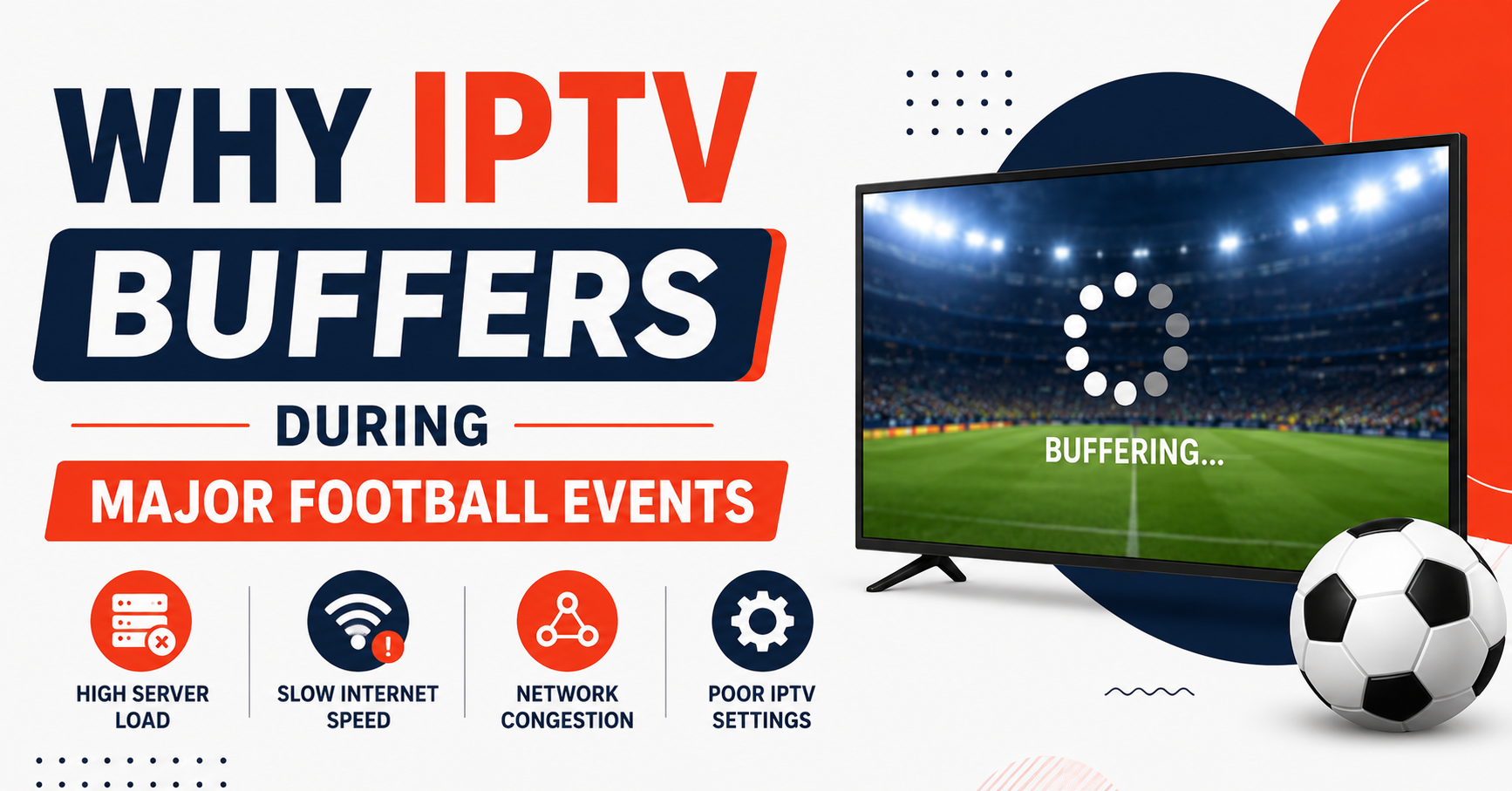
When IPTV buffers during major football events, the failure sits in one of three places. Naming the right one saves you hours.
| Failure point | What it looks like | Who can fix it |
|---|---|---|
| Provider source | Everyone on the service buffers at once | Only the operator |
| Delivery path / ISP | Buffering worsens at peak hours only | Partly the operator, partly you |
| Your local network | Only your devices struggle, others fine | You |
A quick way to self-diagnose: if your neighbour on a different service streams the same match flawlessly while you freeze, the problem is upstream of your home. If every device in your house struggles equally, look at your own connection first.
Why Your ISP Is Quietly Throttling the Match
This is the part most subscribers never consider. Internet providers increasingly use traffic fingerprinting to identify continuous high-bandwidth video streams, and during congested evening windows they sometimes deprioritise that traffic.
You are not imagining it when the same stream plays perfectly at 2pm and stutters at 9pm. The bandwidth number on your plan is a ceiling, not a guarantee, and football nights are exactly when that gap shows.
Pro Tip:
If buffering vanishes the moment you switch on a VPN, your ISP is shaping the traffic. The VPN hides the stream’s signature so it slips past the throttling. This single test tells you more than any speed test will.
The Infrastructure Gap Nobody Advertises
Cheap services survive ordinary nights and collapse on big ones. The difference only ever reveals itself under load, which is why customers churn in clusters right after a major fixture.
| Cheap infrastructure | Professional infrastructure |
|---|---|
| Single streaming source | Multiple distributed sources |
| No failover | Automatic failover during spikes |
| No backup uplinks | Redundant uplinks |
| Buckles at peak concurrency | Load balancing across nodes |
| No live monitoring | Active monitoring during events |
For an IPTV reseller, this gap is the entire business. You can market aggressively, price sharply, and onboard fast, but if the panel behind you folds during the Manchester derby, every customer learns the truth in the same evening.
A mistake we see repeatedly: new resellers test a panel on a quiet Tuesday, see flawless playback, and assume reliability. Reliability is only ever proven on a Saturday at 3pm.
Load Balancing and Failover, Explained Simply
These terms get thrown around by every IPTV operator selling a panel, so here’s what they mean in plain terms.
Load balancing spreads incoming viewers across several servers instead of crushing one. When a match starts, the system distributes that wall of connections so no single node carries everything.
Failover is the safety net. If one source dies mid-match, traffic reroutes automatically to a backup before most viewers notice. Without it, one server hiccup freezes everyone.
Pro Tip:
Ask any IPTV reseller panel provider one question before buying credits: “What happens to my customers if your primary source fails during a live final?” If the answer is vague, walk away. A serious panel owner has a rehearsed answer.
A Reseller’s Peak Night Failure, and What It Taught
One reseller we worked with ran a tidy operation, around four hundred subscribers, healthy renewals, low complaints. Then came a major final. By the second half his support channel had collapsed into chaos and he lost nearly a fifth of his customer base within a week.
The autopsy was simple. His upstream provider ran a single source with no failover. It held all season because no single night had ever pushed it. The final did. Everything that looked stable was just untested.
The lesson for any IPTV business owner: your weakest moment is invisible until the busiest moment arrives. Credit resellers and sub-resellers inherit the reliability of whatever sits above them, so the panel you build on matters more than the price you pay for panel credits.
What Subscribers Can Actually Do Tonight
You cannot fix a provider’s servers. You can stop being your own bottleneck.
- Connect by ethernet cable, not WiFi, for the match
- Close other streaming and downloads in the house during kickoff
- Restart your router an hour before, not at kickoff
- Test whether a VPN clears the stutter, since that reveals ISP throttling
- Lower stream quality manually if your app allows it during peak load
If you have done all five and still freeze while others on better services do not, the problem is the service, not you. That’s a buying decision, not a settings problem. A genuinely resilient IPTV reseller setup, like the infrastructure described at britishseller.co.uk, is built specifically around these peak windows rather than ordinary evenings.
Frequently Asked Questions
Why does IPTV buffer during major football events but not regular shows?
Because football concentrates demand. Thousands of viewers load the same channel within the same minute, overwhelming sources that handle spread-out daily viewing easily. Regular shows rarely create that simultaneous spike, so the same infrastructure that fails at kickoff performs fine the rest of the time.
Why does IPTV buffer during major football events only at night?
Evening kickoffs collide with peak internet usage across your whole region. ISPs face congestion and sometimes deprioritise heavy video traffic, while provider servers hit maximum concurrency. The same stream often plays cleanly during daytime tests, which is why night buffering surprises people.
Will a VPN stop my football streams from buffering?
Sometimes. If your ISP is throttling video traffic, a VPN hides the stream’s signature and buffering improves immediately. If the bottleneck is the provider’s overloaded server, a VPN changes nothing. Use it as a diagnostic test first before assuming it’s a cure.
As an IPTV reseller, how do I prevent peak-event buffering for my customers?
Build on a panel with load balancing, automatic failover, and redundant uplinks, then test it during an actual major fixture rather than a quiet night. A UK IPTV panel that survives a Champions League final is worth more than a cheaper one that has never been stress tested.
Is buffering my internet’s fault or the provider’s?
Check whether others freeze too. If everyone on the service buffers simultaneously, it’s the provider. If only your devices struggle while others stream fine, look at your own network, WiFi, and competing downloads first.
Does paying more for IPTV guarantee no buffering?
No. Price reflects marketing as often as infrastructure. What matters is distributed sources, failover, and monitoring during events, not the monthly fee. Some cheap services are well built and some expensive ones are not, so test reliability on a busy night before judging.
Quick Action Checklists
subscribers
- Switch to ethernet for live matches
- Clear competing bandwidth in the house at kickoff
- Run the VPN test to expose ISP throttling
- Drop stream quality manually under heavy load
- Compare with others to locate the real fault
resellers
- Stress test your panel during a real major fixture, never a quiet night
- Confirm load balancing and automatic failover exist, not just marketing claims
- Ask your provider exactly what happens when a primary source fails mid match
- Track support tickets by event to spot your weakest windows
- Keep a backup panel ready before the season’s biggest nights
sub-resellers
- Verify the reliability of the panel owner above you before reselling
- Do not promise stability you have not personally witnessed under load
- Hold a small credit buffer so you can migrate customers fast if a source fails
- Communicate proactively during big events instead of going silent
The single most useful thing to remember: buffering during football is a load problem disguised as a quality problem. The stream is rarely broken, the path to you is. Diagnose which of the three failure points is choking before you change anything, and you’ll fix in minutes what others spend whole evenings guessing at.