
The most damaging IPTV reseller Panel mistakes are not dramatic. They are small, repeated errors that quietly erode your margin, your customer base, and your credibility over the first few months. I have seen new resellers with real potential walk away from the business because they hit three or four of these in the same week and concluded the model did not work. It works. The mistakes are just very avoidable once you know what they are.
What IPTV Reseller Mistakes Actually Cost You
Most new resellers think the risks in this business are technical. They are not. The panel handles the technical side. The risks are operational: poor credit management, slow customer support, weak pricing, and panel security gaps. Each one has a direct financial consequence.
A reseller who runs out of credits on a Friday evening cannot activate a new customer until Monday. That customer finds someone else. A reseller who takes two days to answer a setup question loses that customer at renewal. These are not technical failures. They are business process failures, and the panel gives you every tool you need to avoid them.
Understanding how the IPTV credit system works before you take your first customer payment is the single most useful preparation you can do.
How These Mistakes Happen in Practice
The pattern is consistent across new resellers. They start with enthusiasm, sign up a few customers quickly, and then get stretched when support requests, renewals, and new signups all land at the same time. Without a daily dashboard routine, things fall through the gaps.
The first month is where most IPTV reseller mistakes take root. Credits run low without warning because the reseller never set a threshold alert. A customer’s account expires unnoticed because no one checked the expiry list that week. A device setup question sits unanswered for twenty-four hours because the reseller was focused on finding new customers instead of serving existing ones.
The good news is that the panel shows you everything you need to catch these problems early. The question is whether you are looking at it consistently enough to act before they become complaints.
Credit Management Errors: the Most Expensive Mistake
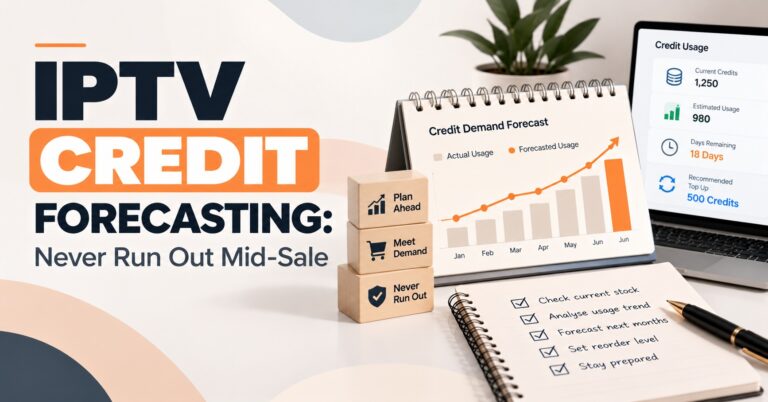
Running out of credits at a busy moment is the most financially damaging mistake a reseller can make, and it is entirely preventable. Your dashboard shows your current balance in real time. If your panel supports low-balance alerts, enable them immediately. If it does not, build a manual check into your morning routine.
Here is a comparison of how credit management differs between panel types:
| Feature | Basic panel | Advanced panel |
|---|---|---|
| Credit balance display | Yes | Yes |
| Low balance alert | No | Yes |
| Transaction history | Limited | Full |
| Automated renewal | No | Yes |
| Sub-reseller credit control | No | Yes |
| Analytics by plan type | No | Yes |
I made this mistake myself during a busy December period. A batch of twelve-month accounts had all been created in the same week the previous year, which meant twelve renewals landed simultaneously. I had not looked at the expiry calendar far enough ahead and bought credits two days too late. Several customers had gaps in service. The renewals all completed, but the trust damage took longer to repair than the credit issue did.
After that, I started checking the thirty-day expiry list every Monday morning. That single habit eliminated the problem entirely. The IPTV dashboard tutorial for new UK IPTV resellers covers exactly where to find this view in most panel setups.
Customer Support Failures and How They Compound
Slow support is the reason most customers leave. They do not cancel because of price. They cancel because when something stopped working, nobody helped them quickly. In a business where the technical side is handled by infrastructure you do not control, your response speed is the main thing that differentiates you from the next reseller.
The most common support scenario in the first week after a customer signs up is a device configuration issue. The customer has valid credentials but cannot get their app to connect. This is almost never an account problem, it is a device problem. If you have tested the setup process yourself on an Amazon Firestick and Android TV box, you can resolve these calls in two to three minutes. If you have not, the same call takes thirty minutes and leaves the customer frustrated regardless of the outcome.
Build a short setup guide for the three or four devices your customers use most. Send it with every new account activation. This reduces inbound setup questions by more than half and positions you as a professional from the first interaction.
Common Mistakes to Avoid
Choosing a panel based on price alone is one of the costliest decisions a new reseller makes. A cheap panel with unreliable uptime, no connection logs, and no credit alerts will create more customer service work than the saving is worth. Pay for the features that protect your operation. The IPTV reseller panel plan comparison shows what the difference in features looks like in practice.
Neglecting device locking is another common error. Without it, one customer pays and four people use the account. Your credit deductions look correct, but your revenue per credit spent drops significantly. Enable device ID locking as a default for all retail accounts and explain the policy to customers before they subscribe.
Ignoring the sub-reseller opportunity is a longer-term mistake that limits growth unnecessarily. Once your own retail operation runs smoothly, creating sub-reseller accounts for other people who want to start in the business is a natural next step. You sell credits wholesale, they handle their own retail customers, and your volume grows without a proportional increase in your support workload. The sub-reseller panel setup guide explains how to structure this correctly.
What to Look for When Choosing an IPTV Management Platform
Before signing up with any provider, ask four specific questions. First, does the panel have full login and connection logs? Second, does it support credit balance alerts? Third, is there a sub-reseller function for when you are ready to scale? Fourth, how does the provider handle a service disruption on their end, do they have a published process, and do they compensate credits for downtime?
A provider who answers all four questions clearly and specifically is one worth working with. A provider who deflects, gives vague answers, or says those features are coming soon is one to approach with caution. Your panel is your entire operational infrastructure. The provider running it is your most important business relationship.
Also test their support before you need it urgently. Send a technical query during off-peak hours and measure the response time. If it takes longer than a few hours to get a useful reply to a non-urgent question, assume it will take longer still when you have an active customer problem at nine on a Saturday evening.
Author Note: Written from direct experience running IPTV reseller panel operations across UK and European markets.
Frequently Asked Questions
What is the single biggest mistake new IPTV resellers make?
Running out of credits without warning is the most immediately damaging operational mistake. It blocks new activations, delays renewals, and creates service gaps for existing customers. The fix is straightforward: check your balance daily, enable alerts if your panel supports them, and keep a buffer that covers at least two weeks of your average activation volume. The mistake is not buying the wrong plan or choosing the wrong niche. It is simply not watching the dashboard closely enough in the early weeks.
How do I handle a customer who says their account stopped working?
Open their account in your panel and check the expiry date first, this resolves the majority of sudden access failures. If the account is active, check the last successful connection time and whether there is a simultaneous login from another device or location. Most issues are either an expired subscription, a password changed in error, or a device ID conflict after the customer switched to a new device. All three are fixable in under two minutes from the dashboard without needing to contact your provider.
Should I offer refunds if a customer is unhappy?
Having a clear, short refund policy stated upfront is better than deciding case by case. Most experienced resellers offer a short trial period rather than refunds, typically twenty-four to forty-eight hours for the customer to test their device compatibility. If a customer has a genuine technical issue that you cannot resolve, a partial credit or plan extension is usually more practical than a cash refund and maintains the relationship better. The key is having a policy written down before the first complaint arrives, not improvising one under pressure.
How many customers do I need before sub-reselling makes sense?
There is no fixed number, but the practical trigger is when your own retail operation runs smoothly enough that you could explain the process clearly to someone else. Most IPTV Panel resellers reach this point somewhere between twenty and forty active customers. At that stage, you have learned enough about the common problems, the device setup questions, and the credit management rhythm to pass that knowledge on. Sub-reselling before you have that operational confidence tends to create support problems you are not yet equipped to handle efficiently.
Is it worth building a website to sell IPTV reseller services?
A basic website improves your credibility significantly, especially when a prospective customer searches your name before buying. It does not need to be elaborate, a clear pricing page, a contact method, and a brief explanation of how the service works is enough to convert customers who would otherwise hesitate. The resellers I have seen grow fastest are the ones who combined a simple website with active presence in one or two relevant online communities, rather than spending heavily on advertising before they had a reliable support process in place.
IPTV Reseller customer support on WhatsApp
Go into your panel right now and open the expiry view for the next thirty days. If more than a handful of accounts are due to renew and you have not sent a reminder yet, start there today. That list is where your recurring revenue either holds or leaks.